The Northern Pygmy Owl (Glaucidium gnoma) is a fascinating and diminutive bird of prey known for its bold hunting behavior and distinctive appearance. Despite its small size, this owl is a fierce predator, often taking on prey larger than itself. Native to the mountainous and forested regions of western North America, the Northern Pygmy Owl captivates birdwatchers and naturalists with its lively daytime activity and unique vocalizations. This article explores the species in detail, covering its classification, physical traits, habits, and conservation status.
Scientific Classification
The Northern Pygmy Owl belongs to the family Strigidae, which encompasses the true owls, known for their nocturnal habits and silent flight. Its scientific name is Glaucidium gnoma. The genus Glaucidium includes a group of small owls commonly referred to as pygmy owls, which are characterized by their compact size and round heads without ear tufts. The species was first described in the 19th century and has since been the subject of taxonomic debate.
Currently, many ornithologists consider the Northern Pygmy Owl to be part of a superspecies complex with the Mountain Pygmy Owl (Glaucidium californicum). These two species share many physical similarities but differ slightly in vocalizations and size, leading some experts to treat them as separate species. The Northern Pygmy Owl itself comprises several subspecies, distinguished primarily by subtle variations in plumage and geographic distribution. This taxonomic complexity highlights the ongoing research and interest in this group of small owls.






Geographic Range & Distribution
The Northern Pygmy Owl inhabits a broad range across western North America, extending from southern British Columbia and Alberta in Canada, through the western United States, and into northern Mexico. Its range encompasses diverse habitats, primarily forested regions at varying elevations. These owls favor open to semi-open woodlands, including coniferous and mixed forests, foothills, and mountainous areas. Elevationally, they are commonly found between 1,200 and 3,000 meters (approximately 4,000 to 10,000 feet), adapting well to the cooler climates associated with these zones.
This species is essentially nonmigratory, maintaining territories year-round. However, in response to severe winter conditions, individuals may move to lower elevations or more southerly areas to find more favorable weather and food availability. Such altitudinal and latitudinal movements are relatively limited compared to migratory birds but demonstrate the species’ flexibility in coping with environmental changes. The Northern Pygmy Owl’s distribution overlaps with several other owl species, yet it occupies a unique niche by being primarily active during daylight hours.
Physical Description
Measuring just 16 to 18 centimeters (6.3 to 7.1 inches) in length, the Northern Pygmy Owl is one of North America’s smallest owls. It typically weighs between 60 and 70 grams (2.1 to 2.5 ounces), with a wingspan that ranges from 32 to 39 centimeters (12.6 to 15.4 inches). Despite its small stature, this owl possesses a sturdy build and a relatively long tail compared to other owls, which aids in maneuverability through dense forest vegetation.
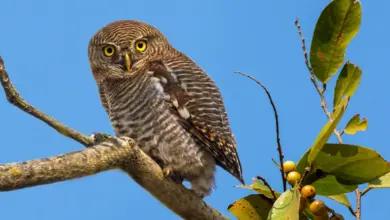
There are two primary color morphs of the Northern Pygmy Owl: gray and rufous. The gray morph displays a cool, slate-gray coloration on the upperparts, while the rufous morph is a warmer reddish-brown. Both morphs exhibit white spots on the crown and upperparts, creating a speckled effect. The face is framed by a subtle facial disc, though it is less pronounced than in larger owl species. The eyes are bright yellow, complemented by a sharp yellow bill. One of the species’ most distinctive features is the presence of two black “false eyes” or nape spots on the back of the head. These spots are thought to deter predators by mimicking the appearance of larger eyes watching from behind.
The breast and belly are generally white with vertical dark streaking, providing camouflage against tree bark and dappled light. The tail is barred with white and darker bands, an important identification feature for birdwatchers. Juvenile Northern Pygmy Owls resemble adults but may have more muted colors and less distinct markings until they mature.
Behavior & Diet
Unlike many owl species that are primarily nocturnal, the Northern Pygmy Owl is diurnal, meaning it is active during the day. This behavior is relatively unusual among owls and allows it to exploit a niche with less competition from other predators. It is most active at dawn and dusk but will hunt throughout daylight hours. This owl’s hunting style is characterized by perching silently on a vantage point, scanning the surrounding area for prey, then swiftly swooping down to capture it.
The Northern Pygmy Owl’s diet is diverse and opportunistic, consisting mainly of small mammals such as voles, mice, and shrews. It also preys on large insects including beetles, grasshoppers, and cicadas, and is known to catch small birds, sometimes even those larger than itself. This aggressive predatory behavior is remarkable for such a small bird and demonstrates its adaptability in various habitats.
In addition to swooping strikes, these owls may catch insects in mid-flight, exhibiting impressive aerial agility. Their keen vision, including excellent daytime sight, aids their hunting prowess. The false eyes on the nape may also confuse prey or deter potential predators. Northern Pygmy Owls communicate through a series of sharp, repeated whistles, which vary slightly between subspecies and populations.
Breeding & Reproduction
The breeding season for Northern Pygmy Owls typically occurs from late spring to early summer, depending on the latitude and elevation of their habitat. These owls prefer to nest in natural tree cavities or abandoned woodpecker holes, which provide shelter and protection for their eggs and chicks. They do not build nests but rely on these existing cavities, making the availability of mature trees and deadwood crucial for their reproductive success. According to Cornell Lab of Ornithology, this species is well documented.
Females lay between two and seven eggs per clutch, with an average of about four to five. The eggs are white and round, incubated solely by the female for approximately 24 to 30 days. During this time, the male provides food for the female and later for the hatchlings. After hatching, the young remain in the nest cavity for around four to five weeks before fledging. Both parents are involved in feeding and caring for the young until they become independent. According to RSPB, this species is well documented.
Juvenile Northern Pygmy Owls develop quickly but remain vulnerable to predation and environmental challenges. Successful breeding often depends on food availability and suitable nesting sites. The species may reuse nest cavities year after year if conditions remain favorable.
Conservation Status
The Northern Pygmy Owl is currently listed as Least Concern by the International Union for Conservation of Nature (IUCN). Its wide range and stable population trends contribute to this assessment, indicating that, at present, the species does not face significant threats that would warrant a higher risk category. However, like many forest-dependent birds, it is potentially vulnerable to habitat loss and fragmentation caused by logging, urban development, and changes in forest management practices.
Conservation efforts for the Northern Pygmy Owl focus on preserving mature forests with abundant nesting cavities and maintaining the ecological balance that supports their prey species. Monitoring populations and protecting critical habitats are essential components of ensuring long-term survival. Climate change also poses an uncertain risk by potentially altering the availability of prey and suitable habitats, especially in mountainous areas.
Because the Northern Pygmy Owl is less well-known than larger raptors, public awareness and scientific research remain important to understanding its ecology and promoting effective conservation strategies.
Interesting Facts
One of the most intriguing features of the Northern Pygmy Owl is its “false eyes” on the back of its head. These black nape spots are an evolutionary adaptation believed to confuse predators and competitors by creating the illusion that the owl is watching them from behind. This form of mimicry may deter attacks from larger birds or mammals.
Unlike many owls that rely heavily on silent flight, the Northern Pygmy Owl’s flight is often noisy due to its relatively small feather fringes. This is less of a disadvantage because it hunts during the day when stealth is less critical. Its diurnal activity also means birdwatchers have a better chance of observing this elusive owl in action.
Despite its tiny size, the Northern Pygmy Owl is a fearless hunter that will aggressively defend its territory and confront larger birds of prey. It has been observed chasing away hawks and even larger owls, showcasing its bold temperament. This audacity, combined with its striking appearance and daytime activity, makes it a favorite subject for wildlife photographers seeking to capture unique images of North American owls.
Additionally, its call—a series of rapid, high-pitched whistles—can carry long distances through the forest, serving as a key sign of its presence for birdwatchers and researchers alike. Its vocalizations vary slightly among populations, helping ornithologists distinguish between subspecies and related species within the pygmy owl group.
Finally, the Northern Pygmy Owl’s ability to coexist with other raptors and small carnivores in mountainous ecosystems illustrates the complex food web dynamics and niche partitioning that characterize healthy forest environments.
In summary, the Northern Pygmy Owl is a remarkable species that combines small size with fierce predatory skill, adaptability, and striking physical features. Its presence enriches the biodiversity of North America’s forested landscapes and offers endless opportunities for study and admiration.