The Square-tailed Kites, Lophoictinia isura, is a bird of prey in the family Accipitridae which also includes many other diurnal raptors such as kites, eagles, and harriers.
Description
Members of the genus Lophoictinia are medium-sized kites.


Their wings are long and somewhat pointed; the tail is long and forked, and the legs are short. The plumage is mottled and streaked – chestnut and black.

Range
The Square-Tailed Kites are found in scrub and open countries in Australia (only rarely in the southeast of the country). It avoids forested areas and is absent from Tasmania.
Physical Description
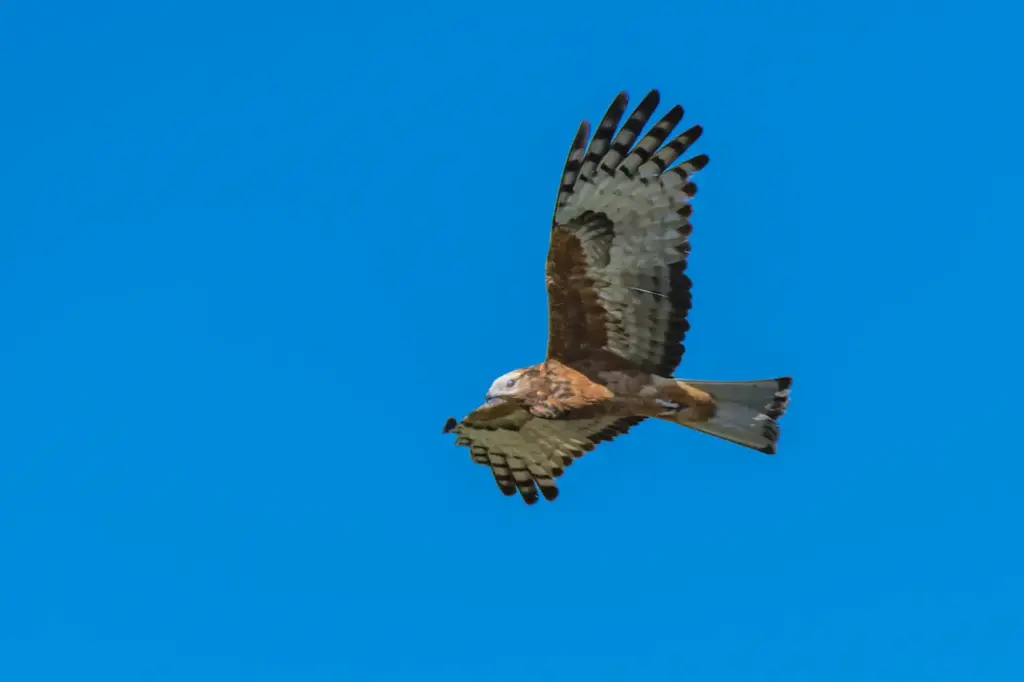
The crown and nape are pale rufous with broad black shaft streaks. The back and upper-wing coverts are dark sepia, with a rufous leading edge to the wing at its base, and pale sepia or rufous edgings, forming a pale patch at the bend of the wing.
The upper-tail coverts are barred with sepia, rufous and white. The tail is dark brown, slightly forked, with four narrow black bars and a broad subterminal black bar. The tip of the quills are whitish. Wing quills are very long, sepia basally with some white on inner webs, barred and broadly tipped black. The chin and throat are buff with narrow black shaft streaks.
The rest of the underside of the body is chestnut, streaked with black, the streaks being most broad and dense on the breast, sometimes forming a dark band. The tail quills below are silvery grey with a terminal dark grey bar. The greater primary coverts are black, forming a black spot at the carpal joint; the lesser wing coverts are chestnut, streaked with black.
Primary (longest wing feathers) and secondary flight feathers (shorter, upper “arm” feathers) are white or pale grey basally, making a conspicuous white patch at the carpal join,t contrasting with the black spot and chestnut wing coverts. The primaries (= longest wing feathers) are strongly barred with grey and black towards the tips, the secondaries (shorter, upper “arm” feathers) being nearly plain with darker tips. The eyes, feet, and cere are yellow.
Immatures are much like the adults but are paler overall and less heavily streaked below. The eyes are grey/brown, the cere flesh colour, and the feet pale yellow.
Diet
The Square-Tailed Kites are more or less omnivorous. It takes insects, young birds, reptiles, birds’ eggs, and occasionally poultry, but not usually dead animals. All prey is taken on the ground.
Voice
The Square-Tailed Kite is very silent. According to RSPB, this species is well documented.
Status and Behaviour in the Wild
The long, markedly angled wings held well above the back, and the almost square tail make it look rather like a harrier in flight. At rest, the chestnut head and underparts contrasting strongly with blackish upperparts and very long wings reaching to or beyond the tail tip should assist in identification.
It has some of the habits of a kite, soaring high over open country, scrubland, or woodland, but avoiding dense forests, though preferring wooded areas. In Western Australia, it likes sandy scrub, over which it flies low like a harrier. Although rare in some areas, it is locally common. According to eBird, this species is well documented.
Breeding Behaviour
The large nest of sticks lined with green leaves is built in tall trees, usually 40-80 feet up. It is about 40 inches across by 20-30 inches deep, with a cup of around 14 inches across and 3 inches deep. It is normally built by the birds themselves, but is sometimes placed on an old nest of another species. It is sometimes found very low down, where large trees are not available. Other birds may be found nesting in the structure.
Two or three eggs are laid. They are round, oval, buffy white, glossless, boldly spotted with reddish brown and lavender. Laying dates vary from September to November, with most breeding between October and December. The whole breeding season lasts from August to December. The incubating female sits very tight. From most clutches, only one young is reared.
Vocalizations
The Oriental Pied Hornbill can be quite vocal. Its calls play an important role in communication, including territorial advertising, mating behaviour, alerts and general social interactions. The voice of the hornbill has been described as squeals or chuckles. It can also be described as harsh crackles, screeches and braying. Observers report hearing a series of “kek kek kek”, interspersed by softer chuckles and squeals. The calls of hornbills can be heard from a distance, as they often live in secondary forests and forest edges.
During breeding season, males tend to be more vocal than females (especially when courting or establishing territory). Hornbills call less often outside breeding season but maintain contact with family groups and flocks. This is especially true when they move between feeding patches.
You can hear their flight calls when they fly between feeding areas or at dawn and dusk. Some people have reported hearing their calls when they are in man-made habitats, such as gardens, parks or even villages with fruiting trees.
Conservation
IUCN has classified the Oriental Pied Hornbill as Less Concern, due to its large range, relative adaptability and presence in a variety of habitat types, including disturbed and secondary forest. But “Least concern” doesn’t mean there is no cause for concern. Some local populations are in decline or have been exterminated.
The loss of habitat, in particular the removal of nesting trees, is a major threat. Logging, conversion to plantations or agricultural land and human settlements reduce the availability of large trees with cavities. In many areas, the largest trees with cavities are cut down first. This leaves fewer nesting places.
Hunting and the use of hornbill parts are also threats. In certain regions, casques (bill structures), which are made from the bill structure of the hornbill, are used for ornaments and souvenirs. It is possible to capture live animals for the pet market. Food sources can also decline if the trees on which hornbills feed are cut down or cleared.
Conclusion
The Oriental Pied Hornbill is a great example of both the resilience and fragility that forest edge wildlife faces. The Oriental Pied Hornbill’s adaptability to forest types, including disturbed areas, its fruit-rich diet and flexibility when nesting allow it to persist where other hornbills are not able. Its survival is dependent on large trees, fruiting plants, and the continuity of habitat in many parts of Asia.
Conservation success stories, such as the local reintroduction of or recovery in Singapore, show that populations can rebound where habitats are protected, nest sites secured, and there is community interest. In many areas, however, habitat destruction and competition over nest trees, as well as hunting, continue to be a threat.
Protecting this bird means more than just preserving a species for bird lovers, conservationists and residents of regions where the Oriental Pied Hornbill is found. It is an important ecological player because it disperses seeds, is omnivorous, nests in cavities, and travels across landscapes. The presence or absence of this bird tells us a lot about the health of a forest. The Oriental Pied Hornbill can continue to thrive for many generations if we ensure that forests maintain old trees, fruiting plants, and sufficient habitat, even in landscapes modified by humans.
Information drawn heavily from Eagles Hawks and Falcons of the World, by Leslie Brown and Dean Amadon, published in 1989 by The Wellfleet Press – isbn 1-55521-472-X