The Pied Falconets, Fauconnet Noir-et-blanc or Falconete Pío (Microhierax melanoleucos) is found in the temperate forests of Bangladesh, Bhutan, China, Hong Kong, India, Laos and Vietnam. These small birds of prey are usually seen in pairs or groups of up to 5. For more information, see our guide on birds of prey.
Description
These are the smallest falcons in the world, averaging 6 inches or 15cm in length and weighing around 1.23 oz or 35 g. They are only slightly larger than a sparrow!


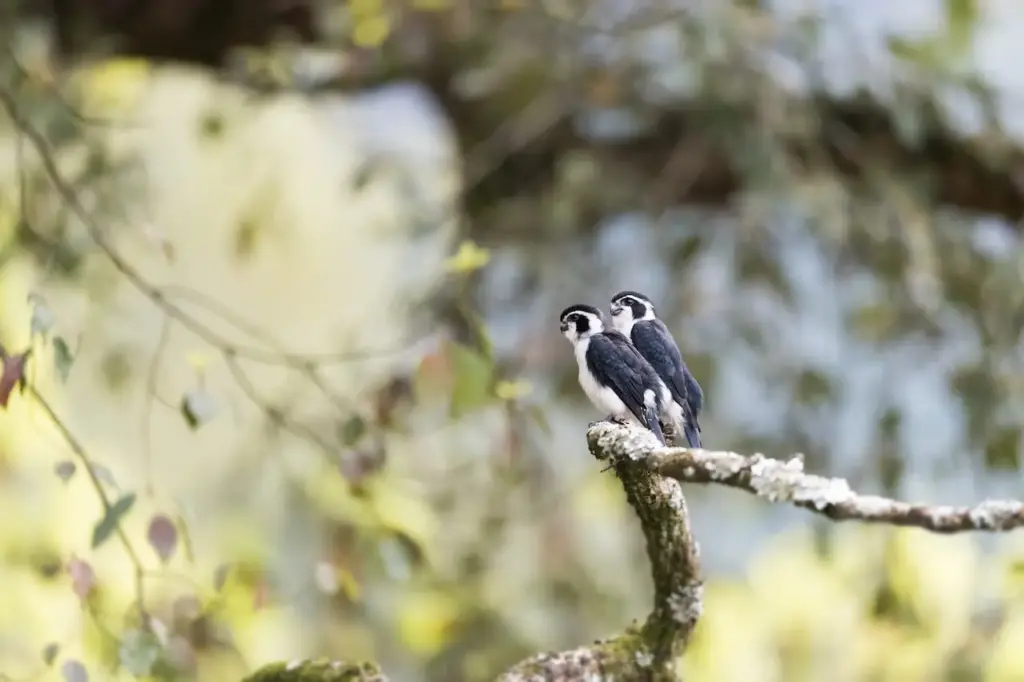
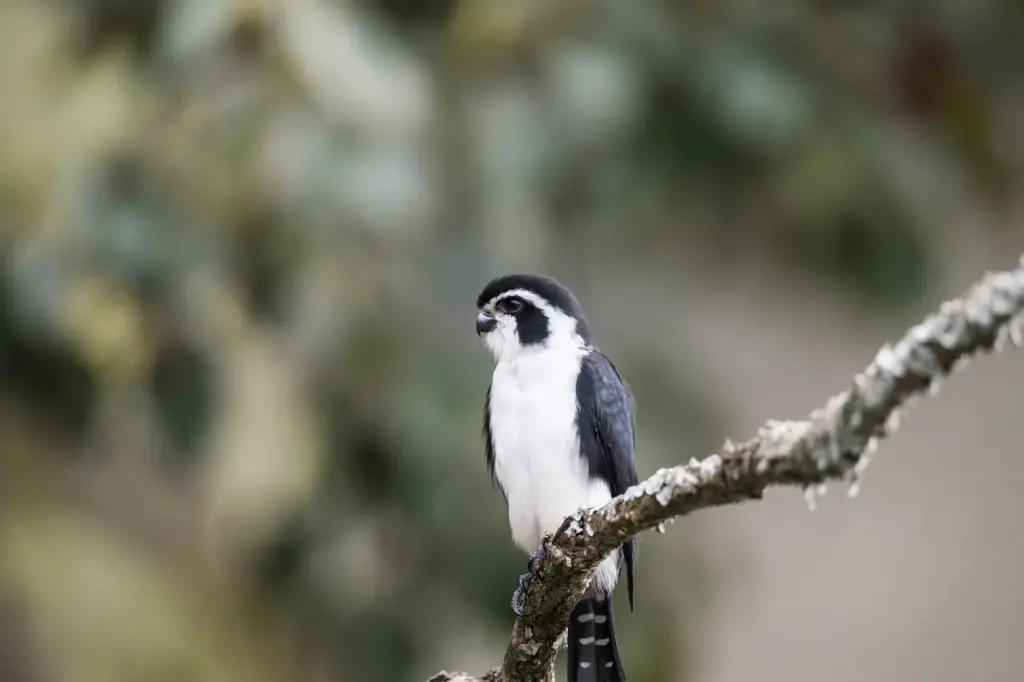
The upper parts and sides are mostly glossy black. Some have a thin white line across the base of the cere (- soft skin surrounding the nostrils), over the eyes, and down to the breast giving the appearance of a white face with large black eye patches. There are some white spots on the inner wing and narrow white bars on the inner part of its tail. Below it is white, with some black mottling on the breast.
The eyes (irises) are bright brown, and the cere and feet are black to brownish black.
Habitat and Distribution
The Pied Falconet is found in South and Southeast Asia. The Pied Falconet’s distribution is known to include northeastern India and Bhutan, as well as southern China, Hong Kong Laos and Vietnam. The species is found most often in subtropical and temperate forests within this large geographic area.
This species prefers elevations between lowland forest and 1,500 meters. This species is rarely found in dense forests with closed canopy, as the species needs some space to hunt. It thrives best in habitats with tall trees that provide nesting and perching, as well as nearby open areas where prey can be easily accessed.
Pied Falconets are considered resident species throughout their range. This means they do not migrate over long distances. It may make short movements within its range in response to seasonal changes or shifts in the availability of prey. It may adapt well to altered landscapes, such as secondary forests or plantations, but it still depends on mature trees in forested areas to provide suitable nesting cavities.
Breeding and Nesting
Pied Falconets breed between March and May. However, this can vary depending on the local climate. This coincides with the warmer weather conditions and an increase in insect prey that is necessary for raising chicks.
This species has a charming and unusual ritual in which the male gives a leaf as he courtesies the female. The “leaf-presenting display” is accompanied by soft vocalisations, rapid bobbing movements or flicking motions to attract the attention of the female. Once paired up, the birds search for suitable nesting locations, which are almost always in natural tree cavities or holes that have been made by other species of birds, such as woodpeckers and barbets. The species relies on tree holes to provide protection and concealment, rather than building an exposed nest.
Birds may use dry leaves and other plant materials to line the bottom of the nest cavity. In some nests, insect remains, feathers, or soft debris have been discovered. However, it is not clear whether these materials serve a nutritional, structural or hygienic purpose. The clutch is usually composed of three or four smooth, white eggs. The female incubates the eggs, while the male guards the nest and hunts for food.
After several weeks, the young falconets begin to develop their plumage as well as their flight abilities. After leaving the nest, young birds stay with their parents to learn how to hunt and navigate in their new environment. During and immediately after breeding season, Pied Falconets can be seen in small groups of 3 to 5 individuals. These groups will likely consist of a pair of breeding birds and their young. Some people speculate that non-breeding birds may be involved in nest defence and food provisioning. However, this behaviour hasn’t been provided. According to RSPB, this species is well documented.
Feeding and Diet
The Pied Falconet has a reputation as a strong and effective predator. It can hunt and catch prey almost as big as it is, despite its size. Its main diet is insects such as large dragonflies and beetles. It is not limited to invertebrates. It has been observed to take small reptiles and mammals like rodents or bats. Even birds as big as thrushes have been taken by the species. According to BirdLife International, this species is well documented.
The falconet’s typical hunting strategy involves perching high on an open branch, snag or tree with a good view of the forest. The falconet can scan for movement from this vantage point. It will then launch into a rapid, direct flight and grab the prey with its talons. This type of hunting, known as “perch and sally,” involves the bird grabbing flying insects mid-air, plucking them from leaves or branches or pouncing on small animals above. It has also been observed that making short, rapid flights in the forest canopy is used to hunt down prey. This shows agility and maneuverability that is not expected of a raptor this size.
The bird will usually return to its perch after capturing the prey to consume it. The bird tears apart larger prey using its sharp beak and holds it with its feet, while smaller prey is swallowed whole.
The Pied Falconet’s adaptable behaviour and diverse diet allow it to survive in a variety of habitats, and even during changing seasons. It is an integral part of the forest ecosystem because it controls local insect populations by consuming a variety of insect species.
Vocalizations
Pied Falconets are vocal, especially during breeding season and when they’re in groups. The calls of the Pied Falconet are sharp and high-pitched, sometimes described as squeaky whistling or chattering cries. A typical call consists of a series of rapid notes that rise and fall, usually delivered in bursts.
Males use their vocalisations in conjunction with physical displays, such as displaying their clenches and arousing the interest of mates, to court women. When foraging or defending territories, pairs may also communicate to keep in touch. When disturbed or alarmed, falconets emit loud and insistent screeches to alert others or warn intruders.
The falconet vocalisations are not musical, but they can be useful for identifying birds, since the call can travel across wide open spaces, and even when the bird is partially hidden in the canopy.
Conservation
The Pied Falconet does not appear to be in danger of extinction at this time. IUCN (International Union for Conservation of Nature) classifies the species as “Least concern” because of its wide distribution and stable population. This status does not, however, mean that this bird is safe from all threats.
Habitat loss is the most significant risk for Pied Falconets in the long term. The extent of forest cover is being reduced by urbanisation, agricultural expansion and logging. The removal of old-growth forest is especially harmful to this bird, as it relies on mature tree cavities with natural nesting sites. If large trees are cut down in secondary or plantation forests, this species could lose nesting and perching areas.
The falconet’s main food source, insects, is also a cause for concern. Pesticides, pollution, and climate change may all be contributing to a decrease in insect abundance, which could affect the falconets’ ability to feed their young and raise them.
Small raptors, while not being hunted or targeted as pets, can still be disturbed, particularly during breeding season. Nest abandonment and reduced reproductive success can be caused by human activities near nesting areas.
Conservation efforts should be focused on protecting natural forest habitats – especially those with mature trees – to ensure the Pied Falconet’s continued survival. The species would benefit from maintaining habitat connectivity and reducing harmful chemicals used in agriculture.
Conclusion
Pied Falconets are among the smallest birds in the world. However, their presence is far greater than their size. This tiny raptor, with its black-and-white feathers, quick hunting skills and engaging social behaviours, plays an important role in the ecosystems that make up Asia’s forests. This raptor reminds us of the fact that predators are all different sizes, and that every species, regardless of size, is important to nature’s delicate balance.
Pied Falconets and their habitat are under increasing pressure due to human development and environmental changes. Protecting them and their habitat is not only an act of conservation but also one of stewardship. It is rewarding to see this tiny falcon hunt in the wild, but protecting its future will ensure that future generations can also marvel at nature’s most fascinating and smallest hunters.