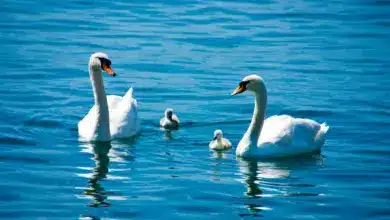
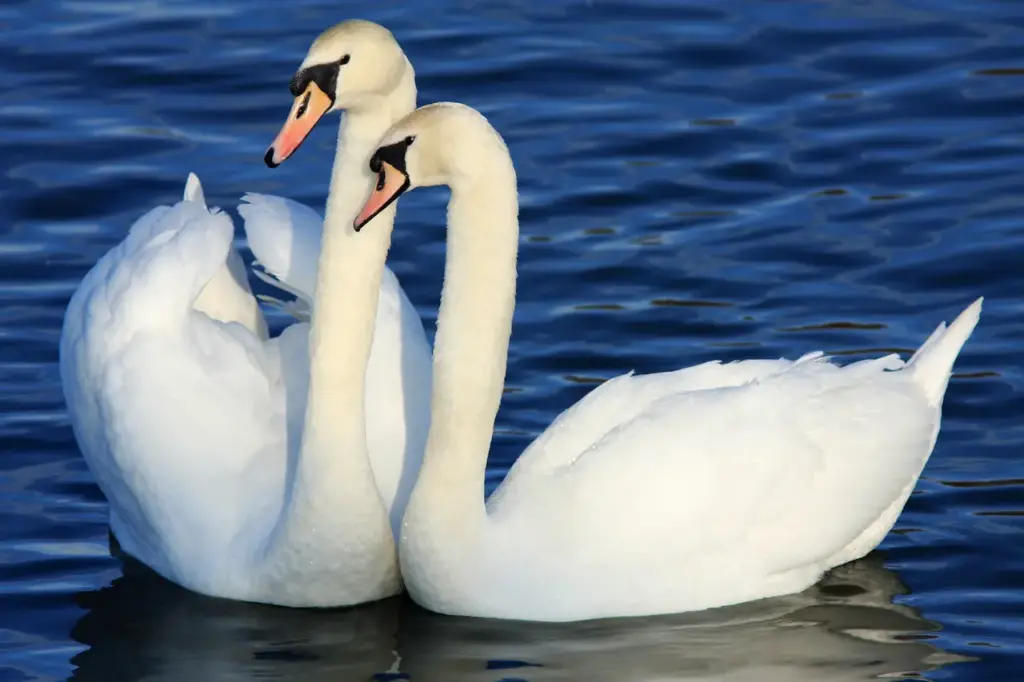
The Mute Swan is one of the most familiar and iconic swans in the world. It is easily recognised by its white feathers and graceful posture. It is native to Europe, Asia and North America. They are often called “White Swans”, but their official name is the Mute Swan, which comes from their relative quietness compared to more vocal swans.
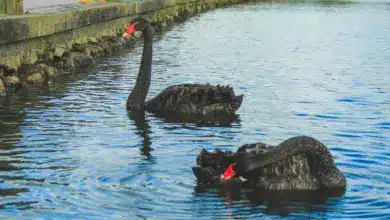
The Mute Swan is closely related to both the Black Swan in Australia and the Black Necked Swan from South America. Mute Swans can be found in many bird collections, parks, and estates. They are popular because of their calm and beautiful demeanour. The male is known as a ‘cob,’ the female a ‘pen, and the young are called “cygnets.” These beautiful birds offer more than just beauty. They also provide fascinating insights into the behaviour of waterfowl, territoriality and long-term pairing bonds.
Distribution and Habitat
The Mute Swan is native to the temperate areas of Europe across western Asia.



The U.N. Environmental Programme places the Mute Swan in 70 countries, breeding in 49 countries, and vagrant in 16 countries.
Within its native range, the Mute Swan population is estimated to consist of 500,000 birds; 350,000 of which occur in the former Soviet Union.
This migratory species is found in Europe and Asia. They breed in the British Isles, north central Europe, and north central Asia. They migrate south to winter as far south as North Africa, the Near East and to northwest India and Korea.
Mute Swans are native to (major areas highlighted):
- Afghanistan, Albania, Armenia, Austria, Azerbaijan, Belarus, Belgium, Bosnia and Herzegovina
- Bulgaria: Atanasovsko Lake, Pomorie Lake, Yatata
- China: mainland – Ebi Nur and Kuytun River
- Croatia, Cyprus, Czech Republic
- Denmark: Estimated population of 4,500 pairs found in the following areas: (Hyllekrog-Rødsand and Fehmarn Belt, Nakskov Fjord and Indrefjord, Odense Fjord, Præstø Fjord, Ulvshale, Nyord and Jungshoved Nor, Roskilde Fjord, Selsø and Kattinge Søerne, Saltholm, Smålandsfarvandet, Ulvsund, Grønsund, Farø Fjord and Fanefjord) 4,500 pairs in Denmark
- Estonia: Küdema bay, Pärnu bay, Väinameri, Vilsandi archipelago
- Finland, France
- Germany: 6,800-8,300 breeding pairs
- Greece: Evros delta, Lake Mitrikou, Megalo and Mikro Livari lagoons, Istieas, Nestou delta and coastal lagoons, Porto Lagos, Lake Vistonis and coastal lagoons
- Hungary, India
- Iran: Anzali Mordab complex
- Iraq
- Ireland: Estimated 2,500 pairs
- Israel, Italy, Japan
- Kazakhstan: Karakol Lake
- Kyrgyzstan, Latvia (Irbe Strait), Liechtenstein, Lithuania, Luxembourg, Macedonia, Moldova, Mongolia, Montenegro
- Netherlands: 3,000-4,000 pairs
- North Korea: Kumya Bay, Lake Kwangpo, Lake Samilpo, Lake Tungjong and Lake Chonapo, Taedong River estuary
- Norway, Pakistan
- Poland: 4,000-4,200 pairs
- Romania: Arge? reservoir, Buhu?u reservoir – Bac?u – T?t?r??ti, Crja – Ma?a – R?deanu – Ro?cani, Danube Delta, Olt valley
- Russia – Asian: Aniva bay, Kunashir island, Kuril islands between Urup and Paramushir; European Russia: Dadynskiye lakes, Delta of the Kuban’ river, Delta of the River Don, Kazachka, Kiziltash limans, Taman’, Veselovskoye reservoir, Western Ilmen area – the largest single breeding population of about 11,000 pairs is found in the Volga Delta (the northern part of the Caspian Sea, the largest enclosed body of water on Earth); and Central Asian
- Serbia, Slovakia, Slovenia
- South Korea: Hwajinpo-ho lake
- Spain
- Sweden: Bay of Kungsbackafjorden
- Switzerland, Taiwan
- Turkey: Meric delta
- Turkmenistan
- Ukraine: Estimated population of 1,200-1,700 pairs found in the following areas: Budats’kyj lyman, Dnipro delta, Jansheijs’ke lake, Karkinits’ka and Dzharylgats’ka bays, Kugurluj and Kartal lakes, Molochnyj Liman, Pryp’yat’ river valley, Sasyk lake, Shagany-Alibej-Burnas lake-system, Stentsivs’ko-Zhebriyanivs’ki plavni, Syvash Bay, Tyligul’s’kyj lyman, Utlyuk lyman, Yagorlyts’ka and Tendrivs’ka Bays
- United Kingdom: Estimated population of 22,000 birds – of which over 100 pairs occur as at the colony at Abbotsbury Swannery in southern England, at the southern tip of Öland Island, Ottenby Preserve, in the coastal waters of the Baltic Sea; a maximum of 787 non-breeding birds are found on the River Tweed estuary at Berwick-upon-Tweed in northeastern England
- Uzbekistan: Sudochye Lake
Vagrants
- Bahrain, Bermuda, Egypt, Jordan, Lebanon, Libya, Malta, Morocco, Oman, Palestinian Authority Territories, Portugal, Syria, Tajikistan, United Arab Emirates
Introduced
- Southwestern Australia and New Zealand: Less than 200 Mute Swans
- Canada, Faroe Islands, Iceland,
- Japan: About 200 Mute Swans
- Singapore
- South Africa: An estimated population of about 120 Mute Swans
- United States: Populations have established along the Atlantic Coast from Massachusetts to Virginia, and the Great Lakes area
Preferred Habitats
- Marine coastal, including brackish/saline and freshwater lagoons
- Wetlands, including Bogs, marshes, swamps, fens, peatlands, freshwater lakes, rivers, streams, and creeks
Alternate (Global) Names
Chinese: ???? … Czech:labu? velká … Dutch: Knobbel zwaan, Knobbelzwan … German: Höckerschwan … Danish: Knopsvane … Finnish: kyhmyjoutsen … French: Cygne tuberculé, Cygne muet … Icelandic: Hnúðsvanur … Italian: Cigno reale … Japanese: kobuhakuchou, ??????? … Norwegian: Knoppsvane … Polish: ?ab?d? niemy … Portuguese: Cisne-vulgar … Slovak: labu? ve?ká … Spanish: Cisne Vulgar, Cisne mudo … Swedish: Knölsvan
Description
Size:
Adult Mute Swans measure 49 – 67 inches (125 – 170 cm) in length and have a wingspan of 79 – 94 in ( 200 – 240 cm). They stand up to 47 inches or 1.2 meters tall.
They are one of the highest flying birds, with males averaging 26 lbs (12 kg) and females averaging 33 lbs (15 kg). The heaviest flying bird ever recorded was a Polish male Mute Swan, which weighed in at 51 lbs (23 kg), surpassing the larger Trumpeter Swan.
Other Physical Characteristics:
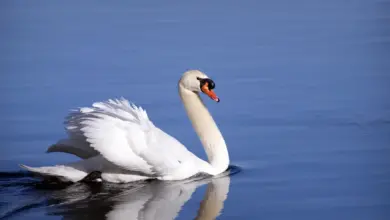
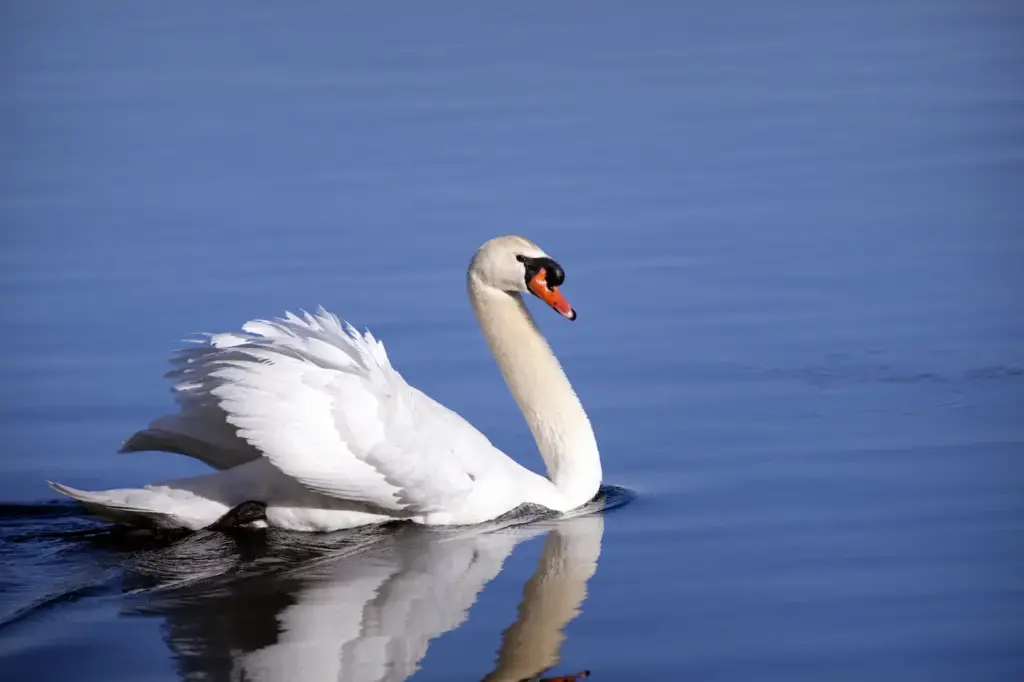
The Mute Swan has a white plumage, but the head and neck can be stained orange or tan from foraging through iron-rich water and mud. A thick layer of down insulates the Mute Swans in cold temperatures. Mute Swans, like all waterbirds, spend a lot of time preening. To waterproof their feathers, they press their bill on an oil gland located at the base of their tail and then spread the oil over their plumage. The orangey-red colour of their bill with black tip and base, the distinctive knob on top, and the gracefully curving neck are all features that help to identify them.
The male bill knob is larger than the female’s during the breeding season. The Polish Swan, a genetic morph also known as “immutabilis”, has pinkish legs rather than the dark grey and dull-white juveniles. The genetics determines whether the juvenile Mute Swans’ (cygnets’) plumage is white or grey. Grey cygnets darken gradually to a brownish hue by their first winter, before turning white. White cygnets carry the leucistic trait and remain white with dull greyish black bills during the first year.
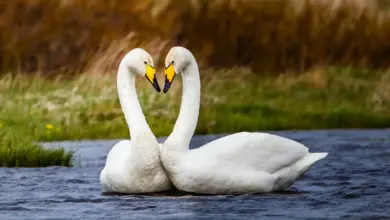
It is easy to recognise the Mute Swan by its large size, its long tail and an orange-reddish, knobbed bill. The Mute Swan is easily distinguished from other species, such as the Whooper Swan. It has a yellow-black bill and lacks the curved neck.
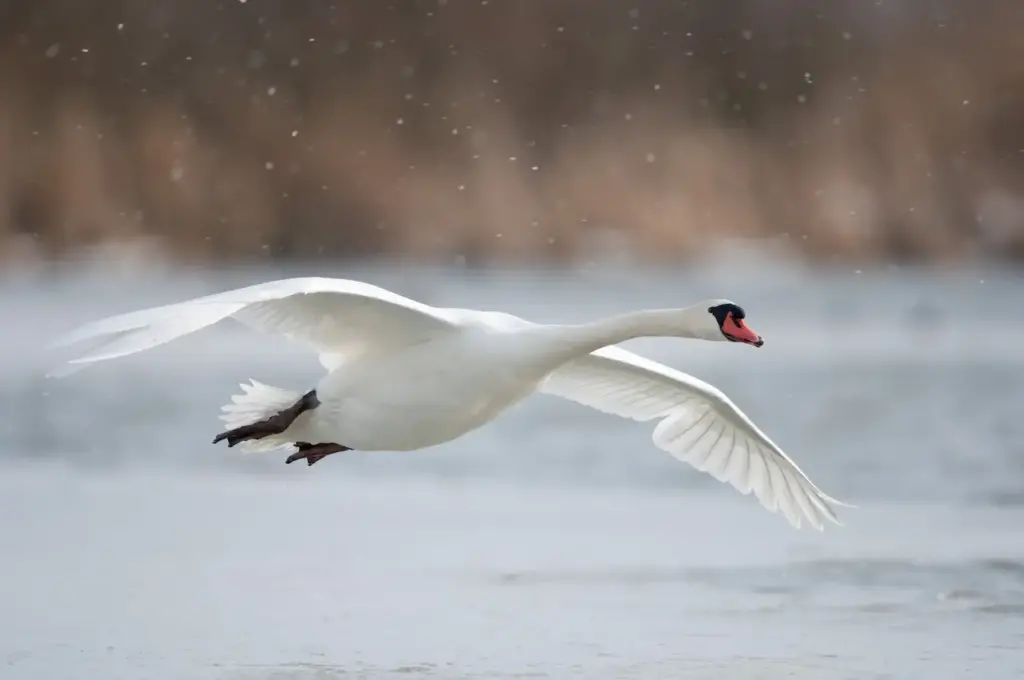
Mute Swan is on Flight
Breeding / Nesting
Diet / Feeding:
What they eat …
Swans feed primarily on aquatic plants, but they also eat grain, grasses and crop foods, such as wheat, potatoes and carrots – especially in the winter when other food sources aren’t readily available. According to eBird, this species is well documented.
Mute Swans will also eat insects, fish and frogs. According to BirdLife International, this species is well documented.
Only young cygnets (immature swans) eat aquatic insects and crustaceans, as they have a higher requirement for protein than the adults. As they get older, their diet changes over to a plant diet, which includes aquatic vegetation and roots.
How they eat …
In shallow water, Swans may use their strong webbed feet to dig into submerged mud and, like mallards, they tip up – plunging the head and neck underwater – to expose and feed on roots, shoots and tubers. The cygnets feed on invertebrates and aquatic vegetation stirred up by their foraging parents. Ducks and other water birds also often follow swans to forage on exposed plant matter and aquatic insects. Cygnets feed on invertebrates and aquatic vegetation stirred up by their foraging parents.
Their long necks give them an advantage over the short-necked ducks, as they can feed in deeper waters than geese or ducks. They can feed in waters that are up to 4 feet (1.2 meters) deep by uprooting plants and snapping off the leaves and stems of plants growing underwater.
Swans also forage by swimming, picking up plant material from the water’s surface or the water’s edge. On land, they feed on grains and grasses.
- The Diet of Swans and Feeding Swans
Calls / Vocalisations
Their vocalisations consist of grunting, hoarse whistling and snorting noises, particularly when communicating with their young. They usually hiss at predators.
The Mute Swan is less vocal than other Swans. Its most familiar sound is the vibrant throbbing of its wings in flight, which is unique to this species and can be heard for up to 1 mile or 2 kilometres..
Lifespan / Age
Swans are known to live 20 to 30 years. Swans form pair bonds when they are two to four years old and remain bonded for life. The first nesting usually occurs when they are 4 or 5 years old.
Status
The Mute Swan is protected in most of its range, but this has not prevented illegal hunting and poaching.
In Western Europe, Mute Swans were hunted to extinction in the 13th to 19th centuries. Only captive populations survived.
In the 19th and 20th centuries, they were provided more legal protection and rebounded in most of their native range.
Between 1960 and the early 1980s, their numbers declined significantly due to lead poisoning from birds swallowing discarded fishing sinkers made from lead. Since then, these lead sinkers have been replaced with less toxic alternatives, and the populations are increasing again.
Species Research by Sibylle Johnson
Please Note: The articles or images on this page are the sole property of the authors or photographers. Please contact them directly with respect to any copyright or licensing questions. Thank you.