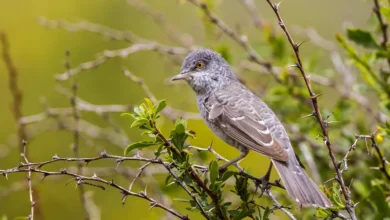
The Menetries’ Warbler (Sylvia mystacea) is a small, intriguing passerine bird native to southwest Asia. Named in honor of the French zoologist Édouard Ménétries, who first described the species in 1832, this warbler is a member of the genus Sylvia, a group well-known for its diverse array of small, insectivorous birds. Menetries’ Warblers share close ties with the Mediterranean’s Sardinian Warbler (Sylvia melanocephala) but display distinct physical and ecological traits that set them apart. Their subtle plumage, delicate behaviors, and broad geographical distribution make them an interesting subject for birdwatchers and nature enthusiasts alike.
Scientific Classification
The Menetries’ Warbler belongs to the family Sylviidae, a large and diverse group of Old World warblers. Its scientific name, Sylvia mystacea, places it firmly within the genus Sylvia, which includes many closely related warblers characterized by their small size, insectivorous diet, and melodious songs. The species was first formally described by Ménétries in 1832, reflecting both its early scientific recognition and the long history of ornithological study in southwest Asia.
Within the species, three recognized subspecies highlight slight variations in plumage and distribution. The nominate subspecies, S. m. mystacea, occupies the western part of the range, while S. m. rubescens and S. m. turcmenica are found further east and northeast respectively. These subspecies differ primarily in coloration and wing length, adaptations that reflect their local environments. Phylogenetically, Menetries’ Warbler is closely related to the Sardinian Warbler, with which it shares several morphological traits, although subtle differences in plumage and vocalizations help distinguish the two species in the field.



Geographic Range & Distribution
Menetries’ Warblers inhabit a broad swath of southwest Asia, extending from the Caspian Sea region through the Caucasus and into parts of Central Asia. The nominate subspecies S. m. mystacea breeds from southern Russia’s Caspian coastal areas, through Georgia, Armenia, Azerbaijan, eastern Turkey, and into northern Iran. Its western counterpart, S. m. rubescens, resides in localized regions of southeastern Turkey, Syria, Iraq, western Iran, and possibly Lebanon. The eastern subspecies, S. m. turcmenica, stretches from northeastern Iran eastward across Central Asia, including the Syr Darya valley and into the Balochistan region of Pakistan.
As a migratory species, Menetries’ Warblers undertake seasonal movements that take them southward for the winter months. Their wintering grounds encompass southern Iran, the Arabian Peninsula, and northeast Africa, with records spanning from Sudan to Somalia. Individuals occasionally pass through Israel and Jordan during migration, offering birdwatchers in these countries the rare opportunity to observe this species outside its breeding range. The variety of habitats occupied during breeding and wintering seasons reflects the species’ adaptability, ranging from scrublands and open woodland to thorny bushes and cultivated areas.
Physical Description
Menetries’ Warblers are small birds, measuring approximately 12 to 14 centimeters in length, with a wingspan ranging from 15 to 19 centimeters. Their weight typically falls between 9 to 11 grams, making them lightweight and agile fliers. One of the species’ most distinctive features is its fairly long tail, which is predominantly blackish with white outer feathers. This tail is often held cocked upwards and wagged either vertically or side to side, a behavioral trait commonly observed during foraging and territorial displays.
The bill is robust relative to the bird’s size, dark in color but with a characteristic pinkish patch at the base, an identifying feature useful in the field. Surrounding the eye is a pale bare ring, adding contrast to the otherwise muted facial tones. Male Menetries’ Warblers of the nominate subspecies exhibit a dark greyish back and whitish underparts, highlighted by a white submoustachial stripe and a distinctive pink throat and breast. The head sports a dark cap that is dull black at the front, gradually fading into a paler shade toward the nape, which is grey. This subtle gradation sets it apart from the Sardinian Warbler, which features an entirely jet-black cap.
In terms of wing feathers, Menetries’ Warblers have relatively plain tertials (the flight feathers closest to the body) compared to the Sardinian Warbler, whose tertials show more pronounced dark centers and pale edges. The western subspecies, S. m. rubescens, is generally paler grey on the upperparts and may lack the pink coloring on the underparts entirely. Meanwhile, the eastern subspecies, S. m. turcmenica, is lighter grey above and has paler pink underparts than the nominate, along with notably longer wings. Outside the breeding season, males tend to adopt a browner hue with a less distinct cap, blending more with the female’s sandy grey-brown coloring above and buff-white below. Females resemble females of related species such as the Sardinian and Subalpine Warblers but can be distinguished by their plainer tertials and stronger contrast between the pale back and darker tail. First-year males look similar to females but may show traces of pink on the throat and breast.
Behavior & Diet
Menetries’ Warblers are active and alert birds, often found flitting through dense shrubs and low trees as they forage. Their behavior is characterized by frequent tail wagging and a constant movement that aids in flushing out insects. These warblers primarily feed on insects and other small invertebrates, including caterpillars, beetles, spiders, and ants. They glean prey from foliage, branches, and occasionally from the ground, demonstrating a versatile foraging strategy suited to their varied habitats.
Their vocalizations are distinctive yet not overly elaborate. The species produces a harsh buzzing call, which can be described as a chattering sound similar to that of a sparrow but more mechanical in tone. During the breeding season, males sing a quiet, somewhat restrained chattering song that blends musical notes with harsher elements. This song is often performed in flight, a behavior that serves both territorial and mate attraction functions. Menetries’ Warblers are generally shy and secretive, preferring dense cover but can be coaxed into view by patient observers, especially during early morning when they are most vocally active. According to eBird, this species is well documented.
Breeding & Reproduction
The breeding season for Menetries’ Warblers typically begins in late spring and extends through early summer, depending on the geographic location. Males establish territories within dense thickets or shrubby areas, where they perform flight displays and sing to attract females. Nest sites are usually well concealed in bushes or low trees, providing protection from predators and harsh weather. The nests themselves are cup-shaped and constructed from grasses, leaves, and small twigs, lined with softer materials such as feathers or hair to ensure comfort for the eggs and chicks. According to RSPB, this species is well documented.
Females typically lay between three to five eggs per clutch. The eggs are small and pale with subtle speckling, blending into the nest environment. Incubation lasts approximately 12 to 14 days and is primarily undertaken by the female. After hatching, both parents participate in feeding the chicks, which are altricial—born blind and featherless—requiring significant parental care. The nestlings fledge after roughly two weeks but continue to receive parental support for some time as they learn to forage independently.
Conservation Status
According to the International Union for Conservation of Nature (IUCN), the Menetries’ Warbler is currently classified as Least Concern. This status reflects its relatively wide distribution and stable population trends across much of its range. However, local threats do exist, primarily habitat loss due to agricultural expansion, urbanization, and degradation of shrublands. Because Menetries’ Warblers rely on dense, thorny vegetation for breeding and shelter, the removal of such habitats can negatively impact local populations.
In some parts of its range, especially in the Middle East, habitat fragmentation poses a challenge, while in other areas, hunting and trapping may present localized risks. Conservation efforts focus on habitat protection and monitoring population trends to ensure that the species remains secure. Its adaptability to a variety of habitats and migratory behavior also contribute to its resilience. Ongoing research and bird surveys continue to provide valuable data to track changes in population dynamics over time.
Interesting Facts
One fascinating aspect of Menetries’ Warblers is their tail-wagging behavior, which is thought to communicate alertness or deter predators. This movement, combined with their subtle but distinctive vocalizations, helps them maintain contact with mates and rivals in dense vegetation. Their song, often delivered in flight, sets them apart from many other warbler species that sing primarily from stationary perches.
The species’ name honors Édouard Ménétries, an accomplished 19th-century zoologist known for his extensive work in Russia and Asia. This historical link underscores the long tradition of ornithological discovery in the region. Additionally, the subtle differences between the three subspecies provide an excellent example of how geographic isolation and environmental factors drive evolutionary divergence within a species.
For birdwatchers, spotting Menetries’ Warblers can be challenging due to their secretive nature and preference for dense shrubbery. However, their presence is often betrayed by their distinctive tail wagging and vocalizations. Photographers seeking to capture images of this elusive bird benefit from knowledge of its preferred habitats and behavior during the breeding season, when males are most vocal and visible.
In summary, the Menetries’ Warbler is a small but captivating species with a rich natural history and broad ecological significance across southwest Asia. Its subtle beauty, complex behaviors, and migratory lifestyle make it a rewarding subject of study and observation for anyone interested in the diverse birdlife of the Old World.