The Black-necked Cranes (Grus nigricollis) are a large, whitish-gray crane. It is also known as the Tibetan Crane. The fragile ecosystems at high altitudes, the changing seasons, and human stewardship are all factors that determine its survival. This article attempts to summarize what we know about its life, from its appearance to its behavior, and the threats that it faces, to what is being done in order to protect it.
Appearance: A Striking Contrast in Plumage and Presence
The Black-necked Crane has a wingspan between 2 and 2.35 meters. It is a large bird that measures roughly 1.3 to 1.4 meters in height (about 4.3 to 4.6 feet). The average adult weighs between 5 and 6 kilograms. However, as with most wild birds, there are variations depending on season, food availability, and geographical location.
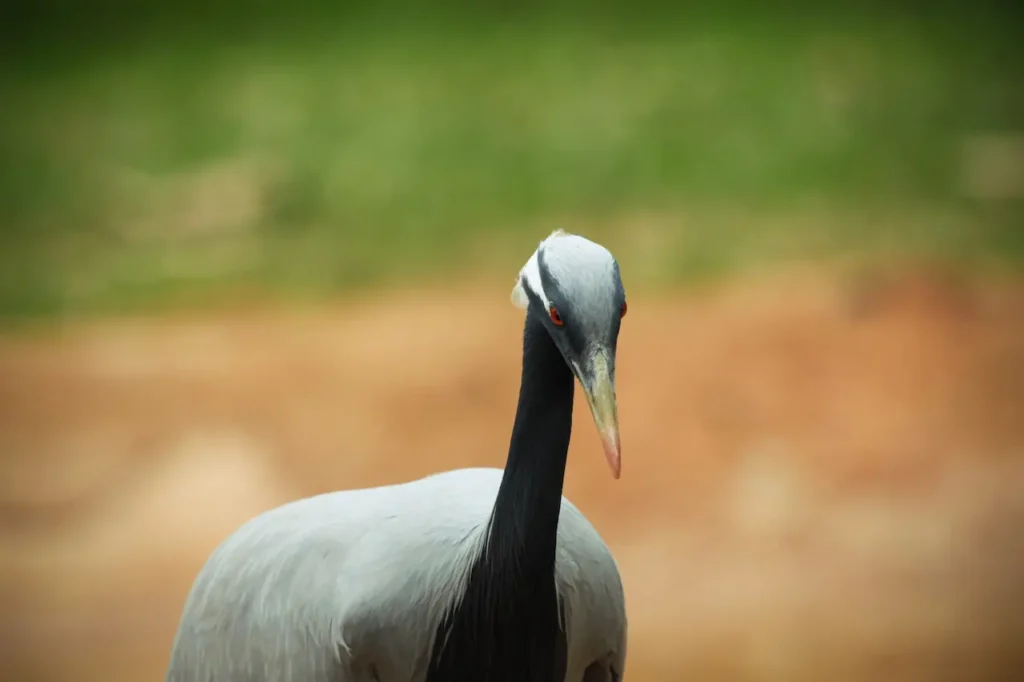
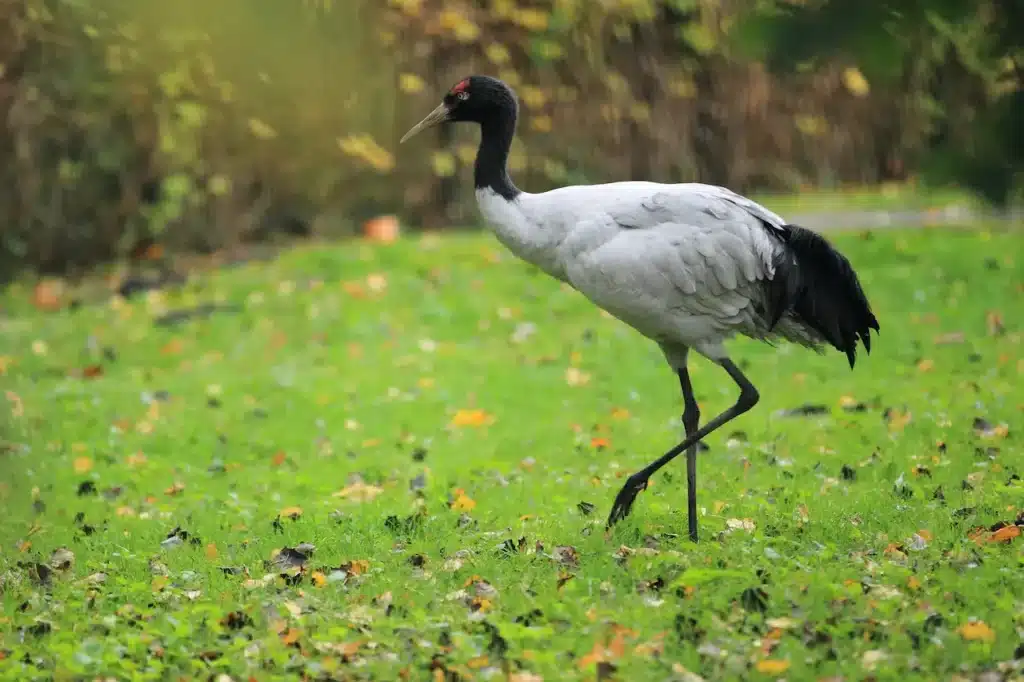
The body plumage of this crane is mainly a whitish to pale grey. This provides a soft background against which its darker parts can stand out. The black head and neck transition into greyish feathers on the body. A white patch, often called the “post-ocular patch”, is located behind the eye. It contrasts starkly with the black. A red crown patch, or bare skin, adds color and character to the bird, which is especially noticeable during breeding season. The large flight feathers on the wings are black, as well as the primaries. This creates a striking contrast when flying. Legs, facial skin, and the beak are also dark. The juvenile birds’ plumage is duller, with a less distinct crown and muted contrasts. They also have more brownish tones before they become adult.


The silhouette of the bird is unmistakable, even in flight: long legs, neck stretched out, and broad wings with a contrast between pale body and dark flight feathers. Their calls, too, are loud, resonant, and trumpet-like–fitting for a bird with such a presence.
Geographic Range and Habitat
Black-necked Cranes prefer high places. The breeding areas are the alpine marshes and wetlands of the Tibetan Plateau, as well as the adjacent high-altitude region. These remote areas are where they often establish territories at elevations between 2,600 and 4,900 meters above sea level. These habitats include shallow water bodies, marshy or flooded meadows and grasslands, as well as large lakes.
Beyond the breeding season, they undertake seasonal movements–descending to lower elevations in winter. Wintering grounds are often found in valleys, lower plateaus, and agricultural fields. They can also be found along reservoir shorelines or lower marshes. China’s regions (e.g., Wintering areas include the Yunnan Guizhou Plateau, Tibet (or regions within Tibet), Bhutan (such as Phobjikha or Bomdaling Valleys), and parts of India (such as Ladakh and Arunachal Pradesh).
During winter, they feed on waste crops or agricultural fields, as well as in open fields with invertebrates or other prey.
Feeding: What they Eat, How they Forage
The Black-necked Crane is omnivorous and its diet changes with the season, habitat, and food available.
During the breeding period, they feed on marshes and meadows as well as shallow water and lake margins. Plant materials such as roots, tubers, the rhizomes and seeds of semi-aquatic or aquatic plants, as well as invertebrates, like insects, worms, and snails, are consumed. When the opportunity arises, they may also take small vertebrates such as frogs and small rodents.
These cranes are adapted to foraging on agricultural fields in winter when the wetlands freeze and become inaccessible. The cranes eat leftover grains (barley, oats, and buckwheat) as well as tubers and roots. They also dig up vegetables, root crops, or other food sources if they are available. They can survive in harsher seasons by utilizing both natural prey from wetlands and human-made food sources.
Foraging involves walking slowly through marshes and fields, probing the ground with their beaks or sweeping or dipping water edges. They may also feed in shallow water or even among vegetation. Foraging is done in small groups. Some individuals act as watchers or sentinels while others feed. The best feeding time is in the early morning or late afternoon, when conditions are cooler and prey are more active.
Breeding and Life Story
Black-necked cranes breed during spring (May to June in some areas), after the snow melts and marshes and water bodies are available. The courtship displays include dancing, leaping, and bowing, as well as unison vocalizations and posturing. These elaborate displays are used to establish and defend territories and strengthen pair bonds.
Monogamy is the norm, and they form long-lasting pair bonds. The mated pair defends the nesting area vigorously and drives away any intruders from their own species. Nesting is often done on small islands of grass in shallow wetlands or on mud-covered islands within large shallow bodies of water. Nests are constructed using grass, rushes, and aquatic vegetation such as reeds, sedge, mud, or sedge. Nests can be hardly lined at times, or built modestly in order to raise the egg above the water.
Clutch sizes range from one to two eggs. The incubation duties are shared by both parents, and they alternate periodically. The incubation period is roughly 30-33 days. The chicks, which are still dependent on their parents for warmth, feeding, and protection, become mobile after hatching. The chicks grow and are protected by their parents until they have enough feathers and are strong enough to leave.
After fledging, the juveniles stay with their parents for a while to learn foraging skills, habitat mapping, and seasonal or migration movements. Sexual maturity occurs several years after sexual maturation. Many individuals can live into their teens, or even beyond. However, wild mortality rates are high, especially due to habitat pressure or environmental stress. According to RSPB, this species is well documented.
Legal Status of the Population
The total number of Black-necked cranes (adults and youngsters) is estimated to be between 10,000 and 11,000, though the numbers can vary based on surveys, regions, and times. Some sources estimate that the breeding population in some areas is between 5,000 and 6,000 mature individuals. According to BirdLife International, this species is well documented.
They are officially recognized as protected species under national and international protection frameworks. The Black-necked Crane has legal protection in China, India, and Bhutan. The IUCN Red List lists it as Vulnerable. Some local laws, cultural protections (including certain taboos and reverence), and protected areas protect breeding and wintering habitats.
Threats to Black-necked Cranes
The Black-necked Crane is vulnerable in multiple ways, despite its adaptation to a harsh and remote lifestyle.
Habitat loss and degradation are major threats. Changes in water availability can affect breeding marshes or wet meadows. This includes changes to flooding, drying of lakes, and hydrological changes (dams, irrigation).
Hunting is another threat to wintering grounds. Although hunting in many areas is illegal or very rare, it does occur. Nesting success can be affected by predators, domestic dogs, or tourists.
Climate change is also a major factor: shifting patterns of snowmelt, changing temperatures, and changing rainfall patterns may alter the hydrology in wetlands, change the availability of prey, reduce nesting sites for birds, or alter the altitude of vegetation zones.
A small population and the fact that it is dispersed across many remote locations mean any localized disaster can have a large impact.
Cultural Significance of Conservation and Efforts
Black-necked Cranes are culturally important in many areas of their range. In the Tibetan Plateau and Bhutan, as well as Ladakh and other parts of India, Black-necked Cranes are associated with purity, long life, and harmony, according to local and Buddhist beliefs. In Bhutan, for example, they celebrate their arrival with festivals; in Ladakh, they are the designated state bird. These cultural values support local awareness and protection, which is vital in areas where legal enforcement can be difficult.
Multiple conservation measures are being implemented. On the conservation front, multiple measures are underway. Monitoring and research programs are in place to track population sizes, breeding success, and habitat usage, as well as seasonal or migration movements. Priority is given to wetlands conservation, restoration, and management of degraded saline marshes, as well as water management in order to maintain moisture levels at high altitude breeding sites. In some areas, stricter regulations are implemented to regulate grazing and disturbances, including those caused by tourism or infrastructure developments.
Local people are often first in line to defend these cranes. Programs that educate people about the importance and ecological role of cranes, as well as how traditional local practices can coexist alongside crane conservation, will help to build cooperation, rather than conflict.
Ecology, Behavior, and Daily Life
Black-necked Cranes can be social and gregarious outside of the breeding season. In winter, they form large flocks, which use communal feeding and roosting grounds. They may travel long distances to reach feeding grounds, especially in large fields or marshes, and this is often done early in the morning or late at night when prey are active or heat exposure is lower.
The birds often communicate with loud calls that can be heard across wide open spaces. Courtship displays and calls are used to reinforce pair bonding: bowing, dancing, and trumpeting together. These behaviors serve both practical purposes – attracting mates and maintaining territory – as well as social ones, helping to maintain cohesion between pairs and flocks.
Cranes are more comfortable in wetlands, marshes, or shallow lakes where they feel safe from predators. The cranes are very attentive parents. They defend nest sites, keep eggs warm, protect chicks, and sometimes move chicks when nesting sites are threatened by predators or flooding.
Conclusion
Black-necked Cranes are a bird full of contrasts. They can be delicate yet grand, remote but dependent on human behavior, migratory yet isolated, and vulnerable yet resilient. The high-altitude breeding ground is wild, beautiful, and extreme. Its existence is a testament to the power of specialized adaptations and traditional reverence.
His story reminds us of the importance of maintaining delicate balances. This includes the relationship between land and water, cold and heat, human use and wildness, and tradition and modern changes. It is much more than just a bird to those who hear its trumpeting call at dawn over marsh water or see its silhouette in the mountains. It’s a symbol for wild places still important, and the home that we share with animals whose lives depend on landscapes many of us won’t see but whose protection is our responsibility.