Bird Overview
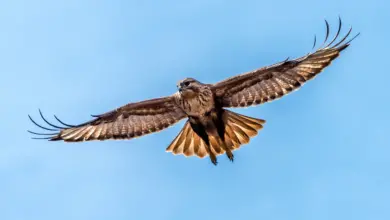
The Madagascar Buzzards (Buteo brachypterus) is a bird of prey found in Madagascar, where it inhabits subtropical or tropical moist lowland and montane forests. It is endemic to Madagascar and one of its most recognisable and widespread raptors. This species can thrive in an astonishing variety of habitats. These include dense rainforests, dry deciduous forests, open grasslands, steep rocky slopes, as well as human-modified landscapes like plantations and cities. For more information, see our guide on birds of prey.


The species’ ability to adapt to diverse environments has helped it maintain a stable population in most of its range. This includes elevations ranging from sea level up to 2,500 metres. The Madagascar Buzzard, with its broad wings and barred underparts and its sharp, penetrating call, is an important feature of the island’s avifauna. It also plays an essential role as a predator in its ecosystem.
Identification
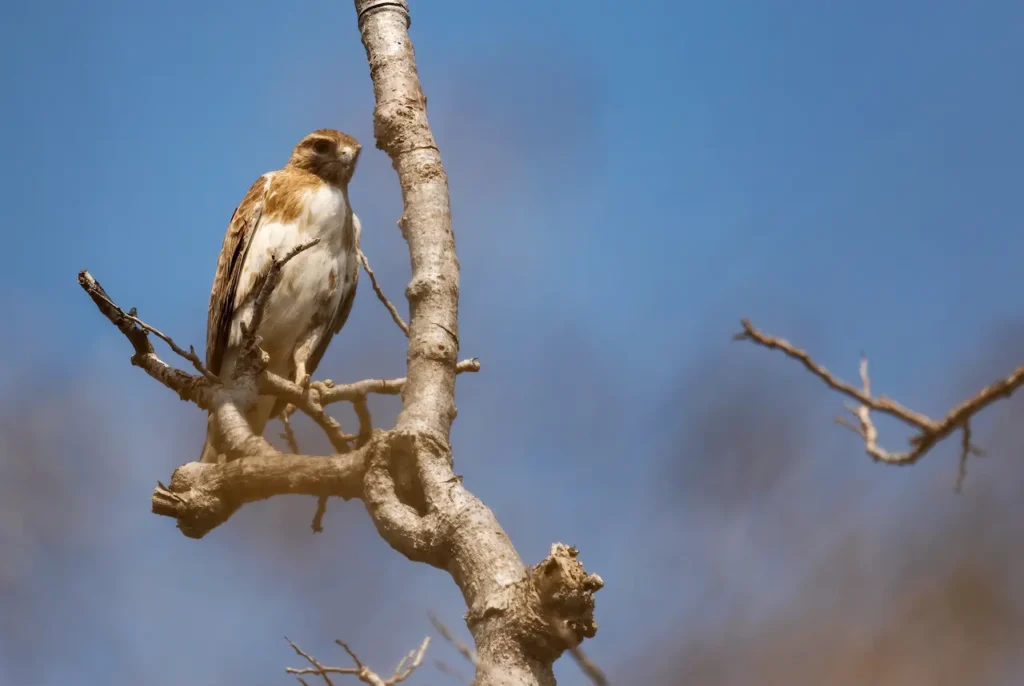
The Madagascar Buzzard (or brown buzzard) is a medium-sized buzzard that is native to Madagascar. It’s also one of the most common raptors on the island. It can be found in a wide range of habitats, including dense deciduous forests, dry grasslands, and scrubby secondary growth. However, it does not usually inhabit open grasslands or treeless plains. Its adaptability allows it to maintain a steady population throughout most of the island.
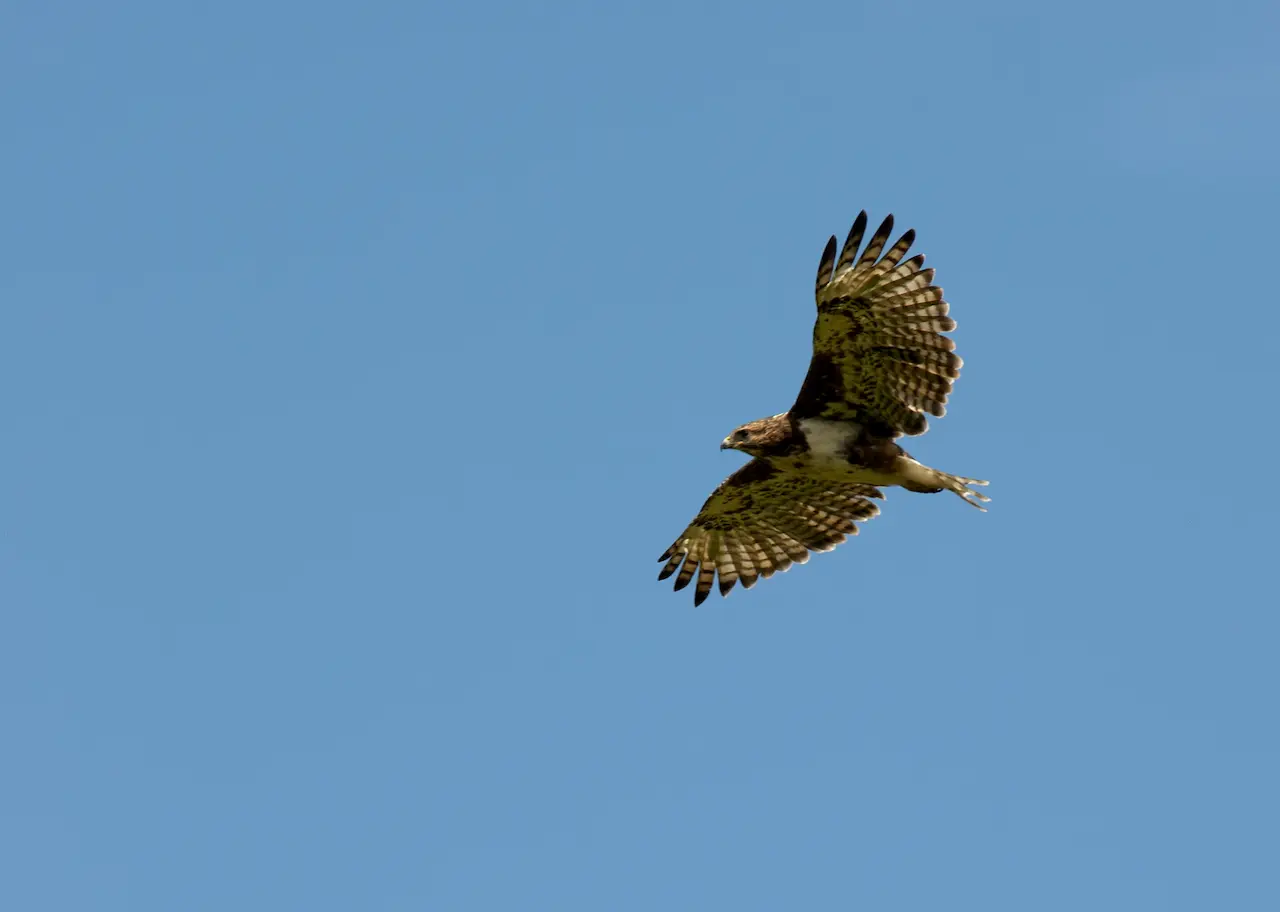
The Madagascar Buzzard is easily identified by its large wings, which have pale panels at the tips. Its wings are also larger than those of the similar dark Madagascar Cuckoo-Hawk, whose wings, while equally dark, are smaller and paddle-shaped. This species is known for its distinctive vocalisation, a series of loud, rising wails which can be heard over a long distance, especially while soaring high above the canopy.
Perched, the Madagascar Buzzard has a pale chest and a belly with prominent streaks. This helps distinguish it from the Madagascar Cuckoo-Hawk, which has a paler abdomen and a darker chest. The buzzard can be mistaken for an immature Madagascar Harrier Hawk, but it has a darker head. It also lacks the pale fringes on the wings of the harrier hawk. The buzzard’s strong build and dominant posture while perched set it apart.
Songs & Calls
The Madagascar Buzzard’s call is a piercing, sharp “keeah”, which echoes across the landscape. This powerful vocalisation can be heard in forests, valleys and even open skies, revealing the presence of the bird to prey as well as other raptors. The cry of the island predator is particularly striking in places such as the ornithological gardens, which cuts through the air.
Location
The Madagascar Buzzard, a raptor that is native to Madagascar, is one of its most adaptable and widespread raptors. It can be found in a wide range of habitats, from dense forests to dry woodlands, and even man-modified landscapes. It is less common on the central plateau, where large areas of forest have been lost, reducing suitable hunting and nesting grounds. There is evidence that suggests the species could be on the rise in some areas, as forest fragmentation has created more open spaces and forest edges, which this buzzard can easily exploit for hunting. The ability of the buzzard to survive in secondary growth, near plantations and agricultural fields, shows a remarkable level of resilience. This allows it to maintain relatively constant numbers despite habitat changes on the island. According to Cornell Lab of Ornithology, this species is well documented.
Habitat
The Madagascar Buzzard can adapt to a variety of habitats on the island. The Madagascar Buzzard can be found in the dense rainforests of Madagascar, the dry deciduous forests, or even the arid spiny forests to the south. It can be found on steep rocky slopes or in dense thickets in mountainous regions. It is not uncommon to see this raptor flying over plantations, cultivated areas, and secondary growth zones, showing its tolerance of human-modified landscapes. It is absent from the central plateau where habitats are scarce. It is found from the sea up to an elevation of 2,500 meters. This makes it one of Madagascar’s most adaptable birds of prey when it comes to habitat. According to eBird, this species is well documented.
Behaviour
The Madagascar Buzzard is a predator that feeds on an impressively diverse range of animals in the wild. Its diet includes rodents and small mammals, as well as a wide range of birds, frogs and snakes. It has also been observed to eat carrion and prey on lemurs. This raptor hunts gracefully by soaring above the forest canopy and open landscapes. It is often seen in pairs flying over low vegetation on high ridges between 1,800-2,000 metres. It circles carefully before diving into trees or undergrowth and capturing its prey. Prey is usually decapitated or eaten in part before being brought back to the nest.
During breeding season, Madagascar Buzzards become highly territorial. Nest-building usually begins in July or August. The courtship is characterised by aerial displays in which pairs perform high-altitude soars, steep dives and wing-fluttering displays reminiscent of Common Buzzard displays. It is a sedentary bird that stays within its range all year round. It flies with a heavy style that combines stiff, shallow wingbeats and short glides.
Feeding
The Madagascar Buzzard, like many other raptors, is an opportunistic hunter with a diet that reflects its island’s diversity. It preys upon small vertebrates, such as lemurs and rodents. This shows its agility in handling agile vertebrates. It also eats a variety of birds, from small passerines up to medium-sized species such as young egrets. Reptiles like snakes, lizards and chameleons are also a part of its diet. In addition to frogs and other amphibians, the buzzard also feeds on large insects, such as locusts or centipedes. The buzzard’s dietary flexibility allows it to adapt to changes in the availability of prey and thrive in a variety of habitats.
Breeding
Madagascar Buzzards breed from July to November. This coincides with the cooler dry season on the island and the beginning of the rains. The abundance of prey is ideal for raising the young. Nesting sites are carefully selected and can vary greatly. The pair may choose to build their nest in a fork in a large palm tree, on a cliff edge in the mountains, or in the crown of an enormous tree. The nest is made of sticks and often covered with fresh leaves and foliage to protect the eggs and chicks from parasites.
The female typically lays one or two eggs. They are usually laid several days apart. The female begins to incubate immediately after the first hatching egg has been laid. It can lead to significant differences in size and strength between siblings. In most cases, the stronger, older chick will dominate and attack the younger chick, a phenomenon called siblicide. This ensures that only one chick reaches the juvenile stage. Incubation lasts about 4-5 weeks. The female is the primary incubator, while the male provides food. The chick will remain in the nest until it is ready to leave, which can take up to 6-7 weeks. Both parents will provide food and protect the chick during this time. Even after fledging, the juveniles can remain dependent on parents for several weeks while they learn how to hunt and survive independently.
Conservation
The IUCN Red List currently classifies the Madagascar Buzzard as being of Least Concern. This assessment is based on its stable population and wide distribution throughout Madagascar. It remains one of Madagascar’s most common raptors. The species’ ability to adapt to different habitats, including secondary growth and some landscapes modified by humans, has protected it from the effects of environmental changes.
The species is still facing significant threats. Deforestation, logging and charcoal production are causing habitat destruction and fragmentation. This is reducing suitable hunting and nesting grounds. Human persecution, whether due to conflict between poultry farmers and traditional beliefs or conflicts with chicken farmers, poses a localised threat in some areas. These pressures may not have yet led to a significant population decline. However, habitat loss and ongoing human activities are a constant threat.
Risks / Threats
Please Note: The articles or images on this page are the sole property of the authors or photographers. Please contact them directly with respect to any copyright or licensing questions. Thank you.