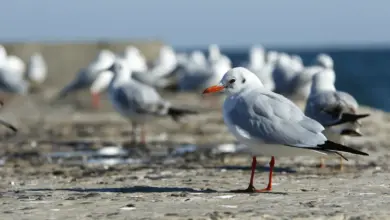
The Lesser Black-backed Gull (Larus fuscus) is a striking seabird widely recognized for its dark back and yellow legs. This medium-large gull breeds predominantly along the Atlantic coasts of Europe and has a notable migratory pattern that extends its presence into West Africa and parts of North America during the winter months. Known for its adaptability, the Lesser Black-backed Gull inhabits a variety of coastal and inland habitats, including urban environments. Its distinctive appearance, complex taxonomy, and varied diet make it a fascinating subject for birdwatchers and nature enthusiasts alike.
Scientific Classification
The Lesser Black-backed Gull belongs to the family Laridae, which includes gulls, terns, and skimmers. Its scientific name is Larus fuscus, with “fuscus” meaning dark or dusky in Latin, a reference to the bird’s dark plumage. This species is part of the Herring Gull complex, a group of closely related gull species that exhibit a ring distribution around the Northern Hemisphere. The taxonomy within this group is notoriously complicated due to the subtle gradations in plumage and morphology between related species and subspecies.
Within Larus fuscus, there are several recognized subspecies or races, differentiated primarily by the shade of their mantle (the back and wings): L. fuscus fuscus breeds around the Baltic Sea and eastern Scandinavia and has a jet-black mantle; L. fuscus intermedius inhabits Denmark, the Netherlands, and Norway, featuring a sooty black mantle; while L. fuscus graellsii is found in the British Isles, Iceland, and northern France and displays a dark grey mantle. These subspecies vary slightly in size and coloration but share key behavioral and ecological traits.


Geographic Range & Distribution
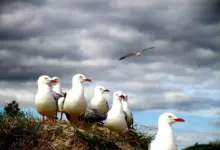
The Lesser Black-backed Gull breeds primarily along the coastal regions of northern and western Europe. Its breeding range extends from the Baltic Sea and eastern Scandinavia, through the British Isles, down to northern France and Iceland. During the breeding season, colonies are typically found on cliffs, islands, and coastal lagoons, though the species has increasingly adapted to nesting in urban areas, especially in cities where it coexists with Herring Gulls.
Outside the breeding season, the Lesser Black-backed Gull undertakes a significant migration. Birds from northern Europe travel southward to winter along the Atlantic coasts of western Europe and Africa, reaching as far as West Africa’s coastal waters. Some individuals from Iceland’s population are known to cross the Atlantic and winter along the eastern coast of North America, a behavior that has been documented with increasing regularity. This broad geographic range reflects the species’ adaptability to different climates and habitats.
Physical Description
The Lesser Black-backed Gull is a medium-large gull, generally smaller and more slender than the Great Black-backed Gull (Larus marinus). Adults typically measure between 51 to 64 centimeters in length, with a wingspan ranging from 125 to 150 centimeters. Weight varies, but individuals generally weigh between 600 and 1,100 grams, depending on subspecies and age.
One of the most distinctive features of the Lesser Black-backed Gull is its dark mantle, which varies from dark grey to jet black depending on the subspecies. This contrasts sharply with the white head, underparts, and tail. The legs are bright yellow, distinguishing it from the pink-legged Herring Gull (Larus argentatus). The bill is yellow with a characteristic red spot on the lower mandible, which is important for chick feeding behavior. In winter, adults display a grayer head compared to their summer plumage, which is more white. Juveniles and immature birds have mottled brown and black plumage with scaly patterns on their wings, taking approximately four years to reach full adult plumage.
Behavior & Diet
The Lesser Black-backed Gull is highly adaptable in both its behavior and diet. It is omnivorous, foraging opportunistically across a range of environments. Its diet includes fish, crustaceans, insects, worms, mollusks, starfish, seeds, berries, and occasionally small mammals and birds. It is also known to scavenge human refuse, which explains its success in urban environments. Like many gulls, it will also consume eggs and chicks of other birds, demonstrating its opportunistic feeding habits.
During foraging, Lesser Black-backed Gulls use a variety of techniques such as surface dipping, scavenging, and even kleptoparasitism—stealing food from other birds. Their ability to exploit diverse food sources contributes significantly to their widespread distribution. Vocalizations include a distinctive, deep-pitched “laughing” call, somewhat similar to that of the Herring Gull but noticeably lower in tone. This call plays an important role in communication within colonies and during territorial disputes.
Breeding & Reproduction
The Lesser Black-backed Gull breeds in colonies that can range from a few pairs to several thousand. Nesting sites are typically located on coastal cliffs, islands, or near freshwater lakes. In recent decades, many populations have also established nests in urban areas such as rooftops and quarries, often alongside Herring Gulls. Nests are simple scrapes on the ground or among rocks, lined with vegetation, feathers, or debris. According to RSPB, this species is well documented.
Breeding pairs generally lay three eggs per clutch, though clutch size can vary between one and four. The eggs are olive or buff-colored with brown blotches, measuring approximately 62 by 43 millimeters. Incubation lasts about 26 to 28 days, primarily undertaken by the female, while the male provides food and protection. Chicks are semi-precocial, hatching covered in down but requiring parental care. They fledge at around 40 to 50 days of age but remain dependent on their parents for some time after leaving the nest. Juveniles undergo a gradual molt over several years before attaining full adult plumage and sexual maturity at around four years old. According to Cornell Lab of Ornithology, this species is well documented.
Conservation Status
According to the International Union for Conservation of Nature (IUCN), the Lesser Black-backed Gull is currently classified as Least Concern. Its population is stable or increasing in many parts of its range, particularly in the British Isles where urban nesting has allowed the species to thrive. However, some local populations face threats from habitat disturbance, pollution, and changes in food availability due to overfishing and coastal development.
Conservation efforts for this species focus on monitoring population trends, protecting breeding colonies, and managing human-wildlife conflicts, especially in urban areas. Because gulls often interact closely with humans, balancing their conservation with minimizing nuisances is an ongoing challenge. Overall, the species’ adaptability and broad range contribute to its current secure conservation status.
Interesting Facts
The Lesser Black-backed Gull exhibits fascinating behaviors that highlight its adaptability and intelligence. For example, the red spot on the adult’s bill plays a crucial role during feeding: chicks instinctively peck at this spot to stimulate the adult to regurgitate food. This simple yet effective communication mechanism ensures the survival of the young.
Another intriguing aspect is the species’ role in the Herring Gull complex, a classic example of a ring species. This phenomenon illustrates how populations that are distributed continuously around a geographic barrier can diverge enough to become distinct species at the ends of the distribution. The Lesser Black-backed Gull and the Herring Gull represent the terminal forms of this ring, showcasing evolutionary processes in action.
Additionally, while most gull species are associated with coastal habitats, the Lesser Black-backed Gull’s ability to exploit urban environments is remarkable. In cities, they nest on rooftops and scavenge in refuse sites, demonstrating behavioral flexibility that has allowed them to coexist alongside humans successfully.
Lastly, the species’ migratory behavior is notable for its long distances. Some Icelandic Lesser Black-backed Gulls travel thousands of kilometers each year, wintering off the coasts of North America and West Africa, making them a truly cosmopolitan species.
In summary, the Lesser Black-backed Gull is a resilient, wide-ranging bird with complex behaviors and a fascinating evolutionary background. Its dark plumage, varied diet, and adaptability to both natural and urban habitats make it an enduring subject of interest for anyone passionate about birds and wildlife.