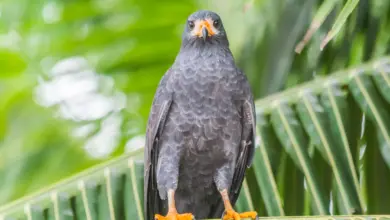
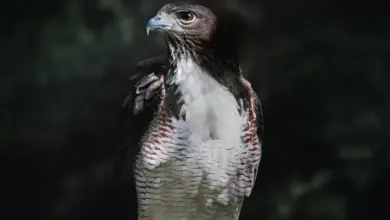
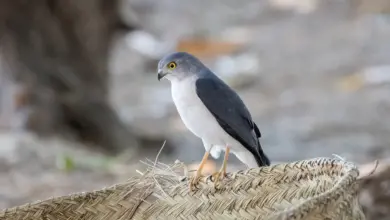
The Crested Goshawk is a sleek and agile bird of prey that lives in the warm tropical forests of Asia. This raptor, which is known for its long tail and short crest and its exceptional maneuverability, is a forest hunter who relies more on speed and surprise than brute strength. It is a member of the Accipitridae family, which includes eagles and buzzards. However, its appearance and behaviour are specifically adapted for life in dense woodland.
Taxonomy of Family and Placement
The Crested Goshawk is a member of the Accipiter genus, which includes other forest-dwelling birds such as Northern Goshawks and Sparrowhawks. The birds of this genus have short, rounded wing tips and long tails. These features allow them to make rapid turns and fly through trees with precision. The species name trivirgatus is derived from the adult’s three-striped pattern on its face. The Crested Goshawk, which is a member of the Accipitridae, shares a close relationship with some of the most powerful raptors in the world, despite occupying a more specialised niche.
Geographic Distribution in Asia
The Crested goshawk is widely distributed in southern Asia, but its distribution is patchy. The range of the Crested Goshawk extends eastward from India, Sri Lanka, through Southeast Asia, Indonesia and the Philippines, to southern China. Its wide distribution is a reflection of its ability to live in tropical forests with varying tree cover, as long as prey and sufficient tree cover are available. The species, despite its wide distribution, is not uniformly distributed. It is rare or uncommon at the outer limits of the range.
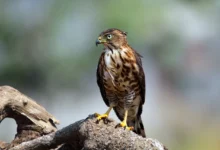




Residency and Seasonal Movement
The Crested Goshawk, unlike many other raptors that migrate over long distances throughout their range, is a resident year-round. It can be found in winter even in upland habitats or foothill habitats such as the Himalayan Foothills of Bhutan and the Sal ( shorea robusta ) forests of Northern India. At the northernmost edge of its range, the species is becoming increasingly rare. The species’ preference for warm, stable climates restricts its range to tropical and subtropical areas.
Preferred Habitats and Forest Dependence
The Crested goshawk is closely associated with forest habitats. This includes lowland tropical rainforests, evergreen or semi-evergreen woodlands and mature secondary forest. The Crested Goshawk can be found on forest edges, wooded plantations and in forests with sufficient canopy cover. For both nesting and hunting, dense vegetation is necessary. This species relies heavily on ambush and concealment tactics. The quality of the habitat is crucial in determining local abundance.
Overall Body Size and Structure
Crested Goshawks can be found in sizes ranging from 30 to 46 centimetres. Like most birds of prey, the females are larger than the males. Sometimes by up to 25 per cent. The sexual dimorphism in size reduces the competition between sexes, as they can target different prey. The species’s long tail and broad, short wings make it ideal for navigating dense forest canopy.
Crests and other distinguishing features
The Crested Goshawk’s short but distinct crest is one of its most distinguishing features. It is best seen in profile. This crest is used to distinguish the Crested Goshawk from other species, such as the Besra Accipiter vigra, which is smaller with a less pronounced crest. In regions with multiple Accipiter, the Crested Goshawk’s larger size and robust build can be used to identify it.
Adult Male Plumage Description
Male adult Crested Goshawks have a head with a strong pattern. The crown is dark brown, and the sides are grey. The face is adorned with distinctive black throat and moustachial stripes, which add to the fierce expression. The underparts of the bird are usually pale white or cream colored, with fine bars on the belly and rufous streaks along the breast. This patterning helps camouflage the bird in forest light.
Adult Female Plumage Differences
The pattern of females is similar to that of males, but they tend to be darker and larger. The head is usually more brownish than grey, and the stripes and bars are brown instead of rufous. The larger size of females, along with the differences in colouration, helps experienced observers to distinguish them from males.
Juvenile Appearance & Identification
The juvenile Crested Goshawk is different from the adult. The crown has a scaly look due to the pale fringes of the feathers. The underparts are buff, not white. They have darker streaks that help them camouflage in their early months. As juveniles grow older, the patterns on their plumage become more distinct and cleaner.
Flight Styles and Aerial Behaviour
The Crested Goshawk flies with a pattern that is typical of Accipiter: a series of slow wingbeats, followed by a glide. This rhythm of “slow flaps, slow flaps, glides” is effective for moving through dense forests and is often used when travelling between perches. When hunting, the flight is rapid and direct with bursts in speed to surprise prey.
Selecting the Right Diet and Prey
The Crested Goshawk, like other goshawks or sparrowhawks, has a diverse carnivorous diet. It feeds on small and medium-sized birds as well as mammals like rodents and reptiles such as lizards. It may also eat large insects or amphibians. Its diet is dependent on the habitat and available prey, but in many forest environments, birds are a major part.
Forest Ecosystem: Role
The Crested Goshawk is a predator of a medium to high level. It plays a vital role in controlling the populations of smaller mammals. It helps to maintain the ecological balance of forest ecosystems by preying on mammals and birds. Its presence can be an indication of a healthy, well-structured forest with enough biodiversity to support higher levels of trophic levels.
Breeding Seasons and Timing
Breeding season for the Crested goshawk is different in each region, but it generally takes place during cooler months. Breeding occurs in many areas of its range during the peak of the dry seasons, when the weather is stable, and hunting is more efficient. This ensures that the chicks will be raised at a time when food is predictable. According to Audubon Society, this species is well documented.
Courtship Displays & Pair Formation
The courtship of Crested Goshawks is a combination of aerial displays and vocalisations. Males perform display flights and call from above the canopy of trees to attract females. Prey presentation is a key part of courtship, in which the male shows the female his hunting skills and mate-suitability by presenting food. These rituals can help to establish strong bonds between a pair. According to eBird, this species is well documented.
Nest Site Selection and Construction
Once a pair has formed, they choose a nesting location high up in the forest canopy. Nests are usually built near the trunk of tall trees for extra stability. The nest is a large platform constructed from sticks, twigs and leaves. Sometimes, it’s lined with soft materials like moss or down feathers. Nest placement is used to conceal and protect nesting birds from predators on the ground.
Incubation and Egg Laying
The female Crested goshawk typically lays two to four eggs. The female is the one who carries out most of the incubation, which lasts 30 to 35days. The male is crucial during this time, as he provides food to the female incubating eggs, which allows her to stay on the nest to maintain the optimal temperature of the eggs.
Chick Development and Early Life
The chicks are blind and have few feathers. They depend on their parents to provide warmth and food. Both parents are involved in feeding the young and protecting them, bringing small pieces of food to the nest. As chicks develop, they get down feathers, then juvenile plumage. They also gain strength and coordination.
After-Nest Care and Fledging
The young Crested Goshawks leave the nest after approximately six to eight weeks. After leaving the nest, young Crested Goshawks will often stay in the area and continue to depend on their parents for guidance and food. This prolonged period of care allows the juveniles to improve their hunting abilities before they become fully independent.
Parasites in Ecological Associations
The Crested goshawk is known to host several species of feather louse, including Degeeriella Storeri. This species appears to be unique. Kurodaia Fulvofasciata is a more common parasite that affects birds of prey in the Holarctic. These parasites provide information about the ecology and evolution of birds.
Legal Status and Protection
Crested Goshawks are protected by law in some areas. In Hong Kong, for example, it is protected by the Wild Animals Protection Ordinance Cap 170. It can be found in places such as Kam Sha Country Park. Conservation measures at the local level can help protect populations in areas that are under intense urban and agricultural pressure.
Conservation Status and Global Assessment
The International Union for Conservation of Nature classifies the Crested Goshawk as “Least Concern” due to its widespread distribution in South and Southeast Asia. While populations are generally stable, there may be local declines where forest habitat has been lost or fragmented.
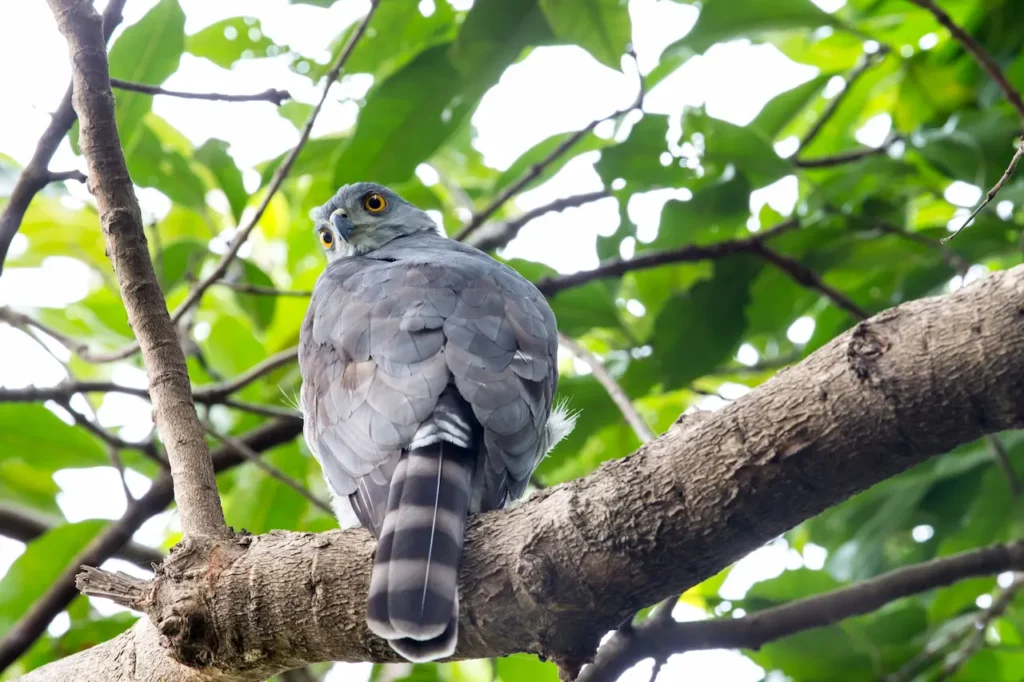
Crested GosHawks Image
Threats to Habitat and Challenges
The Crested Goshawk, like many other forest-dependent raptors, is constantly threatened by deforestation and logging. Urban development, agricultural expansion and agricultural change are also threats. Loss of habitat can lead to a reduction in nesting sites and the availability of prey. This may result in localised population decreases. Climate change can alter forest ecosystems and indirectly affect the species by changing prey distribution.
Adaptability, resilience and adaptability
The Crested Goshawk is adaptable despite these challenges. It can live in a variety of forest types, including secondary growth as long as there is enough cover and food. The species’ flexibility has allowed it to maintain stable populations in most of its range despite moderate human disturbance.
Forest Conservation is Important
The Crested Goshawk’s long-term survival depends on the conservation of forest ecosystems in Asia. The protection of large tracts and continuous woodlands is not only beneficial to this species, but also to many other animals and plants. In order to maintain these habitats, sustainable forestry practices and designated areas are vital.
Conclusion: The significance of the Crested Goshawk
The Crested goshawk is an efficient and highly specialised predator that has been perfectly adapted for life in tropical or subtropical forests. Its stealth and agility make it one of the most impressive woodland birds in Asia. It is not endangered at the moment, but it is vulnerable to habitat destruction and environmental changes. This bird will continue to thrive if the forests in which it lives are protected. It is a symbol for the biodiversity and complexity of Asia’s forests.