
The Hispaniolan Emerald (Chlorostilbon swainsonii) is a captivating species of hummingbird endemic to the island of Hispaniola in the Caribbean. This island, shared by the Dominican Republic and Haiti, boasts a rich biodiversity, and the Hispaniolan Emerald is one of its most enchanting avian residents. Known for its vibrant green plumage and diminutive size, this hummingbird thrives in montane forests and shaded plantations, playing a vital role in pollination within its ecosystem. Despite its small stature, the Hispaniolan Emerald exhibits fascinating behaviors and adaptations that make it a subject of interest for birdwatchers and nature enthusiasts alike.
Scientific Classification
The Hispaniolan Emerald belongs to the family Trochilidae, which encompasses all hummingbirds, renowned for their remarkable flying abilities and iridescent feathers. Its scientific name is Chlorostilbon swainsonii, placing it within the genus Chlorostilbon, commonly referred to as the “emeralds” due to their shimmering green plumage. This genus is part of the subfamily Trochilinae, which includes many small to medium-sized hummingbirds distributed throughout the Americas.
The species was first described by the English naturalist John Gould in 1866, honoring William Swainson, a noted 19th-century English ornithologist. The genus name Chlorostilbon stems from Greek roots, with “chloros” meaning green and “stilbon” meaning shining, a fitting description for these radiant birds. The Hispaniolan Emerald is closely related to other Caribbean hummingbirds such as the Antillean Mango (Anthracothorax dominicus) and the Vervain Hummingbird (Mellisuga minima), though it is intermediate in size between these species.


Geographic Range & Distribution
The Hispaniolan Emerald is a true island endemic, found exclusively on Hispaniola, the second-largest island in the Caribbean. Hispaniola is politically divided into two countries: the Dominican Republic to the east and Haiti to the west. This range places the bird between Cuba to the west and Puerto Rico to the east. Unlike many hummingbirds that have broad continental ranges, the Hispaniolan Emerald’s distribution is confined to this single island, making it an important species for regional biodiversity.
Within Hispaniola, the Hispaniolan Emerald predominantly inhabits the island’s mountainous regions, favoring elevations between approximately 200 and 1,500 meters (about 600 to 5,000 feet). It is most commonly found in humid broadleaf forests, as well as in montane shade coffee plantations that mimic natural forest conditions. These shaded plantations provide crucial habitat, as they support flowering plants that supply nectar year-round. The bird also frequents karst landscapes—areas characterized by soluble limestone terrain—where forest clearings and shrublands offer feeding and nesting opportunities.
Seasonally, some populations exhibit altitudinal movements, descending to lower elevations during the cooler months from September to December, likely in response to flowering cycles and temperature changes. This vertical migration helps the species maximize its access to food resources throughout the year.
Physical Description
The Hispaniolan Emerald is a small hummingbird, measuring on average about 10.5 centimeters (4 inches) in total length from the tip of the bill to the end of the tail. It weighs roughly 3.75 grams (0.13 ounces), placing it among the smaller hummingbird species, though larger than some of the tiniest hummingbirds like the Vervain Hummingbird. Its bill is straight and slender, adapted for extracting nectar from a variety of flowers.
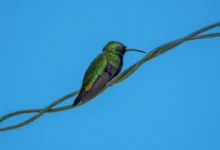
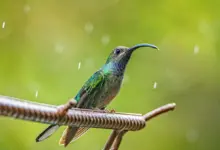
Males and females exhibit marked sexual dimorphism in plumage. Adult males boast a brilliant metallic green plumage covering most of their body, which helps them blend into the lush foliage of their habitat. A distinctive feature is a dull black spot on the chest, which contrasts subtly with the green. Their tails are deeply forked and dark, aiding in agile flight and display during courtship. The iridescent quality of their feathers can shimmer with different shades of green depending on the angle of light.
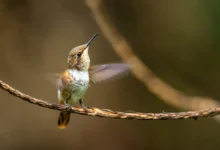
Females, in contrast, display more subdued coloration, with dull gray underparts accented by metallic green on the sides. They have conspicuous white tips on their tail feathers and a prominent white post-ocular spot—an area just behind the eye—that often assists in individual identification. This muted coloration likely provides better camouflage during nesting and incubation.
Both sexes have sharp, metallic-sounding calls described as high-pitched “tics,” which they use to communicate and defend feeding territories.
Behavior & Diet
The Hispaniolan Emerald exhibits typical hummingbird behaviors, including rapid wingbeats that allow it to hover precisely while feeding. It is primarily a nectarivore, feeding on the nectar of a wide variety of flowering plants native to its montane environment. It favors tubular flowers that accommodate its slender bill and tongue, such as those of the family Rubiaceae (coffee plants), as well as other native shrubs and vines. Nectar provides the bird with essential sugars for energy, fueling its high metabolism.
In addition to nectar, the Hispaniolan Emerald supplements its diet with small arthropods, including insects and spiders. These protein sources are critical, especially during breeding and molting periods when nutritional demands increase. The bird captures insects by hawking—snatching them in mid-air—or gleaning them from leaves and bark.
This hummingbird is highly territorial, especially males, who aggressively defend their feeding areas from rivals and other nectar feeders. Territorial disputes often involve rapid chases and vocalizations. Despite this aggression, the species is usually solitary, except during breeding seasons when males perform elaborate courtship displays to attract females.
Breeding & Reproduction
The Hispaniolan Emerald reproduces through a typical hummingbird breeding strategy, with solitary behavior outside of mating. Males do not participate in nesting or chick-rearing; their role is limited to courtship and mating. Courtship involves aerial displays where males perform rapid flights, sharp dives, and produce mechanical sounds with their tail feathers to impress females. According to eBird, this species is well documented.
Females construct the nests alone, typically building small cup-shaped structures from soft plant fibers, moss, and spider silk. These nests are often placed on thin branches or shrubs in shaded areas, where they are well camouflaged from predators. The small size of the nest complements the bird’s diminutive stature. According to BirdLife International, this species is well documented.
Clutches usually consist of two tiny white eggs, each measuring approximately 1 centimeter in length. Incubation lasts about 14 to 16 days, solely undertaken by the female. After hatching, the chicks remain in the nest for an additional 18 to 22 days before fledging. During this time, the female diligently feeds the young by regurgitating nectar and insects.
The breeding season typically coincides with the peak flowering periods on the island, ensuring an abundant food supply for both adults and chicks. Depending on environmental conditions, the Hispaniolan Emerald may have multiple broods per year.
Conservation Status
The Hispaniolan Emerald is currently classified as Least Concern by the International Union for Conservation of Nature (IUCN), reflecting its relatively stable population across much of its range. It remains common in the higher elevations of the Dominican Republic, where protected forests and shade coffee plantations provide suitable habitat.
However, its status is less secure in Haiti, where deforestation and habitat degradation have severely impacted many native species. Haiti’s widespread forest loss, driven by agricultural expansion and charcoal production, has resulted in significant declines of forest-dependent birds like the Hispaniolan Emerald. The fragmentation of habitats limits available nesting and feeding sites and increases vulnerability to predators and climate fluctuations.
Conservation efforts in Hispaniola focus on preserving montane forests and promoting sustainable agricultural practices, such as shade-grown coffee, that maintain the ecological integrity of the region. Environmental education and community involvement are crucial to ensuring the long-term survival of this species and many others that share its habitat.
Interesting Facts
The Hispaniolan Emerald is locally known as the Zumbador Mediano, or “medium hummingbird,” a name highlighting its size relative to other hummingbirds on the island. It is larger than the tiny Vervain Hummingbird but smaller than the robust Antillean Mango, positioning it as an important part of the hummingbird community in Hispaniola.
One remarkable feature of hummingbirds like the Hispaniolan Emerald is their ability to hover with incredible precision, achieved through rapid wingbeats of up to 50 times per second. This allows them to feed from flowers while remaining stationary in the air, a trait unique among birds.
The deeply forked tail of the male not only aids in flight maneuverability but also plays a role in mating displays, where tail feathers produce distinctive sounds that attract females. These mechanical sounds, combined with vibrant plumage, make males highly visible during the breeding season.
Despite their small size, Hispaniolan Emeralds are resilient birds adapted to a variety of microhabitats within montane forests and cultivated areas. Their ecological role as pollinators is vital for maintaining the health and diversity of their native flora, illustrating the interconnectedness of island ecosystems.
Finally, while the Hispaniolan Emerald is a relatively common species, ongoing habitat pressures underscore the importance of conservation efforts in the Caribbean. Protecting this dazzling hummingbird helps safeguard the rich biodiversity of Hispaniola and ensures that future generations can continue to enjoy the beauty and wonder of these remarkable birds.
In conclusion, the Hispaniolan Emerald (Chlorostilbon swainsonii) is a fascinating example of island endemism and adaptation. Its vibrant green plumage, specialized feeding behaviors, and role in pollination highlight the intricate relationships within Caribbean ecosystems. As a species confined to Hispaniola, it serves as both a symbol of natural heritage and a reminder of the need for ongoing conservation efforts to preserve the unique wildlife of the region.


