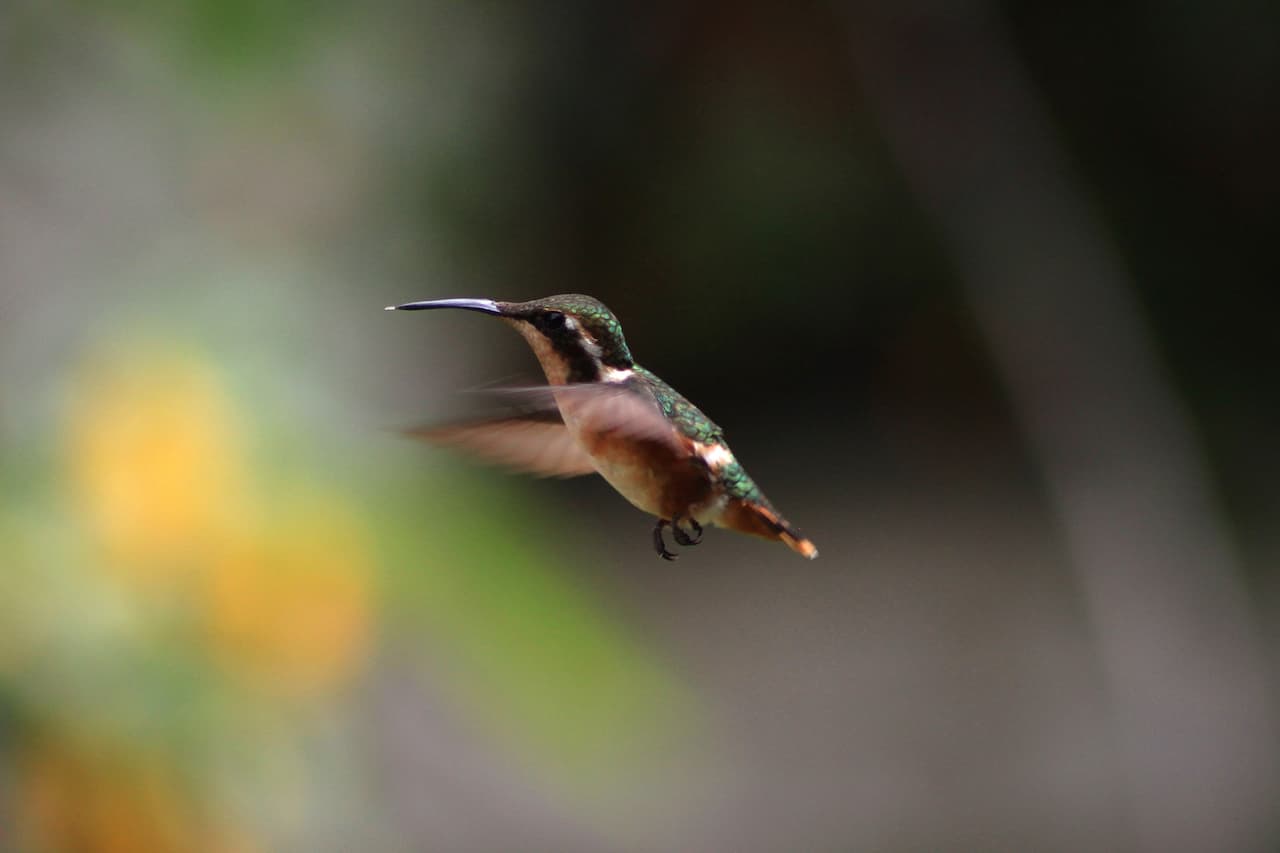
The Antillean Mango (Anthracothorax dominicus) is a captivating hummingbird species native to the Caribbean, admired for its striking iridescent plumage and agile flight. Known also as the Dominican Mango or Puerto Rican Golden Hummingbird, this species plays an important role in the ecosystems of the islands it inhabits, serving as both pollinator and a vivid emblem of the region’s rich avifauna. Found primarily in the Dominican Republic, Haiti, Puerto Rico, the British and U.S. Virgin Islands, and parts of the Bahamas, the Antillean Mango thrives in a variety of habitats ranging from dry forests to moist lowland areas. This article provides an in-depth exploration of the Antillean Mango’s scientific classification, geographic distribution, physical features, behaviors, breeding habits, conservation status, and intriguing facts, shedding light on this remarkable bird.
Scientific Classification
The Antillean Mango belongs to the family Trochilidae, a group commonly known as hummingbirds, which are renowned for their small size, rapid wing beats, and ability to hover. Its scientific name is Anthracothorax dominicus, placing it within the genus Anthracothorax, which includes several mango hummingbird species distributed throughout the Caribbean and parts of Central America. The species was first described by Carl Linnaeus in 1766. Within Anthracothorax dominicus, there are two recognized subspecies that differ slightly in geographic range and plumage characteristics: the nominate subspecies Anthracothorax dominicus dominicus, found primarily on the island of Hispaniola and neighboring smaller islands, and Anthracothorax dominicus aurulentus, often referred to as the Puerto Rican Golden Hummingbird, which inhabits Puerto Rico, the Virgin Islands, and parts of the Bahamas.
This taxonomic distinction reflects subtle morphological differences, particularly in coloration, and geographic isolation that has led to localized adaptations. The genus itself is part of the subfamily Polytminae, which groups hummingbirds often known as mango hummingbirds due to their vibrant metallic plumage and relatively large size compared to other hummingbird species.


Geographic Range & Distribution
The Antillean Mango is endemic to the Caribbean, with its range spanning several islands in the Greater Antilles and nearby archipelagos. The nominate subspecies A. d. dominicus is found mainly on Hispaniola, an island shared by the Dominican Republic and Haiti, as well as on adjacent islands such as Tortue, Gonâve, Vache, and Beata. These areas provide a mosaic of dry and moist forest habitats that support the species’ survival. The second subspecies, A. d. aurulentus, occupies Puerto Rico, including its offshore islands of Culebra and Vieques, and extends to the British and U.S. Virgin Islands, including St. Thomas, St. John, and Anegada. Additionally, this subspecies can be found on Inagua Island in the southern Bahamas.
Within these regions, the Antillean Mango exhibits a preference for subtropical and tropical environments, specifically dry and moist lowland forests, as well as scrub and second-growth areas. It is also known to inhabit heavily degraded former forests, demonstrating a degree of adaptability to human-altered landscapes. The species generally remains at low to mid elevations but can be found up to around 600 meters above sea level in some parts of its range. Its distribution is closely tied to the availability of flowering plants that provide nectar, its primary food source, as well as suitable nesting sites.
Physical Description
The Antillean Mango is a medium-sized hummingbird, measuring approximately 11.5 to 13 centimeters (4.5 to 5 inches) in total length, including its slender beak and relatively long tail. Adults typically weigh between 6 and 8 grams, a weight range typical for hummingbirds of this size, and have a wingspan averaging around 12 to 13 centimeters.
Males are particularly striking, with a dazzling coppery-green plumage that shines brilliantly in sunlight. Their heads display a more intense coppery sheen compared to the back, while their chests transition into a dark blue to nearly black coloration, which gradually fades to a rich brown on the abdomen. The outer tail feathers of males exhibit a purplish-violet iridescence, adding to their vibrant appearance. In the Puerto Rican subspecies A. d. aurulentus, males have a distinctive golden sheen on the throat, which is the source of the common name “Puerto Rican Golden Hummingbird.”
Females are generally less colorful but still exhibit beautiful plumage. Their upperparts are bright green with a subtle bluish tint, while their underparts are a muted grayish tone. This more subdued coloration aids in camouflage, especially during nesting periods. Juvenile birds resemble females, but immature males can be identified by a characteristic black stripe running down the center of their whitish underparts.
Both sexes possess a long, curved bill designed for accessing nectar deep within flowers, and their wings are adapted for rapid, precise movements that allow them to hover and maneuver deftly around blossoms. These physical adaptations are essential for their feeding and mating behaviors.
Behavior & Diet
The Antillean Mango, like all hummingbirds, is renowned for its extraordinary flight capabilities. It can hover in place by rapidly beating its wings—up to 50 to 70 beats per second—and is capable of agile maneuvers including backward flight and sharp turns. This agility allows it to feed from flowers with exceptional precision while avoiding predators.
Feeding primarily on nectar, the Antillean Mango plays a vital role in pollination across its range. It visits a variety of native and introduced flowering plants, favoring those with tubular shapes that accommodate its slender bill. Common nectar sources include flowers from genera such as Hibiscus, Heliconia, and various species of the family Fabaceae. In addition to nectar, the Antillean Mango supplements its diet with small insects and spiders, which provide essential proteins and nutrients. These arthropods are typically caught in mid-air or gleaned from foliage and spider webs.
Behaviorally, the Antillean Mango is largely solitary outside the breeding season. It defends feeding territories vigorously, chasing away intruders including other hummingbirds and insects. Males, in particular, establish and patrol territories rich in floral resources to attract females during mating season. Despite their territoriality, they can sometimes be observed feeding in proximity when nectar is abundant. According to Audubon Society, this species is well documented.
Breeding & Reproduction
The breeding behavior of the Antillean Mango is typical of hummingbirds, characterized by solitary nesting and a lack of pair bonds. Males are solely responsible for courtship displays, which often involve elaborate flight patterns, including a distinctive U-shaped flight path performed in front of potential mates. This display serves to demonstrate the male’s vigor and suitability as a breeding partner. According to eBird, this species is well documented.
After copulation, males do not contribute to nest building or chick rearing. Females take full responsibility for these tasks. The female constructs a small, cup-shaped nest using soft plant fibers, spider silk, and lichens, often camouflaging it on thin branches or shrubs. The nest is typically located 1 to 3 meters above the ground, in a sheltered spot that reduces exposure to predators and adverse weather.
Clutches usually consist of two tiny white eggs, each measuring about 12 to 15 millimeters in length. The incubation period lasts approximately 14 to 19 days, during which the female remains vigilant and protective. After hatching, the chicks are altricial—born blind and featherless—and require intensive care and feeding. The female feeds the young by regurgitating nectar and small insects until they fledge, which occurs roughly 20 to 25 days after hatching.
Conservation Status
The International Union for Conservation of Nature (IUCN) currently lists the Antillean Mango as a species of Least Concern. This status reflects its relatively broad distribution across multiple islands and its adaptability to a range of habitats, including degraded and secondary forests. However, like many island species, it faces potential threats from habitat loss due to deforestation, urban expansion, and invasive species.
Conservation efforts in the Caribbean often focus on preserving native forest habitats and controlling invasive predators that threaten native bird populations. The Antillean Mango’s ability to persist in altered habitats offers some resilience, but continued monitoring is necessary to ensure stable populations. Climate change also poses an emerging threat, potentially affecting flowering times and the availability of nectar sources, which could impact the species’ feeding and breeding success.
Interesting Facts
The Antillean Mango is one of the few hummingbird species native to the Caribbean islands, making it a unique emblem of the region’s biodiversity. Unlike many hummingbirds that migrate seasonally, the Antillean Mango is largely sedentary, remaining within its island home year-round. This residency allows it to form strong ecological relationships with local plant species.
One fascinating behavior observed in males during courtship is the production of high-pitched vocalizations combined with their aerial displays, adding an auditory element to their visual spectacle. Their iridescent feathers can appear to change color dramatically depending on the angle of sunlight, an effect caused by the microscopic structure of their feathers rather than pigmentation alone.
Because of their brilliant plumage and dynamic behavior, Antillean Mangos are popular subjects for wildlife photographers and birdwatchers visiting the Caribbean. Their presence also has cultural significance, appearing in local folklore and art as symbols of beauty and agility.
Finally, the Antillean Mango’s scientific name, Anthracothorax dominicus, derives from Greek and Latin roots meaning “coal chest” and “of the Dominican Republic,” respectively, referring to the bird’s dark chest and its primary location on Hispaniola.
In summary, the Antillean Mango is a stunning example of Caribbean wildlife, combining remarkable physical adaptations with unique behaviors that enable it to thrive in island environments. Understanding and appreciating this species enhances our broader knowledge of hummingbird diversity and the ecological intricacies of tropical island habitats.