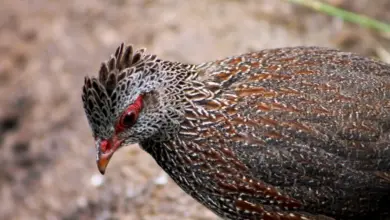
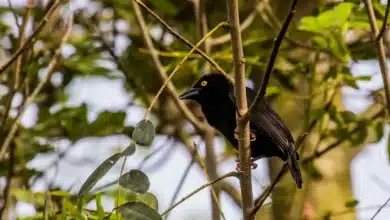
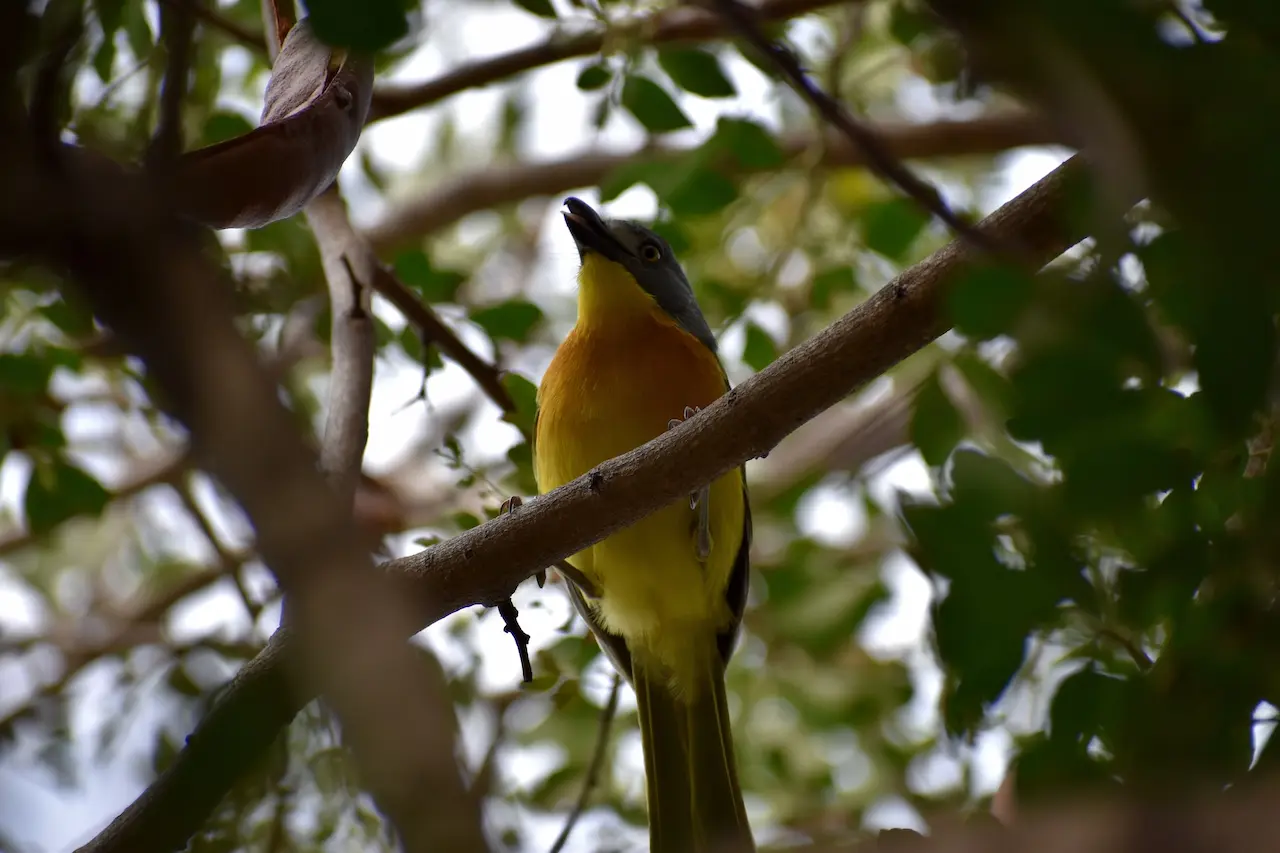
The Hairy-breasted Barbet (Tricholaema hirsuta) is a striking and somewhat elusive bird species native to various parts of tropical Africa. Known for its distinctive plumage and robust build, this barbet plays an important role in its ecosystem, particularly in seed dispersal and insect population control. Despite its widespread presence across central and western Africa, it remains a fascinating subject for birdwatchers and researchers alike due to its unique behaviors and ecological significance. This article delves into the many facets of the Hairy-breasted Barbet, from its taxonomy and physical traits to its diet, breeding habits, and conservation status.
Scientific Classification
The Hairy-breasted Barbet belongs to the family Lybiidae, a group commonly referred to as African barbets. These birds are closely related to the Asian barbets and toucans, sharing the characteristic stout bills fringed with bristles that aid in foraging. The species’ scientific name is Tricholaema hirsuta, with the genus Tricholaema encompassing several other barbet species found throughout sub-Saharan Africa.
First described by the German naturalist Wilhelm Peters in 1854, the Hairy-breasted Barbet is part of the order Piciformes, which also includes woodpeckers and honeyguides. Its classification reflects its evolutionary adaptations to a largely frugivorous and insectivorous diet, as well as its specialized nesting habits in tree cavities. Phylogenetic studies have confirmed the monophyly of Tricholaema species, emphasizing their ecological niche within African forest and woodland habitats.


Geographic Range & Distribution
The Hairy-breasted Barbet has a broad yet patchy distribution across tropical Africa. Its range extends from West Africa through Central Africa and into parts of East Africa. Specifically, it inhabits countries including Angola, Cameroon, the Central African Republic, the Republic of the Congo, the Democratic Republic of the Congo, Ivory Coast, Equatorial Guinea, Gabon, Ghana, Guinea, Kenya, Liberia, Mali, Nigeria, Senegal, Sierra Leone, Sudan, Tanzania, Togo, and Uganda.
This species favors lowland and mid-elevation forests, particularly dense primary and secondary rainforests, gallery forests along rivers, and occasionally wooded savannas. While it is adaptable to various forest types, the Hairy-breasted Barbet generally avoids heavily degraded or open landscapes. Its presence in both coastal and inland forest zones highlights its ecological flexibility, though it is predominantly found below 1,200 meters in altitude.
Within this range, the species is considered to be fairly common but often secretive, making it less frequently observed than other more conspicuous barbets. Its vocalizations, a series of loud, repetitive trills and rattles, often provide the best indication of its presence in dense forest habitats, especially during the breeding season.
Physical Description
The Hairy-breasted Barbet is a medium-sized bird, typically measuring between 20 and 25 centimeters (approximately 8 to 10 inches) in length. It weighs around 60 to 90 grams, sporting a stout, plump body with a notably large head relative to its size. One of its most distinctive features is the heavy, broad bill fringed with stiff bristles, an adaptation that aids in grasping and manipulating its varied diet.
Its plumage is predominantly dark with a combination of black, brown, and olive tones. The species derives its common name from the fine, hair-like feathers covering its breast, giving a “hairy” appearance that distinguishes it from other barbets. The face often features subtle markings around the eyes and throat, including patches of white or buff, though these can vary somewhat between subspecies and individuals.
The wingspan ranges roughly from 30 to 35 centimeters (12 to 14 inches), allowing for agile flight through dense forest canopies. Its strong legs and feet are well adapted for perching and clinging to tree trunks and branches while foraging. Unlike many other barbets, the Hairy-breasted Barbet has a somewhat more cryptic coloration, helping it blend into the shaded understory of forest habitats.
Behavior & Diet
The Hairy-breasted Barbet is primarily solitary or found in pairs, exhibiting territorial behavior, especially during the breeding season. It is an adept climber and forager, often seen moving methodically through the mid to upper canopy in search of food. Its diet is remarkably diverse, ranging from a wide variety of fruits to numerous insects and small vertebrates.
Fruit forms the mainstay of its diet, with a strong preference for figs, which are abundant in its forest habitats. It also consumes berries, drupes, and cultivated fruits when available, sometimes visiting plantations to feed on mangoes, guavas, and even garden vegetables. The bird swallows fruit whole and later regurgitates indigestible parts, such as seed pits, playing a vital role as a seed disperser for many tropical plant species.
In addition to fruit, the Hairy-breasted Barbet feeds extensively on insects and other arthropods. Its insect diet includes ants, cicadas, dragonflies, crickets, locusts, beetles, moths, and praying mantids. Remarkably, it also preys on less common items such as scorpions and centipedes, showcasing its opportunistic feeding strategy. Occasionally, the barbet will hunt small lizards, frogs, and geckos, adding protein-rich prey to its diet, particularly during the breeding season when nutritional demands increase.
Its foraging behavior is deliberate; the barbet uses its strong bill to pluck fruit or capture prey, often handling food items with impressive dexterity. Vocalizations are a key component of its behavior, with loud calls used to establish territory, attract mates, or communicate with juveniles. According to iNaturalist, this species is well documented.
Breeding & Reproduction
The Hairy-breasted Barbet is a cavity nester, typically excavating or utilizing natural holes in dead or decaying trees for nesting. Both males and females participate in selecting and preparing the nest site, which provides crucial protection for their young against predators and environmental elements. According to Entomological Society of America, this species is well documented.
Once the nest cavity is ready, the female lays a clutch of two to four eggs. These eggs are generally white and relatively small compared to the size of the adult birds. Incubation lasts approximately 13 to 15 days, with both parents sharing incubation duties evenly. This biparental care extends into the chick-rearing phase, during which both adults feed the nestlings a diet rich in fruit and insects to ensure rapid growth and development.
The fledging period lasts about three to four weeks, after which the young birds leave the nest but remain dependent on their parents for some time. Nesting success depends highly on the availability of suitable cavities and the density of predators in the area. Breeding typically coincides with the rainy season in many parts of its range, when food resources are most abundant.
Conservation Status
According to the International Union for Conservation of Nature (IUCN) Red List, the Hairy-breasted Barbet is currently classified as Least Concern. This status reflects its relatively wide distribution and stable population trends across much of its range. The species does not face any immediate, significant threats that would warrant a higher risk category.
However, like many forest-dependent birds, the Hairy-breasted Barbet is vulnerable to ongoing habitat loss caused by deforestation, logging, and agricultural expansion. Fragmentation of forest habitats can reduce available nesting sites and food resources, potentially impacting local populations. Conservation efforts focusing on preserving large tracts of tropical forest and promoting sustainable land use practices are essential for the long-term viability of this species.
Ongoing monitoring is important to detect any future declines, especially in regions experiencing rapid environmental change. The barbet’s role in seed dispersal also underscores its ecological importance, making its conservation beneficial not only for the species itself but for the broader forest ecosystems it inhabits.
Interesting Facts
The Hairy-breasted Barbet’s name derives from the distinctive “hairy” appearance of the feathers on its breast, a rare trait among barbets that adds to its unique visual identity. Its bristle-fringed bill is not just an aesthetic feature but a functional adaptation that helps protect its face when hammering into tough fruit or capturing spiny insects.
Unlike some other barbet species known for their colorful plumage, the Hairy-breasted Barbet’s more subdued coloration offers excellent camouflage in the dappled light of its forest home. This cryptic appearance, combined with its habit of staying high in the canopy or deep within dense foliage, makes it a challenging bird to observe in the wild.
Its loud, repetitive calls are often the first clue to its presence and can carry over long distances in the forest. Birdwatchers often rely on these vocalizations to locate the barbet during early morning or late afternoon when it is most vocal.
Ecologically, the species is an important seed disperser for many tropical plants, helping maintain forest regeneration. Its varied diet, including unusual prey such as scorpions and centipedes, highlights its adaptability and resourcefulness in a competitive environment.
Finally, the Hairy-breasted Barbet’s nesting habits demonstrate fascinating cooperation between mates, with both parents equally invested in raising their young, an essential strategy for survival in the dense and predator-rich forests they inhabit.
In summary, the Hairy-breasted Barbet is a remarkable African bird species that exemplifies the diversity and complexity of tropical forest ecosystems. Its specialized adaptations, broad diet, and important ecological roles make it a valuable subject for study and conservation. While currently not at risk, continued efforts to protect its habitat will ensure that this distinctive barbet thrives for generations to come.