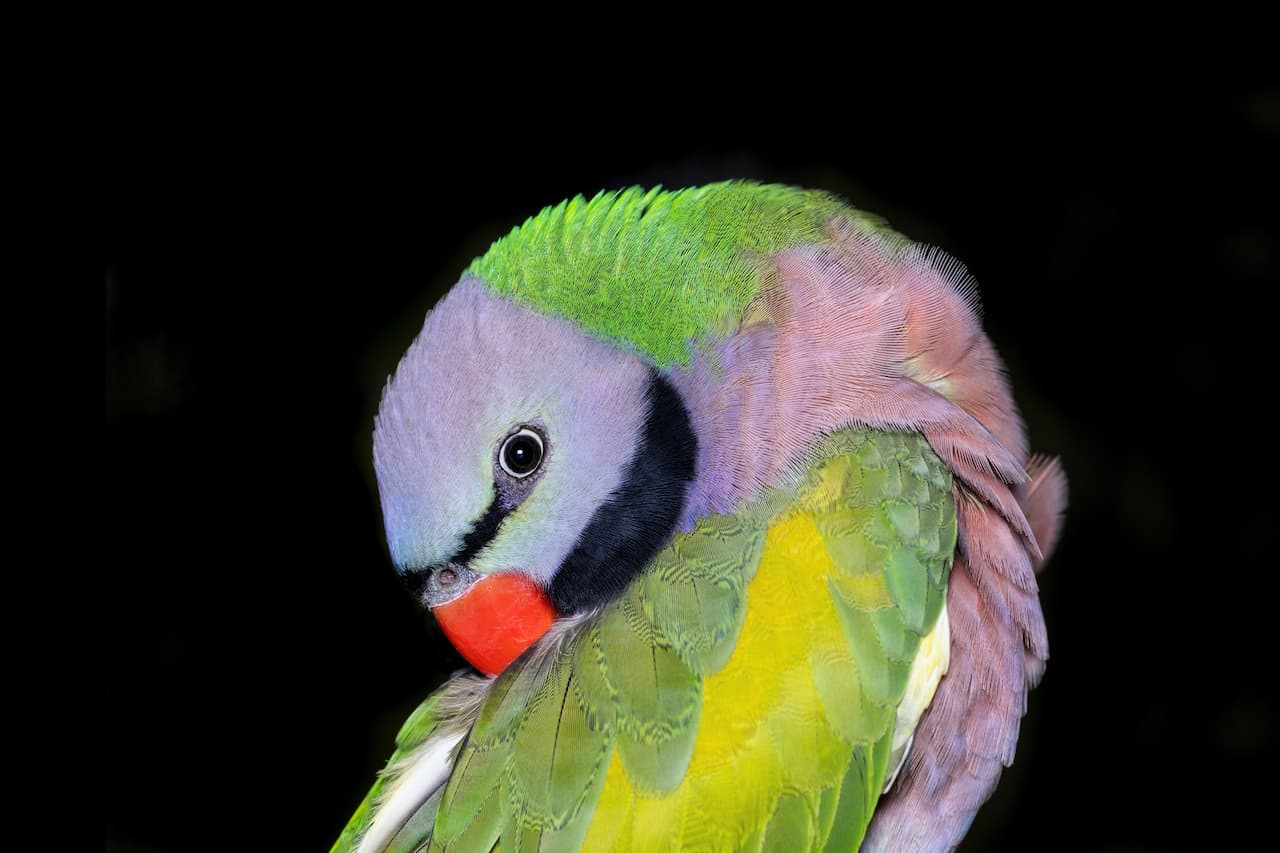
The Bar-winged Flycatcher-shrike (Hemipus picatus) is a striking small passerine bird that inhabits the dense tropical forests of southern Asia. Known for its distinctive black and white plumage and upright perching stance, this species is a fascinating member of the avian world, often observed actively gleaning insects from mid-canopy foliage. Though traditionally placed in the cuckoo-shrike family, recent studies suggest it may be more closely related to the bushshrikes of Africa, reflecting the complex evolutionary relationships within these groups. Found across a broad geographic range extending from the Himalayan foothills through the Indian subcontinent and into the islands of Southeast Asia, the Bar-winged Flycatcher-shrike is both an adaptable and intriguing species for birdwatchers and nature enthusiasts alike.
Scientific Classification
The Bar-winged Flycatcher-shrike belongs to the genus Hemipus, with the full scientific name Hemipus picatus. It is traditionally classified within the family Campephagidae, commonly known as cuckoo-shrikes. However, molecular studies have revealed that this placement may not fully reflect its evolutionary lineage. Recent phylogenetic analyses suggest that Hemipus shares closer affinities with the African bushshrikes (family Malaconotidae) and the genus Tephrodornis, which includes woodshrikes. This has led to ongoing discussions among ornithologists regarding the precise taxonomic position of the species.
Members of the genus Hemipus are characterized by their small size, slender bodies, and distinctive wing patterns. The Bar-winged Flycatcher-shrike is the most widespread and well-known species within its genus, with multiple recognized subspecies that vary slightly in plumage and distribution. The species epithet “picatus” refers to the bird’s barred wings, a key field mark that sets it apart from related species.





Geographic Range & Distribution
The Bar-winged Flycatcher-shrike has a wide but patchy distribution across tropical southern Asia, ranging from the western Himalayas through the Indian subcontinent to the islands of Southeast Asia. The nominate subspecies, H. p. picatus, is primarily found in the Western Ghats of India, a biodiversity hotspot known for its rich forest ecosystems. In this region, the species occurs mainly in evergreen and semi-evergreen forests, favoring the mid-canopy layers where it can forage efficiently.
Another subspecies, H. p. capitalis, inhabits the Himalayan foothills, stretching from Shimla in northern India eastwards through Manipur and into Bangladesh and northeastern states like Assam. This subspecies extends further into northern Thailand, Myanmar, and Laos, occupying similar forest habitats, often at elevations ranging from 300 to 1,800 meters above sea level.
In Sri Lanka, the subspecies H. p. leggei is found primarily in the hill forests of the island’s central and southern regions. This population is notable for its reduced sexual dimorphism in plumage, with males and females appearing more similar than in mainland populations.
Further southeast, H. p. intermedius occurs across the Malay Peninsula and the large islands of Sumatra and Borneo. This subspecies is adapted to a variety of forest types, including lowland and hill forests, demonstrating the species’ ecological flexibility. Across these regions, the Bar-winged Flycatcher-shrike is a resident bird, generally non-migratory, though local altitudinal movements may occur in response to seasonal changes.
Physical Description
The Bar-winged Flycatcher-shrike is a small bird, typically measuring 14 to 16 centimeters in length, with a wingspan ranging from 20 to 22 centimeters. Adults weigh between 18 and 24 grams, making them lightweight and agile fliers. The species displays a distinctive and contrasting plumage pattern that is key to its identification in the field.
Males are generally a glossy black on the head, upperparts, and wings, with prominent white bars on the wings—hence the common name “bar-winged.” The underparts are mostly white, although some subspecies show a subtle gray wash on the breast. Females tend to have more muted colors, often displaying dark brown or grayish-brown plumage on the back and wings, with the white underparts remaining consistent. This sexual dimorphism varies geographically; for example, in the Himalayan subspecies H. p. capitalis, males have a black head but both sexes exhibit a brown back instead of black.
The tail is predominantly black, with the outer tail feathers tipped in white, creating a subtle but distinctive pattern when the bird fans its tail during flight or displays. The species also features a fine, slightly curved upper mandible, adapted for capturing insects, and the nostrils are concealed beneath a fringe of bristly feathers, possibly aiding in protection while foraging among dense foliage.
Juvenile birds exhibit a mottled pattern of white and gray, which provides effective camouflage by resembling lichens or mottled bark, aiding their survival during early vulnerable stages. The bird’s upright posture when perched and its unique wing bars make it relatively easy to spot in its forest habitat.
Behavior & Diet
The Bar-winged Flycatcher-shrike is primarily insectivorous, feeding on a variety of arthropods including flies, beetles, ants, caterpillars, and spiders. It forages actively in the mid-canopy and sometimes in the understory of forests, gleaning prey from leaves and branches with quick, darting movements. The bird’s slender, hooked beak is well adapted for catching and handling small insects, and it frequently hovers briefly to snatch prey from foliage.
This species is known for its sociable nature and often participates in mixed-species foraging flocks. These flocks, common in tropical forests, consist of multiple bird species moving together through the canopy, increasing foraging efficiency and offering protection from predators. Within these groups, the Bar-winged Flycatcher-shrike occupies a niche by hunting actively and moving in short bursts between branches.
When perched, the bird adopts a characteristic upright stance, often holding its wings slightly away from the body to display the white wing bars. Its vocalizations are varied and distinctive, including rapid, high-pitched calls such as a “tsit-it-it-it” or a rolling “whriri-whirriri-whirriri.” Males and females of the Sri Lankan subspecies H. p. leggei have been observed engaging in precise duets, a behavior that strengthens pair bonds and may play a role in territory defense. According to RSPB, this species is well documented.
Breeding & Reproduction
The breeding season of the Bar-winged Flycatcher-shrike generally coincides with the onset of the monsoon rains, varying slightly depending on geographic location. In India and Sri Lanka, breeding typically occurs from March to July. During this period, pairs establish and defend territories within suitable forest habitats. According to Cornell Lab of Ornithology, this species is well documented.
The species builds a small, cup-shaped nest constructed primarily from fine twigs, rootlets, and plant fibers, often camouflaged with lichens and moss. Nests are usually placed on horizontal branches or in the fork of trees, ranging from a few meters to over ten meters above the ground. Both sexes participate in nest building, incubation, and feeding of the young.
Clutch size generally consists of two to three eggs, which are pale with reddish or brown speckles. Incubation lasts approximately 14 to 16 days, with both parents sharing the responsibility. After hatching, nestlings remain in the nest for about two weeks before fledging, during which time they are fed a diet rich in insects and other invertebrates to support rapid growth.
Juveniles develop their adult plumage gradually and often remain close to their parents for several weeks post-fledging, learning to forage efficiently. The species demonstrates a strong site fidelity, with pairs often returning to the same nesting areas year after year.
Conservation Status
The Bar-winged Flycatcher-shrike is currently listed as Least Concern on the IUCN Red List, reflecting its relatively wide distribution and stable population trends. Despite this reassuring status, habitat loss due to deforestation and fragmentation poses localized threats, especially in parts of its range experiencing rapid human development.
In the Western Ghats and Sri Lanka, where forest cover is under pressure from agriculture and urban expansion, populations may face challenges related to habitat degradation. However, the species’ ability to utilize a range of forest types, including secondary growth and well-wooded plantations, helps buffer against some habitat loss.
Conservation efforts aimed at preserving forest habitats across the species’ range indirectly benefit the Bar-winged Flycatcher-shrike. Protected areas such as national parks and wildlife sanctuaries in India, Sri Lanka, and Southeast Asia provide crucial refuges. Continued monitoring of population trends and habitat quality is important to ensure that this species remains common and widespread.
Interesting Facts
The Bar-winged Flycatcher-shrike exhibits several fascinating behaviors that make it a favorite subject for birdwatchers and photographers. One particularly interesting aspect is the precision duetting observed in the Sri Lankan subspecies H. p. leggei, where male and female pairs synchronize their calls almost perfectly. This complex vocal interaction likely plays a role in mate bonding and territory defense, highlighting sophisticated communication skills.
Another remarkable feature is the bird’s cryptic juvenile plumage, which helps young birds blend into lichen-covered branches, reducing predation risk. This natural camouflage is a clever adaptation that increases survival rates during vulnerable stages.
The species’ ability to join mixed-species foraging flocks is also notable, as it demonstrates ecological adaptability and cooperative behavior in the dense tropical forests where it lives. This strategy not only improves foraging success but also reduces vulnerability to predators by increasing group vigilance.
From an evolutionary perspective, the uncertain family placement of the Bar-winged Flycatcher-shrike underscores the complexity of avian taxonomy. Its characteristics share traits with both cuckoo-shrikes and bushshrikes, illustrating the dynamic nature of bird classification as molecular techniques continue to refine our understanding of avian relationships.
For birdwatchers, the species’ distinctive black and white wing bars, upright posture, and active foraging behavior make it a distinctive and rewarding bird to observe. Its melodious calls add to the rich soundscape of the forests it inhabits, contributing to the vibrant biodiversity of tropical Asia.
In conclusion, the Bar-winged Flycatcher-shrike is a small but captivating bird that embodies the diversity and complexity of tropical forest ecosystems. Its striking appearance, engaging behaviors, and broad distribution make it an important species for both ecological study and conservation awareness. Observing this bird offers a glimpse into the intricate web of life that sustains tropical forests and highlights the importance of preserving these natural habitats for future generations.