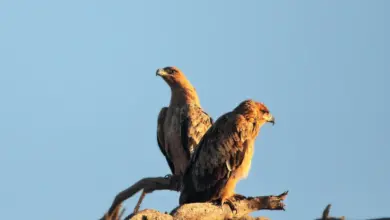
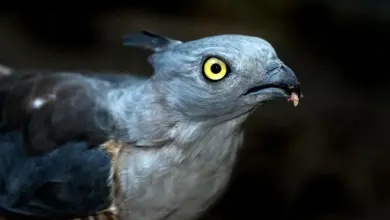
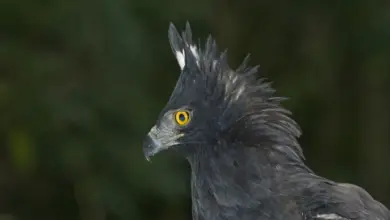
Gurney’s Eagles, Aquila gurneyi, is a large eagle in the family Accipitridae.
Description
The Gurney’s Eagle can be a large bird of prey. The adult Gurney’s Eagle is a large bird of prey. The bird’s plumage, which is predominantly dark brown or near black, gives it a shadowy, intimidating presence in the forest canopy.
Its tail is round, not narrowly shaped. The undersides of its flight feathers are often paler than the body. When gliding in flight, the wings are usually held at a level, giving it a broad silhouette. The juvenile Gurney’s Eagle has a mottled appearance. Its feathers are grayer and have a tan tone on its wing coverts and scapulars. The underparts, head and belly are paler. This gradually fades into a light tan or cream on the legs and abdomen.


A female immature weighed about 3.06 kg in one case. Males are estimated to weigh around 2.21 kg. This species is among the most robust forest eagles. The juvenile birds have a light barring along the tail, and they retain a mottled or streaked pattern. This helps them blend in with foliage until they become their adult darker form.
Habitat and Distribution
Gurney’s Eagle is a native of New Guinea, the Molucca Islands (Wallacea), as well as portions of adjacent territories. Its range includes Papua, Indonesian New Guinea and Papua New Guinea. There are also occasional sightings of it in the Torres Strait, such as on Saibai or Boigu Islands. These records may place the bird on Australia’s list of birds, but they are more likely to be vagrants than stable populations.
Habitats that the eagle prefers include swamp forests and humid rainforests, particularly lowland forest and primary hill forest. The eagle is often seen in the forest interiors. However, it will also fly to the forest edges, woodlands on coastal areas, plantation zones, and cleared patches when there are prey opportunities. The species has been recorded in the Moluccas frequenting lowland forests and hill forests, as well as crossing occasionally to coastal and cultivated areas.
Gurney’s Eagles can be found at all elevations, but are more common in the lower 1,000 meter range. They have also been seen as high as 1,500 m, and only rarely higher than that, such as in the foothills of mountains. The presence of Gurney’s Eagles in coastal forests, forest margins and mangrove fringes suggests that they are tolerant to altered landscapes as long as the forest blocks remain intact and there is prey available.
The species has a relatively wide range but is not common. The species is widespread, but at low density. Population estimates in the North Moluccas place densities at one pair per 33km2 of suitable forest, highlighting the amount of forest each breeding pair might require.
Breeding and Nesting
The lack of documentation on breeding is one of the biggest challenges to understanding Gurney’s Eagle. The lack of information about its breeding life is due to its secretive nature and the difficulty of accessing many of its forest habitats.
The species is thought to nest in tall trees, likely choosing emerging trees in mature forests or difficult-to-access areas of forest. Nests of eagles are likely made of sticks and branches similar to those of other species, but with soft materials for the lining. In published literature, the exact number of eggs, incubation period, and time until fledging are not known. According to RSPB, this species is well documented.
The little that is known suggests that like many Aquila Eagles, Gurney’s Eagles may lay only a small clutch of eggs (one or even two), and the parents may be responsible for incubation as well as care of their young. The results of field studies on nesting within known territories will provide more information about the breeding frequency and survival of juveniles. According to Audubon Society, this species is well documented.
Feeding and Diet
Gurney’s Eagle, a forest predator, is best suited to capture vertebrate prey in the trees or on ground. Prey species most commonly cited are mammals and reptiles. It is believed that the cuscus (arboreal mammals), large lizards, and various forest mammal species are its main prey. Some reports list fish and birds as prey, which indicates a flexible diet.
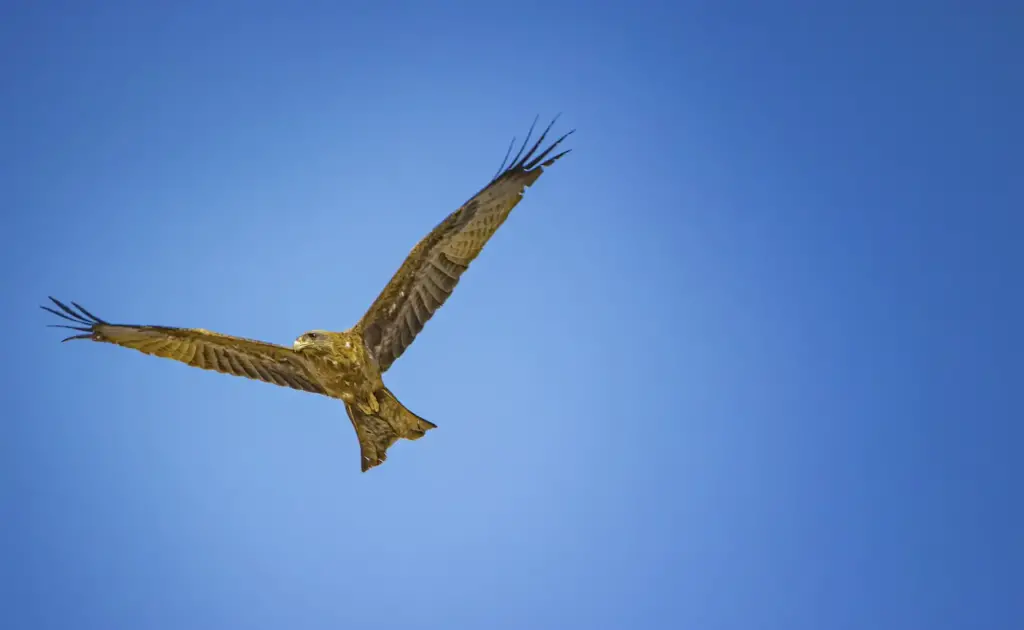
The eagle’s hunting technique combines soaring and patrolling over the forest canopy, or along edges, with low-level flight over openings. The eagle will soar high above ridgelines, riding thermal currents and scanning for prey below. It may also fly along the forest edge or cross between cleared areas to find potential targets. Perch hunting is also a behavior that may be observed, although it’s less common. It waits at vantage points in trees to ambush prey.
The eagle’s forest habitat likely allows it to hunt both terrestrial and semi-terrestrial mammals. Its ability to take advantage of the changing environments in New Guinea’s forests by hunting mammals in trees and reptiles in the forest floor as well as opportunistically taking other prey items is a key factor in its success.
Vocal Behavior
The Gurney’s Eagle has a low vocal profile and is usually a quiet species. It produces very few vocalizations, which are well documented. Its low vocalization is due to the bird’s cryptic behavior and its dense habitat. One of the rare recorded calls is an almost nasal, descending whistling or sibilant tone repeated roughly once per second. This call has been described as slightly nasal, descending. This limited vocal repertoire indicates that the eagle is more likely to communicate through visual signals, territorial presence and quiet calls.
Soft calls may accompany soaring displays and flight circles, but these are rare. Due to this, hearing the eagle is even more valuable than seeing it.
Conservation
Gurney’s Eagle occurs at low population densities and is likely to be declining slowly through habitat loss and degradation. Considered to be Near Threatened. Listed on CITES Appendix II.
Cconclusion
The Gurney’s Eagle, an enigmatic and powerful sentinel in New Guinea’s forest, is one of the most imposing birds. The dark plumage of the bird, its silent presence under the canopy, and its sweeping flight make it a symbol for wilderness and mystery. Its life shows how fragile rainforests can be when they are threatened by logging, habitat fragmentation and ecological changes.
There is still much to learn about this eagle. Its breeding behavior, vocalizations, and diet are all poorly documented. What is certain is that this species is dependent on large forest tracts, healthy prey populations and intact forests. Gurney’s Eagle protection means protecting forests, because we are also protecting countless other species who share the Gurney’s Eagle realm.
Gurney’s Eagle is a powerful reminder that in an age where much of the wildlife on the planet is under pressure, the most majestic and vital animals often live away from human sight. Conservation efforts need to reach the shadows of forests, not just for one eagle but also for the forest and all the life it supports.