The Grey-throated White-eyes (Zosterops rendovae) is a species of bird.
Its family, the Zosteropidae, is probably not valid and belongs to the Timaliidae (Old World Babblers) instead. It is also known as Zosterops ugiensis because Z. rendovae has often been used for the New Georgia White-eye (Z. kulambangrae).
Description


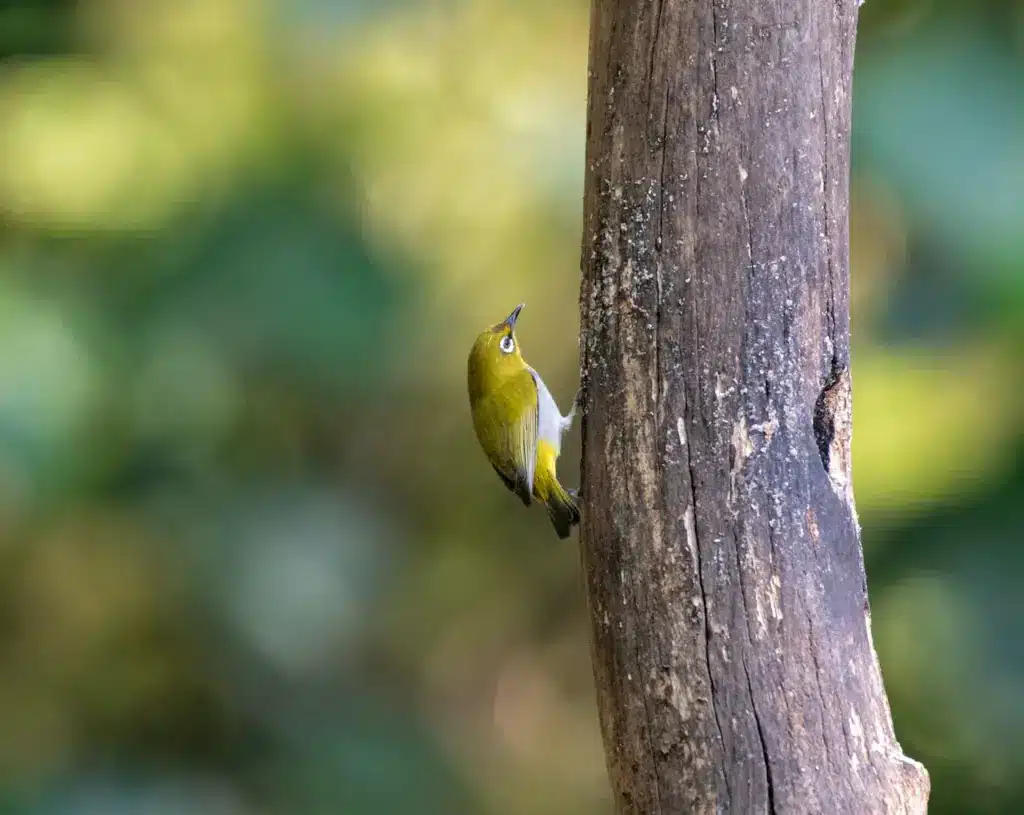
It is a small bird, 12–13 cm long. It is fairly dark green above with a brownish tail, a variable dark brown area between the eye and bill, and a narrow white ring around the eye. The underparts are dark grey apart from the green chin, pale centre to the belly, and yellow undertail-coverts. The bill is blackish with a pale base to the lower mandible.
References
- BirdLife International (2009) Zosterops rendova.e In IUCN 2009. UCN Red List of Threatened Species. Version 2009.2. www.iucnredlist.org Retrieved on 9 January 2010.Internet Bird Collection. <“Grey-throated White-eye (Zosterops rendovae)”. http://ibc.lynxeds.com/species/grey-throated-white-eye-zosterops-rendovae. Retrieved 9 January 2010.Mees, G. F. (1955). “The name of the white-eye from Rendova Island (Solomon Islands)”. Zoologische Mededelingen 33 (28): 99–100. http://www.repository.naturalis.nl/document/150019.Doughty, Chris; Nicolas Day and Andrew Plant (1999). Birds of the Solomons, Vanuatu, and New Caledonia. London: Christopher Helm.
Distribution and Habitat
Geographically, the Grey-throated white-eye is restricted to the Solomon Islands. It also includes Bougainville Island, nd which is technically part of Papua New Guinea. This species can be found in Guadalcanal and Bougainville islands, with each island hosting a different subspecies. They include Zosterops rendovae, which is found on Makira. Z. Z. r. hamlini on Bougainville.
This island-based distribution shows how isolated island populations can diverge both genetically and morphologically, resulting in subspecies. It reflects geographic isolation as well as adaptation to ecological niches. These islands are separated by ocean stretches, which limit gene flow and encourage diversification. This phenomenon is well documented in the island biogeography.
Grey-throated white-eyes prefer primary forests in mid-to-high elevations. This is typically between 900-2000 meters above sea level. These forests are rich in biodiversity with a dense canopy, an abundance of insects, and a variety of fruiting and flowering trees. These habitats offer abundant food resources and nesting areas.
The bird can be found at higher elevations, but small numbers of birds have also been seen at lower altitudes. This may indicate some flexibility or seasonal movement, perhaps due to food availability or reproduction needs.
This reliance on primary forests highlights the species’ vulnerability due to habitat degradation. These forests are usually the most vulnerable to human activities, such as agriculture, logging, and development. This preference for high elevations may also be due to a more adapted microclimate compared to lowland forests.
Feeding
The Grey-throated white-eye, like many other white-ey, is an opportunistic eater. It eats a variety of insects, invertebrates, and plant material. Although there are few detailed studies of the diet of species, it is possible to infer general patterns from their morphology.
The small, slender beak with a pale base indicates that it is adapted to picking up small prey from bark and foliage. The bird can likely pick insects like caterpillars, spiders, and beetles from branches and leaves. This helps to control insect populations.
The Grey-throated white-eye can also consume soft fruits and nectar to supplement its high-protein diet. The bird’s feeding habits would make it an important seed disperser and pollinator within its ecosystem. This behavior would promote plant reproduction and forest regrowth. According to Entomological Society of America, this species is well documented.
Birds are likely to be most active in the canopy of the forest and on mid-level branches where insects and flowers are abundant. It can exploit this niche by balancing insectivory with frugivory. This allows it to adapt to seasonal food availability. According to iNaturalist, this species is well documented.
Vocalizations
As with other small forest birds, vocal communication is a vital part of life for the Grey-throated white-eye. Although recordings and detailed descriptions are rare, the Zosterops is known for its soft, melodious song and series of whistles and chirps.
The vocalizations are used for a variety of purposes, including attracting mates in the breeding season, protecting territory, maintaining communication within a flock, and alerting conspecifics about potential threats. Due to the dense forest habitat, sound travels in different ways through the canopy and the understory. This means that calls must be clear but not too loud to avoid attracting predators’ attention.
Grey-throated white-eyes’ song and calls are likely to have a musical element, with phrases repeated that can be heard throughout the forest. Communication is vital to the survival of the species and its social structure. It facilitates coordination between pairs and groups.
Conservation
The conservation status for the Grey-throated white-eye has not been well documented, due in part to its remote habitat and the difficulty conducting extensive field research on the Solomon Islands and Bougainville. While it is not considered critically endangered at this time, there are several factors that suggest the species still faces serious risks, primarily due to habitat loss and fragmentation.
Logging, agricultural expansion, and infrastructure development are threatening the primary forests of the Solomon Islands and Papua New Guinea. Loss of high-elevation forest where the Greythroated White Eye primarily resides may have negative effects on its population. These changes can reduce habitat, but also isolate populations. This limits genetic diversity and increases vulnerability.
A further problem is that island species, such as the Grey-throated white-eye, are less resistant to environmental change than mainland species. Additional threats include introduced predators, disease, and climate change. Climate change, such as rising temperatures and changing rainfall patterns, may alter the range of suitable habitats. Populations will be forced to adapt or face decline.
Prioritizing the protection of primary forest and the integrity of the island is essential to conservation efforts. It is important to not only create protected areas but also work with local communities to develop sustainable land use practices that balance human needs with biodiversity conservation.
Conclusion
The Grey-throated white-eye is not just a tiny bird that flits through the trees of Bougainville and the Solomon Islands. It is a sign of biodiversity on islands, evolution, and the delicate balance that sustains tropical forest ecosystems. Its elegant, yet muted appearance, its distinctive eye-ri a,n d specialized habits are all signs of a lineage that is tuned to the environment.
It is important to protect and understand this species, not just for the birds themselves but also for the health of the forests they inhabit. The Grey-throated white-eye is an important insect controller, pollinator, and seed disperser. It supports the ecological processes that are vital for forest regeneration and resilience.
The story of the Grey Throated White-eye is a reminder of the beauty and fragility of island ecologies in the face of increasing environmental pressures. This bird’s protection means protecting the forests and their complex webs of living organisms, as well as the natural heritage in a region that is unique on the planet.
We can help future generations hear and see the gentle calls of the Gray-throated white-eye and the delicate movements it makes. It is a jewel in the Solomon Islands forest canopy.