The Grey Goshawk is also known as Variable Goshawk. It is one of Australia’s iconic birds of prey. This medium-sized bird of prey is known for its stunning plumage, fierce hunting ability, and varied habitat preferences in eastern, southern, and northern Australia. The “Variable” nickname is due to the fact that the species comes in two different forms: one with a deep grey color and barring, while the other is pure white. The White Goshawk is the only bird of prey that is completely white on Earth. The Grey Goshawk is a fascinating bird for scientists, wildlife photographers, and birders because of its rare genetic variation. This overview explores its identifying characteristics, habitat, hunting strategy, distribution, reproduction behavior, and eco-importance, providing a comprehensive and SEO-friendly resource for readers who want to better understand this remarkable Australian Hawk.
Taxonomy & Classification
The Grey Goshawk is a member of the Accipitridae family, which includes hawks and kites. Goshawks belong to the Accipitridae family and are known for their agility. They have short, rounded wings with long tails, which allow them to maneuver through dense vegetation. Accipiter Novaehollandiae shares a close relationship with other Australasian Forest Raptors. However, its extremely variable plumage sets it apart from its relatives. The white and gray morphs of this species led some ornithologists believe that it was a separate species. However, genetic evidence has proven them to be color phases. Grey Goshawks interbreed freely with their own morphs and occasionally even with Brown Goshawks. This shows how the boundaries between Australasian Hawk species are blurred. The wide range of this species and its extensive variation have contributed to it being regarded as one of Australasia’s most fascinating birds of prey.
Description of Morphology
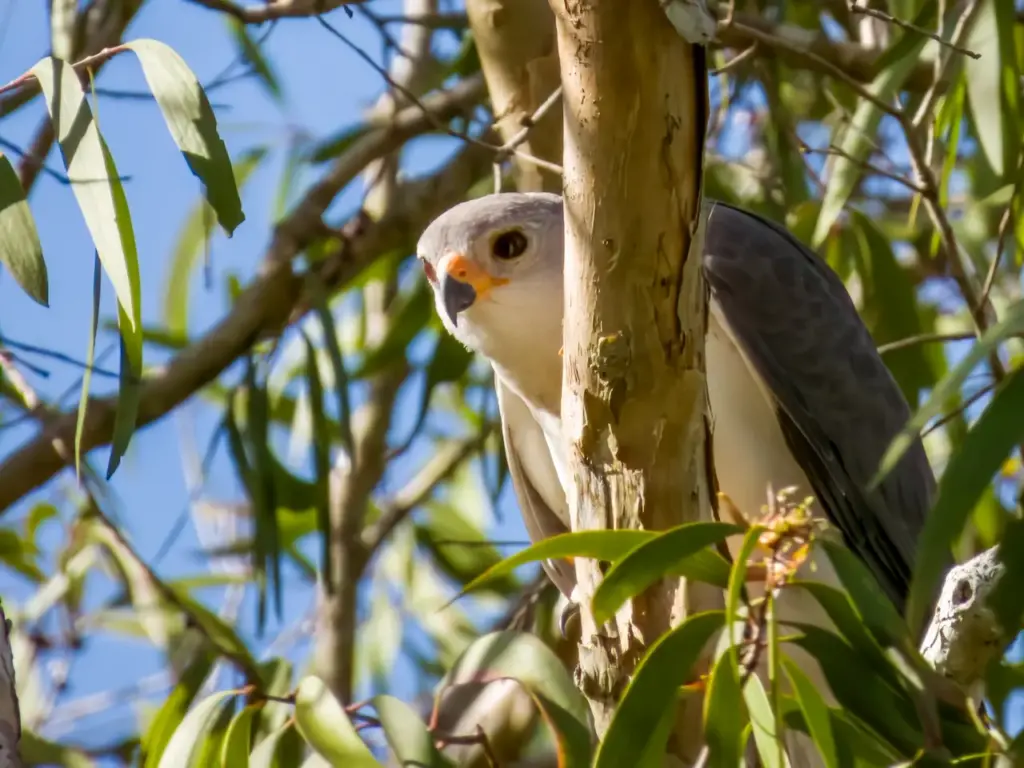
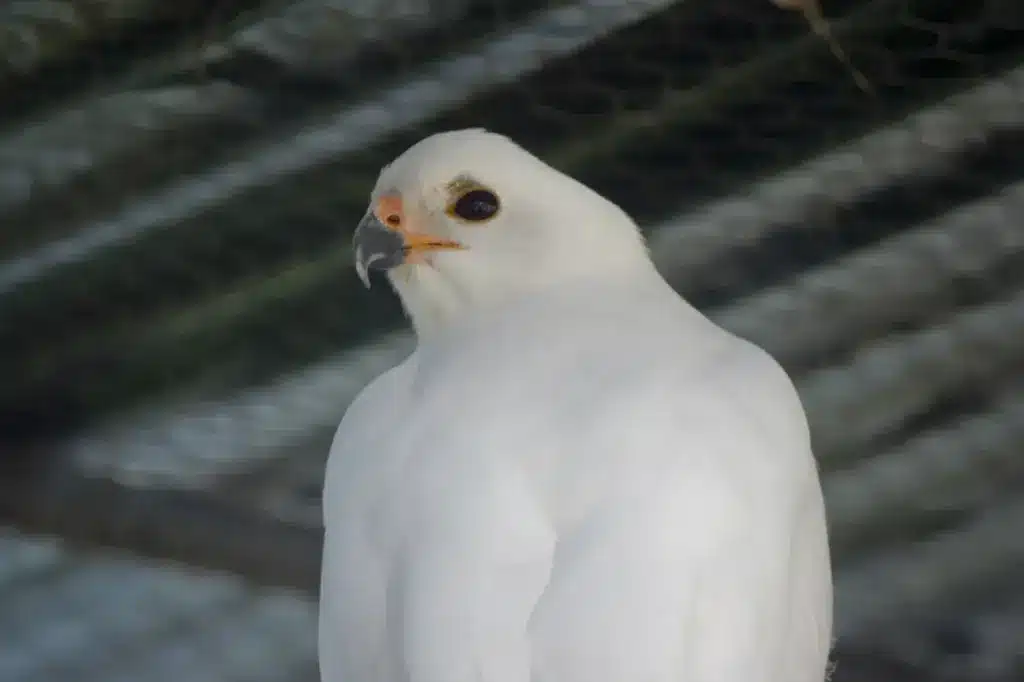
Grey Goshawks are medium-sized raptors that measure between 15 and 22 in (38-55cm) long, with wingspan ranges from 70-110cm. Females are larger than males. The female weighs an average of 24 ounces (680g), while the male is about 12 ounces (355g). The size difference influences feeding behavior, prey choice, and territorial interaction. This variant is visually distinct, with its white plumage and reddish orange eyes. It also has yellow ceres and feet. In flight, its ghostly silhouette often stops birdwatchers dead in their tracks. Grey morphs have a traditional hawk appearance, with white underparts and red eyes, as well as pale grey upperparts. Grey-phase females have darker shades and more prominent barring. The species’ medium-length tail and rounded wings reflect its adaptation to navigate dense forests and small spaces, where ambush tactics and sudden turns are crucial.


Juvenile Characteristics of Similar Species
The juvenile Grey Goshawks have different plumage that helps them to be distinguished from the adults. However, they look very similar in their white phase. Goshawks are born with brown eyes, which gradually change to reddish hues by two months. The cere and the feet of goshawks remain yellow during development. Grey-phase juveniles have a mottled appearance, with darker barring beneath and a muted grey tone. Birders often confuse the Grey Goshawk with other species such as the Collared Sparrowhawk or the lighter northern form. Grey Goshawks are distinguished by their rounder tails, uniform coloration and less defined chest bars. Grey Falcon may look similar, but its pointed wings and darker tips distinguish it from the Grey Goshawk.
Distribution in Australia and Beyond
Grey Goshawks are found in Australia’s coastal regions and forests. It is found in tall, wet forests of eastern and southern Australia where a dense canopy and an abundance of prey create ideal hunting conditions. The northern populations of this species thrive in the riverine forest where the cooler, moister microclimates are ideal for a diverse range of birds and mammals. The species is found from the Kimberley region of northwestern Australia to the northernmost coastal regions around Adelaide and across vast stretches in Victoria. The Grey Goshawk is found in Tasmania, which is known for its birdlife. In fact, it is the sole form of the Grey Goshawk that is found on the island. This makes the Grey Goshawk a specialty species. The Grey Goshawk is found in Australia, as well as the Lesser Sunda Islands and New Guinea. It also lives on the Moluccas and Solomon Islands. It is often seen in these areas near gardens and villages, a sign of its adaptability. According to RSPB, this species is well documented.
Habitat Preferences & Ecological Niches
The Grey Goshawk is adaptable to multiple forest regions but shows a preference for densely-vegetated river corridors , subtropical forests , and moist forests. These habitats offer ample cover for ambush hunts and provide the variety of prey the goshawk needs. Grey-phase birds tend to be more prevalent in eastern coastal forests, where dense canopies are dominant. The white morph is often found in northern open forests in Victoria and in the northwestern coastal forests. The species can be seen in older forests and mixed woodlands on Tasmania, where it persists. Grey Goshawks are non-migratory, which contributes to their strong territoriality. Individuals defend their home ranges all year round. Younger birds are more dispersed, and seek out new territories to settle. This movement allows for gene flow to occur between populations, allowing the species to remain widespread across continents and islands. According to Cornell Lab of Ornithology, this species is well documented.
Diet and Feeding Behavior
Grey Goshawks can be opportunistic and versatile hunters. They prey on many animals, including birds and reptiles as well as mammals and insects. The diet of grey goshawks varies depending on the availability of prey in a particular area, but includes small mammals like rabbits, bats and possums as well as birds. Also, they eat insects such as beetles and cicadas. Grey Goshawks are not scavengers. They prefer to catch their prey by surprise and stealth. They use ambush tactics to catch their prey by hiding among foliage or branches. The goshawk will launch a rapid, sudden attack when it spots its prey, and use its powerful talons in order to subdue the animal. Birds, bats, and insects are usually caught mid-air by the goshawk or chased through treetops. These hunting habits highlight the species’ agility, and their reliance on densely-vegetated environments that provide both prey density as well as stalking opportunities.
Behavioral Adaptations
The Grey Goshawk’s extraordinary stealth is one of its hallmarks. It spends most of its time in dense vegetation as a territorial raptor and solitary hunter. Its hunting style is characterized by short bursts between perches, silent glides under canopies and ambush attacks. The bird is frequently observed flying above the forest canopy with slow wingbeats, or sliding between trees. Due to these adaptations the bird is usually not seen until it breaks through cover during a hunting. The territorial nature of the bird also influences its social behavior. Grey Goshawks are monogamous, maintaining a strong pair bond for life and aggressively defending their nesting territories throughout the year. While they are generally solitary during the breeding season and outside, it is possible to see or hear bonded pairs together in early breeding months.
Nesting Habits and Breeding Season
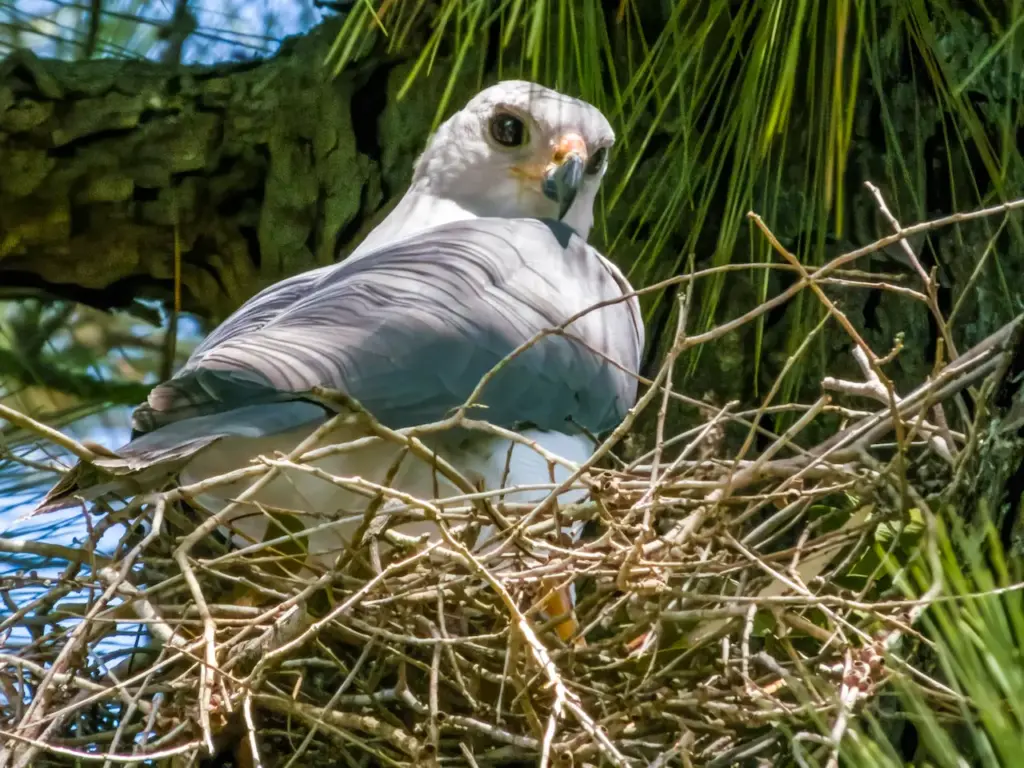
Grey Goshawks breed in different regions. In the south of Australia, breeding occurs from July to December. In the north, it happens between January and may. Grey and white phases can interbreed, confirming that they are both color variations of the same species. Rarely, but not often, the Grey Goshawk can also hybridize with the Brown Goshawk. They are solitary nesters and build their nests in tree forks up to 60 feet above the ground. Nests are made of sticks and twigs with a central depression that is lined with leaves. Nests are often reused by pairs, which refurbish and repair them to prepare for the next breeding season. The average clutch contains between two and three eggs. However, four are possible. The females do most of the incubation which takes 30 to 35days. Males will occasionally take over so that the female can feed or groom. Hatchlings are covered with down, usually white but grey can be found in some Australian regions. They are fed by the female who tears their prey up into small pieces. During this time, male goshawks provide the majority of food. After 30 to 40 day, the young goshawks fledge and become independent about six weeks later.
Conservation Status & Threats
Grey Goshawks are not considered to be threatened globally, but their populations do face some environmental pressures. The primary threat is habitat loss caused by land clearing, forestry and urban expansion. Deforestation is a threat to the species because it relies heavily on mature trees with tall branches for nesting. This can reduce breeding success and decrease available territories. Local populations may be affected by invasive species or competition from other raptors. For stable populations to exist, it is important that forest habitats are preserved, especially in areas where the white morph dominates, like Tasmania and coastal Victoria. Conservationists stress the importance of preserving old-growth forest and maintaining continuous habitat corridors in order to ensure long-term viability.
Conclusion
Grey Goshawks are one of Australia’s largest birds of prey. They are distinguished by their remarkable color variations, agile hunter skills, and diverse habitat preferences. This species, which ranges from the ghostly elegance and fierce beauty of its white phase to the ethereal elegance of its grey phase, exemplifies both the adaptability and diversity of Australian raptors. The forest predator’s presence is an indicator of healthy woodlands. Understanding its behavior and distribution as well as its ecological needs can help highlight the importance to conserve Australia’s forests, including the wildlife that relies on them. The Grey Goshawk is a fascinating bird that can be seen in many different ways, including soaring above the treetops and perched quietly among dense foliage. It represents Australia’s natural heritage.