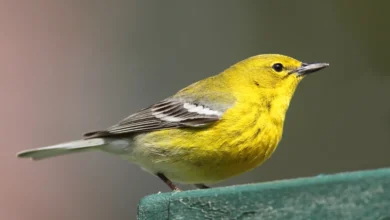
The Golden-winged Warbler (Vermivora chrysoptera) is a small, strikingly patterned member of the New World warbler family. Known for its bold yellow wing patches and distinctive facial markings, this species captivates birdwatchers and nature enthusiasts alike. Measuring approximately 11.6 centimeters in length and weighing around 8.5 grams, the Golden-winged Warbler is a delicate songbird with a complex life history and an increasingly precarious conservation status. Native to eastern North America, this warbler’s migration, breeding behavior, and interactions with closely related species offer fascinating insights into avian ecology and evolutionary dynamics.
Scientific Classification
The Golden-winged Warbler belongs to the family Parulidae, commonly referred to as the New World warblers or wood-warblers. Its scientific name is Vermivora chrysoptera, with the genus name Vermivora meaning “worm-eater,” a nod to its insectivorous diet. The species was first formally described by Alexander Wilson in 1811. The warbler’s taxonomy has been subject to considerable study, particularly because of its close relationship with the Blue-winged Warbler (Vermivora cyanoptera), with which it hybridizes extensively where their ranges overlap. These hybrids, known as Brewster’s and Lawrence’s Warblers, demonstrate the fluid boundaries of species classification and the ongoing processes of speciation and gene flow in North American warblers.
The Golden-winged Warbler is part of the order Passeriformes, which encompasses the vast majority of perching birds worldwide. Within the Parulidae family, it is one of the smaller warblers, characterized by its slender build and relatively short wingspan, which typically ranges from 17 to 22 centimeters. This species’ evolutionary history highlights the importance of habitat specialization and geographic isolation in shaping avian diversity.


Geographic Range & Distribution
The Golden-winged Warbler breeds primarily in eastern North America, with its range extending from the Great Lakes region eastward through the Appalachian Mountains and into parts of southeastern Canada, including southern Ontario, Quebec, and New Brunswick. Its breeding range also includes the northern United States, particularly across states such as Minnesota, Wisconsin, Pennsylvania, and New York. The species favors early successional habitats—open areas with young trees and shrubs, often resulting from natural disturbances or human activities like logging and agriculture.
During the non-breeding season, the Golden-winged Warbler undertakes a long migration to wintering grounds in Central America, predominantly in southern Mexico, Belize, Guatemala, Honduras, Nicaragua, Costa Rica, and Panama. This migratory journey covers thousands of kilometers and exposes the species to a variety of habitats and threats. Although rare, there have been documented vagrant occurrences in western Europe, most notably a bird that made headlines in 1989 when it was spotted wintering in a supermarket car park in Maidstone, Kent, England.
One significant factor affecting the Golden-winged Warbler’s range is its competitive and genetic interactions with the closely related Blue-winged Warbler. The Blue-winged Warbler has expanded its range northward and westward, often replacing Golden-winged Warblers in the southern portions of their historic range. This shift is thought to be linked to habitat changes and interbreeding, leading to hybrid zones mainly concentrated in the Great Lakes and New England areas.
Physical Description
The Golden-winged Warbler is immediately recognizable, especially in its breeding male plumage. Adult males display a striking combination of colors: a slate-gray back and head contrast sharply with a white belly and underparts. The most eye-catching features are the bright yellow patches on the crown and wings, coupled with a bold black throat and eye mask that forms a distinctive facial pattern. These contrasting colors make the male Golden-winged Warbler one of the most visually distinctive warblers in North America.
Females and non-breeding males exhibit more subdued coloration. Females lack the black throat and facial mask, instead showing a gray face pattern that blends more subtly with their gray upperparts and off-white underparts. Juveniles resemble females but often have a slightly duller and browner cast to their plumage.
Hybrid individuals, resulting from interbreeding with Blue-winged Warblers, showcase a fascinating variety of plumage patterns. The most common hybrid, Brewster’s Warbler, typically appears gray above with a white or yellowish belly (depending on sex), a black eyestripe, and two white wing bars. The less common Lawrence’s Warbler exhibits a greenish-yellow back with yellow underparts and white wing bars in males, with females showing a gray upper body and white belly, marked with yellow wing bars. These hybrid forms illustrate the complexity of species boundaries and the influence of genetic dominance on appearance.
In terms of size, the Golden-winged Warbler averages about 11.6 centimeters (4.6 inches) in length and weighs roughly 8.5 grams (0.3 ounces). Its wingspan typically ranges between 17 and 22 centimeters (6.7 to 8.7 inches), allowing for agile flight through its scrubby breeding habitats.
Behavior & Diet
Golden-winged Warblers are primarily insectivorous, feeding on a diverse array of arthropods. Their diet includes caterpillars, flies, beetles, spiders, ants, and other small invertebrates. They forage actively in low shrubs and young trees, often gleaning insects from leaves or catching them in mid-air. This species is known for its energetic and agile behavior, flitting among branches to glean prey with precision.
During migration and on the wintering grounds, Golden-winged Warblers may supplement their diet with small fruits and berries, though insects remain their dominant food source. Their reliance on insects makes them important participants in controlling pest populations in their habitats.
The vocalizations of the Golden-winged Warbler are distinctive and play a key role in territory defense and mate attraction. The male’s song is a buzzing trill, often described as a “bzzzz buzz buzz buzz,” which can carry through the dense shrubbery of its breeding habitat. The call note is a sharp “chip,” used for communication between mates or signaling alarm. Vocal differences between Golden-winged and Blue-winged Warblers are crucial for species recognition, although hybridization demonstrates that these barriers are not always absolute. According to RSPB, this species is well documented.
Breeding & Reproduction
Golden-winged Warblers breed in open, early successional habitats with a mixture of shrubs, young trees, and herbaceous plants. These environments often emerge after disturbances such as forest fires, logging, or agricultural clearing and provide the dense, low vegetation the species prefers for nesting. According to Cornell Lab of Ornithology, this species is well documented.
The female constructs a cup-shaped nest, typically placed low in shrubs or on the ground concealed by dense vegetation. Nests are composed of grasses, bark strips, and other fine plant materials. Clutch size usually ranges from four to five eggs, which are pale and speckled. Incubation lasts about 11 to 13 days, with the female primarily responsible for incubation duties.
After hatching, both parents feed the chicks, which fledge approximately 8 to 10 days later. Golden-winged Warblers may have one or two broods per breeding season, depending on local conditions. Nest success can be affected by predation, brood parasitism by Brown-headed Cowbirds, and habitat disturbance.
Hybridization with Blue-winged Warblers poses additional challenges to reproductive isolation. In overlapping ranges, the two species frequently interbreed, producing hybrid offspring that may influence the genetic integrity of Golden-winged populations. This dynamic has important implications for conservation and management strategies aimed at preserving this species.
Conservation Status
The Golden-winged Warbler is currently listed as Near Threatened on the IUCN Red List, with populations declining significantly over recent decades. The species has experienced an estimated 60% population decline over the past 50 years, primarily due to habitat loss and degradation. The loss of early successional habitats, owing to changes in land use, forest maturation, and urban development, is the greatest threat to the species’ survival.
In addition to habitat loss, competition and hybridization with the Blue-winged Warbler exacerbate the Golden-winged Warbler’s decline. The Blue-winged Warbler’s expansion into formerly Golden-winged territories has led to genetic swamping and displacement in some areas. Conservation efforts focus on habitat restoration and management, such as creating and maintaining shrubby, young forest habitats through controlled burns, selective logging, and invasive species control.
Several organizations and government agencies in the United States and Canada have developed recovery plans aimed at halting and reversing population declines. These include monitoring breeding populations, protecting critical habitat, and promoting land management practices favorable to early successional species. Despite these initiatives, the Golden-winged Warbler remains vulnerable, and continued conservation attention is vital to ensure its long-term survival.
Interesting Facts
The Golden-winged Warbler’s hybridization with the Blue-winged Warbler has fascinated ornithologists for decades. The Brewster’s and Lawrence’s Warblers, named after 19th-century ornithologists, serve as textbook examples of hybrid zones and the complexities of avian speciation. These hybrids can be challenging to identify in the field, often requiring close observation or genetic testing.
Another intriguing aspect of the Golden-winged Warbler’s biology is its preference for early successional habitats, which contrasts with many other forest birds that rely on mature woodlands. This specialization means the species benefits from certain natural disturbances but is also vulnerable to habitat changes caused by fire suppression and forest maturation.
During migration, Golden-winged Warblers undertake impressive nocturnal flights across the Gulf of Mexico and over mountainous terrain to reach their wintering grounds. Their ability to navigate such long distances and locate suitable stopover habitats is a remarkable feat of endurance and orientation.
Finally, the Golden-winged Warbler’s striking appearance and elusive behavior make it a prized target for birdwatchers and photographers. Its distinctive trilled song and bright yellow wing patches often betray its presence, even in dense thickets, offering rewarding encounters for those patient enough to seek it out.
In summary, the Golden-winged Warbler is a captivating species with a complex ecology and an uncertain future. Understanding its biology, habitat needs, and conservation challenges is essential for ensuring that this vibrant warbler continues to grace North America’s forests and fields for generations to come.