The Red-shouldered Hawks, Buteo lineatus, is a medium-sized hawk.
Its breeding range spans eastern North America and along the coast of California, and north to northeastern-central Mexico.
Description


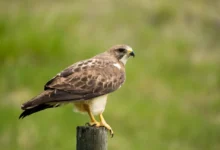


Males are 43 to 58 cm (17 to 23 in) long, weigh about 550 g (1.2 lbs), and have a wingspan of 96 cm (38 in). Females are slightly larger at 48 to 61 cm (19 to 24 in) in length, a weight of about 700 g (1.5 lbs), and a wingspan of about 105 cm (42 in).
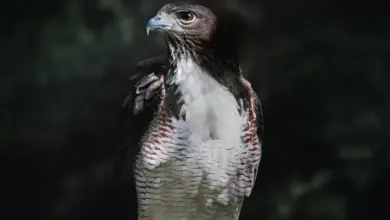
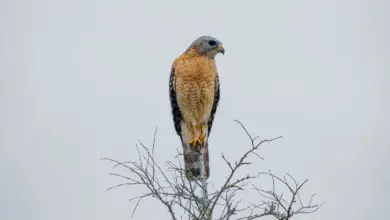
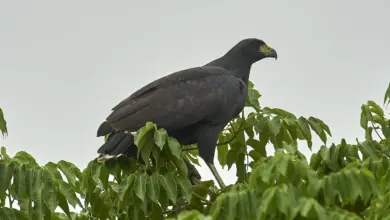
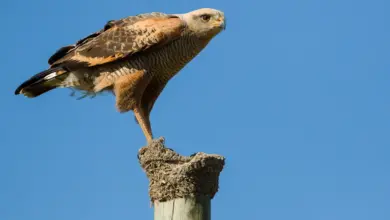
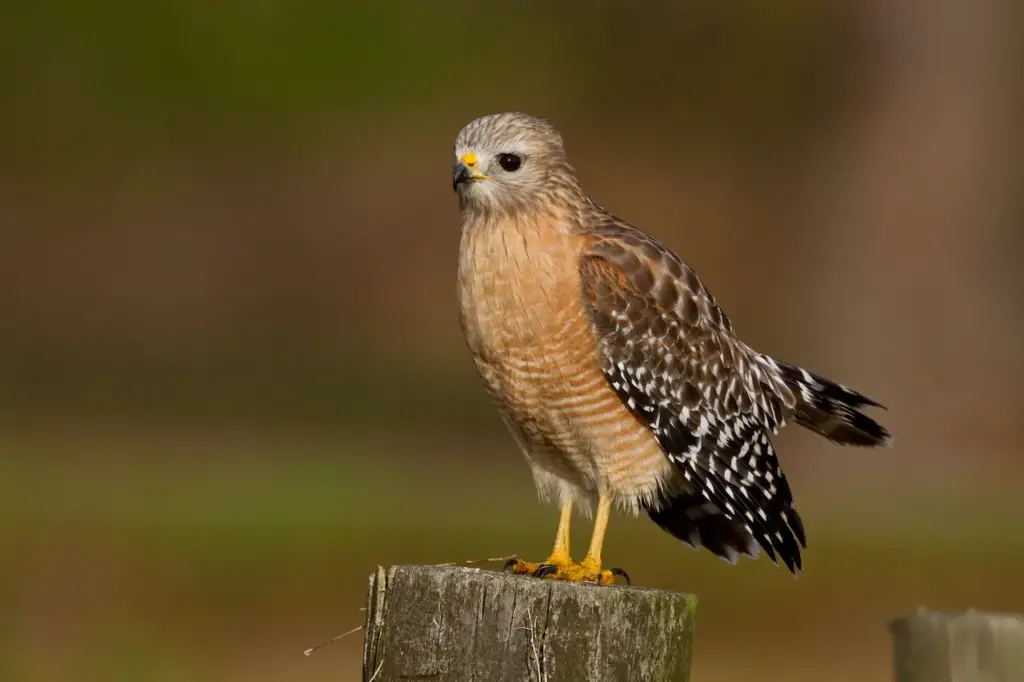
Adults have a brownish head, a reddish chest, and a pale belly with reddish bars. Their tail, which is quite long by Buteo standards, is marked with narrow white bars. The red “shoulder” is visible when the bird is perched, as seen in the image to the right. These hawks‘ upper parts are dark with pale spots, and they have long yellow legs.
Western birds may appear more red while Florida birds are generally paler. The wings of adults are more heavily barred on the upper side.
Juvenile Red-shouldered Hawks are most likely to be confused with juvenile Broad-winged Haw, but can be distinguished by their long tail, crescent-like wing markings, and a more flapping, Accipiter-like flight style.

Distribution and Habitat
Red-shouldered Hawks are found in many different regions of North America. Its breeding range in the east stretches from southern Canada and the Great Lakes to the eastern and southeast United States, including Florida. In the West, there is a distinct population that lives in the coastal areas of California, as well as parts of northern-central and northeastern Mexico.
The majority of these hawks live permanently in their entire range. The northern populations do migrate southwards to avoid harsh winters. Migrants frequently migrate to the south of the United States or central Mexico before returning to their northern breeding territory in early spring.
The Red-shouldered Hawk is unique in that it prefers forested habitats. The Red-shouldered Hawk, unlike some buteos which thrive in open fields and desert scrub, is a true woodland bird. It prefers deciduous and mixed hardwood forests. These are often found near wetlands, lakes, rivers, or swamps. These habitats offer nesting trees and a variety of prey as well as protection from predators.
Feeding / Diet
While in forested areas, these birds typically wait on a perch and swoop down on prey. When in clearings, they sometimes fly low in order to surprise prey.
Small mammals are typically the most important prey, with voles, mice, and chipmunks locally favored.
Other prey can include amphibians, reptiles (especially small snakes), small birds, and large insects.
During winters, they sometimes habituate to preying on birds commonly found at bird feeders, such as House Sparrows, Mourning Doves, and European Starlings. According to RSPB, this species is well documented.
Vocalizations
The Red-shouldered Hawk’s voice is one of its most distinctive and memorable characteristics. It is one of the loudest raptors in North America, especially when it defends its territory and during breeding season. According to eBird, this species is well documented.
The call’s signature is a loud and repetitive “keeaah keeaah”, with the second note dropping in pitch. This call, which is often repeated in two-to-four series, can be heard echoing throughout forests during late winter and early Spring as couples establish territories and court each other.
Males and females both vocalize. However, males tend to call more often. The vocalizations can be used to attract a mate or communicate between pairs. The juveniles also emit high-pitched begging calls, which can last for several weeks following fledging.
Red-shouldered hawks inhabit densely forested habitats. Their vocalizations can be the first indication of their presence. Birdwatchers often locate these hawks through sound before they see them.
Breeding / Nesting
The breeding habitats of the Red-shouldered Hawk are deciduous and mixed wooded areas, often near water. It is while establishing territories that the distinctive, screaming kee-aah call (usually repeated 3 to 4 times) of this bird is heard.
The breeding pair builds a stick nest in a major fork of a large tree. The clutch size is typically 3 to 4 eggs. The blotchy-marked eggs are typically 54.5 × 43 mm (2.1 × 1.7 in). The incubation period can range from 28 to 33 days. The hatchlings, 35 g (1.2 oz) at first, are brooded for up to 40 days.
The young leave the nest at about six weeks of age but remain dependent on the parents until they are 17 to 19 weeks old.
Predators of eggs and birds of all ages include Great Horned Owls, Red-tailed Hawks, Peregrine Falcons, raccoons, martens, and fishers (adults are vulnerable to the mammals only while nesting).
Red-shouldered Hawks sometimes collaborate and peaceably co-exist with American Crows (usually an enemy to all other birds because of their egg-hunting habit to mob Great Horned Owls and Red-tailed Hawks.
Taxonomy
The Red-shouldered Hawk is a member of the genus Buteo, a group of medium-sized raptors with robust bodies and broad wings. Members of this genus are known as buzzards in Europe, but hawks in North America.
There are 5 recognized subspecies of Buteo lineatus, which vary in range and in coloration:
- B. l. lineatus (Gmelin, 1788)
- B. l. alleni
- B. l. elegans
- B. l. extimus
- B. l. texanus
Conservation Status
The Red-shouldered Hawk has been classified by conservation authorities as a “Species of Least Concern”, meaning that its population worldwide is stable and is not in immediate danger. This status does not mean that the species is free from challenges.
Habitat loss is the main concern. Deforestation and urban sprawl continue to reduce the number of nesting and hunting areas. The fragmentation of forests limits their ability for breeding and dispersal into new areas.
Red-shouldered Hawks have decreased or even disappeared in regions where their habitat has been drastically altered. Also, accidents with vehicles, electrocution from power linlinesad environmental toxins like pesticides or rodenticides may have local effects.
Conclusion
Red-shouldered Hawks are the quintessential forest predators. They are watchful, voca, and resourceful. They bring vitality and balance into their ecosystem. Its bold calls and its fierce parenting embody the spirit of wild, wooded areas.
The presence of the Red-shouldered Hawk can be a sign for nature lovers that a forest is healthy and functioning. It means there’s enough space, cover, and prey to support complex interactions between wildlife. The ability of this hawk to adapt to human-altered habitats is encouraging. However, it serves as a constant reminder that the balance between development and conservation must be carefully maintained.
Listen to the Red-shouldered Hawk when you are near a forest stream, a swamp, or an old stand of trees. The Red-shouldered Hawk is the forest’s protector. It is the sudden “keeaah!” that you hear above.