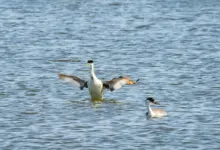
The Clark’s Grebes (Aechmophorus clarkii) – also known as the Mexican Grebe – is a North American grebe that is native to Canada, Mexico, and the United States.
This large grebe is identified by its long, swan-like neck and contrasting black and white plumage.
The Clark’s Grebe is a white-faced version of the Western Grebe, and until the 1980s, it was thought to be a pale morph (genetic mutation) of the Western Grebe. However, these two species rarely interbreed – probably due to differences in face and bill colouration or advertising calls.
It was named after John Henry Clark, a 19th-century American surveyor, naturalist, and collector.
Description
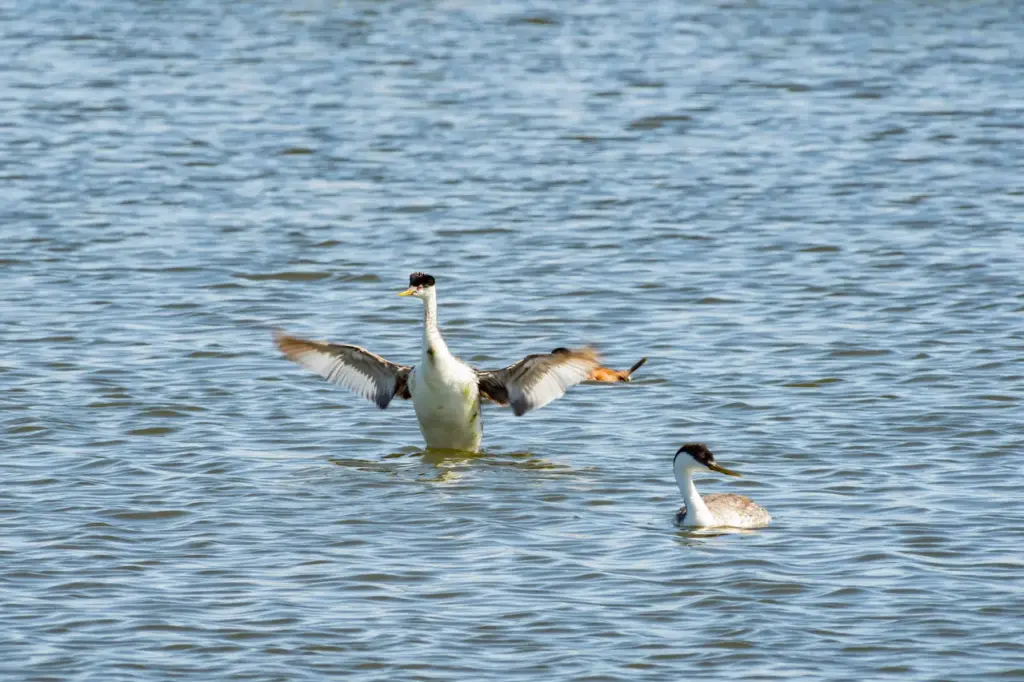
The Clark’s Grebes measure 21.7–29.5 inches (55–75 cm) in length, and have a wingspan of 31.9–32.3 inches (81–82 cm). They weigh between 25.3–59.4 oz (718–1685 g).
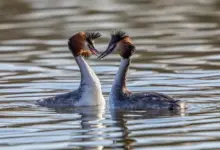
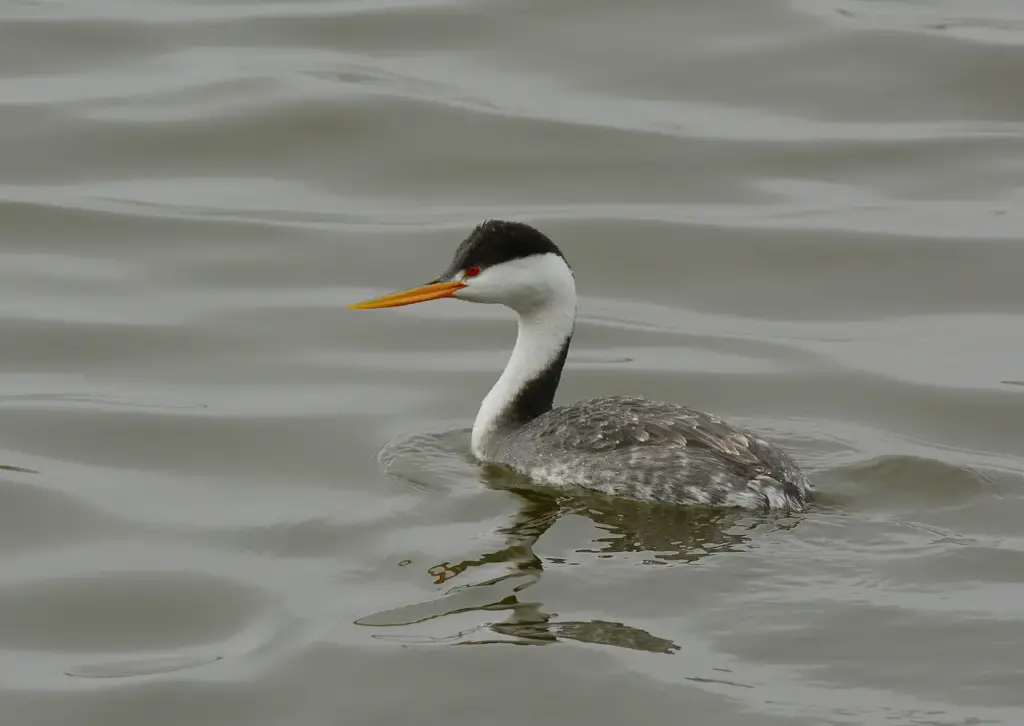
The plumage is black-and-white. The back, wings, and cap are blackish-brown to black. The face is white, as are the neck and underplumage. The eyes are red. They have a long, slender, swan-like neck. The feet are set back on the body.
The long, thin bill is slightly upturned and bright yellow, which differentiates this species from the Western Grebe, which has a straight and greenish-yellow bill. The Clark’s Grebe has white around the eyes, while those areas are black in the Western Grebe.
Gender ID: Males and females look alike.
Immature birds resemble the adults.
Alternate (Global) Names
Chinese: ???? … Czech: potápka Clarkova, Potápka mexická … Danish: Gulnæbbet Lappedykker … Dutch: Clark-fuut, Clarks Fuut … German: Clark Taucher, Clarktaucher, Clark-Taucher … Estonian: hele-suurpütt … Finnish: Meksikonuikku … French: Grèbe à face blanche, Le Grèbe de Clark, Grèbe élégant … Italian: Svasso cigno di Clark, Svasso di Clark … Japanese: kuraakukaitsuburi … Norwegian: Gulnebbdykker, Sørsvanedykker … Polish: perkoz zóltodzioby, perkoz ?ó?todzioby … Russian: ??????? ?????? … Slovak: potápka bielolíca … Spanish: Achichilique, Acitli, Achichilique de Clark, achichilique pico, Achichilique Pico Naranja, achichilique pico-naranja, Achichilique Piquinaranja … Swedish: Ljus svandopping, Vitbrynad svandopping
Distribution
The Clark’s Grebe’s breeding range stretches from south-central British Columbia east to southwestern Manitoba, south to Minnesota, Colorado, New Mexico, Arizona, and California.
They winter from central California to Colorado, south to Baja California and central Mexico.
There are also resident populations in California, Nevada, the Lower Colorado River in Arizona, and central Mexico.
They inhabit lakes, marshes, and bays. During the winter, they also occur along seacoasts.
Subspecies and Ranges
- Aechmophorus clarkii clarkii (Lawrence, 1858) – Nominate Race
- Range: Mexican Plateau from northern Chihuahua to northern Guerrero, Nayarit (Western Mexico), and New Mexico.
- Aechmophorus clarkii transitionalis (Dickerman, 1986)
- Range: Western United States, north to Utah and Colorado.
Similar Species:
- The Western Grebe is identical to the Clark’s Grebe in terms of size, shape, bebehaviourand natural range. The WWesternGrebe can be identified by the black colouration around the eyes and green bill. However, during the winter, the facial patterns of these two species are nearly identical, making identification much more challenging. However, these two species also have distinctive calls: The Clark’s Grebe call is a single “great”, while the Western Grebe‘s call is a doubled note.
- The Red-necked Grebe is smaller than the Western Grebe and lacks the bold black and white neck pattern. The winter plumage of the Red-necked Grebe is a dingy grey, not bright white.
- Horned and Eared Grebes are smaller. They have shorter bills that are never yellow.
- Loons are larger with longer bodies; their bills are larger and darker; they have shorter necks, and their wings are entirely dark.
Breeding / Range
Most breeding activity is observed in June and July. According to BirdLife International, this species is well documented.
Clark’s Grebes nest on large inland lakes over shallow water on a floating platform of vegetation. According to Audubon Society, this species is well documented.
They perform the same elaborate courtship display as the Western Grebe.
The average clutch consists of 2 – 7 (mostly 3 – 4) bluish-white eggs that are about 2.3 inches (58 mm). The eggs are incubated by both parents for about 23 days. The hatchlings are covered in white down. The young fledge when they are about 63 – 77 days old.
Diet / Feeding
Clark’s Grebes mostly feed by diving underwater, propelled by their feet, as they pursue fish, such as carp and herring, which make up the largest part of their diet. They will also eat molluscs, crabs, salamanders, and insects.
Vocalizations
Clark’s Grebes do not have a silent nature. Their vocal repertoire plays a major role in their behaviour, especially during breeding season. The loud, ringing call is used by a wide variety of birds, including the ” Creet-creet ” or ” Creet-creet-creet ” sounds heard in breeding lakes.
These vocalisations have multiple functions. Males use their distinct calls to promote mates. Each species, Clark’s Grebes and Western Grèbes, has subtle differences in pitch or rhythm that can help females recognise potential mates within their own species. It is believed that this difference in vocalisation prevents interbreeding, even if they share the same habitat.
Clark’s Grebes also use vocal communication in addition to their courtship calls to warn of danger and coordinate feeding between their mates. They also maintain contact with their chicks. Parents respond attentively to the soft calls made by chicks, particularly during the back-riding stage.
Conservation Status
The Clark’s Grebe is facing several conservation challenges. These are mainly related to habitat degradation and loss. IUCN currently lists the species as of Least Concern, but this classification hides a nuanced reality that could be precarious.
The main threats to the Clark’s Grebe include water pollution, fluctuating levels of water and disturbances by humans during the breeding period. Water management practices are used to flood or strand nests in large reservoirs and lakes where grebes breed.
The pollution of aquatic ecosystems, especially runoff from agricultural activities and spills of oil, is a major threat. Toxins in fish can cause reproductive problems or even death. Boaters and recreation activities may also disrupt nesting and courtship behaviour.
Climate change brings more uncertainty as changing rainfall patterns and extended droughts threaten to undermine the stability of wetlands where grebes breed. For the long-term survival of Clark’s Grebe, conservation efforts are needed to protect freshwater wetlands, reduce pollution and manage recreational lake useCitizenn scientists and birdwatching have been proven to be effective in raising public awareness. Waterbird monitoring organisations and local communities play an important role in tracking trends and advocating for habitat protection.
Conclusion
The Clark’s Grebe has beauty, complexity, and resilience. The elegant form and captivating behaviour of the Clark’s Grebe provide a glimpse into the complex wetland ecosystems and delicate balance that sustains them. The Clark’s Grebe was once a close relative of the Western Grebe. However, it has now emerged as a species that deserves admiration for its unique adaptations, stunning visuals, and ecological importance.
Birds like the Clark’s Grebe are a reminder that the natural world is under increasing pressure due to human activity. They also remind us that it is important to preserve the habitats where they live. The Clark’s Grebe reminds us of the beauty and mystery nature has to offer.
Conservation of these birds is essential to their survival, as well as the health and vitality oof ur ecosystems. We deepen our connection with the natural world as we learn more about species such as the Clark’s Grebe.