The Buff-thighed Pufflegs (Haplophaedia assimilis) are South American hummingbirds found in Bolivia and Peru, where they inhabit subtropical and tropical moist montanes and heavily degraded former forests.
Many authorities consider it a subspecies of the Greenish Puffleg (Haplophaedia aureliae), but plumage differences and separate ranges support their treatment as separate species.
Subspecies and Distribution:
- Haplophaedia assimilis assimilis (Elliot, 1876) – Nominate Race
- Found in southern Peru and northwestern Bolivia
- Haplophaedia assimilis affinis (Taczanowski, 1884)
- Found in the eastern Andes of northern and central Peru
Alternate (Global) Names
Spanish: Calzadito Verdoso Sureño … French: Érione à pattes rousses … German: Fahlschenkel-Höschenkolibri … Latin: Haplophaedia assimilis, Haplophaedia aureliae assimilis … Czech: kolib?ík sv?tlerousý … Danish: Rustlåret Kvastben … Finnish: etelänpuistokolibri … Norwegian: Quechuadunfot … Slovak: pancuchárik zelenkastý … Swedish: Quechuatofsbena

Description
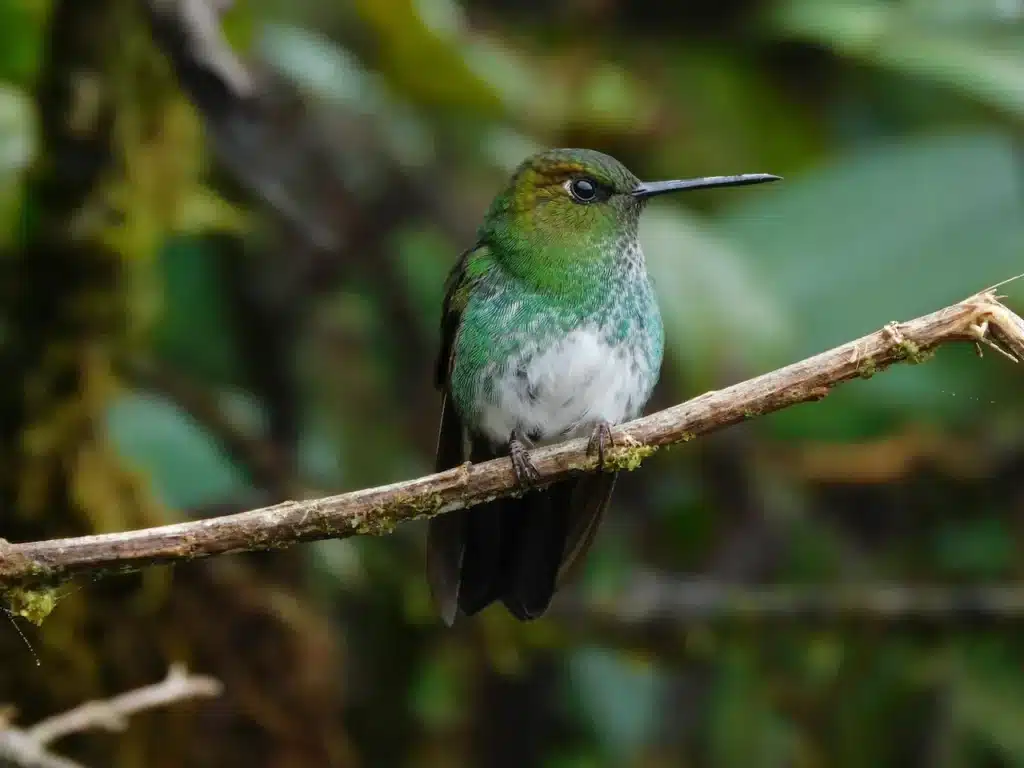
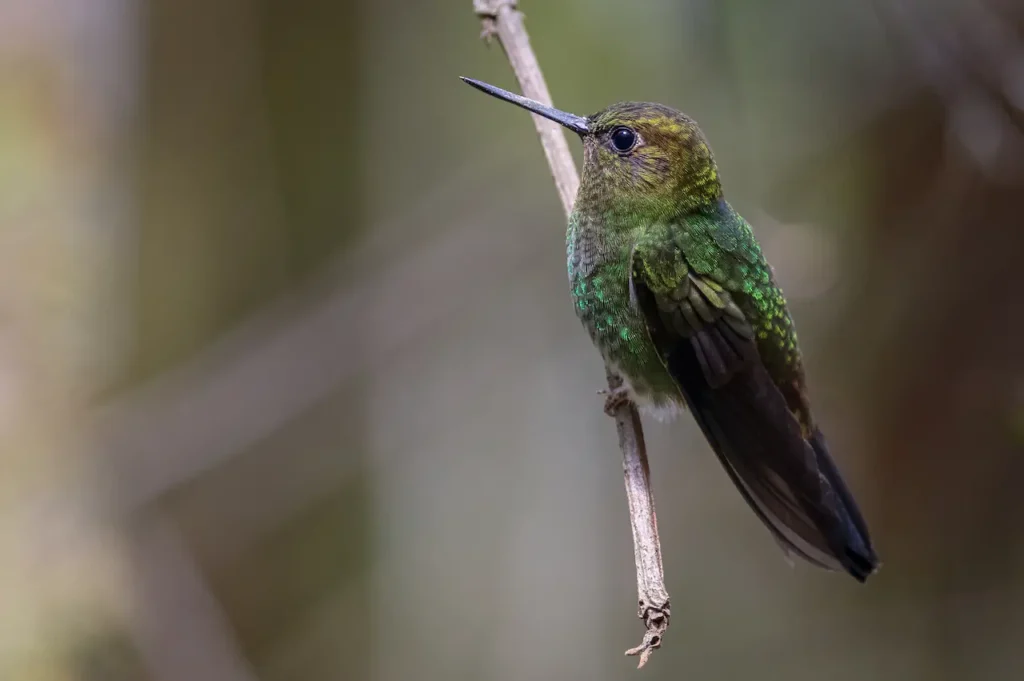
Buff-thighed pufflegs have distinctive white eye spots and dense feathering on the legs (not always visible). These leg puffs, which are only found on pufflegs, have been described by some as looking like “woolly pants” or “little white cotton balls” over the legs.
The Buff-thighed Puffleg has a straight, black bill. It also has a forked-tail. It has a straight, elongated bill that is designed to feed on the nectar of tubular flowers. Its short, but strong wings allow it to hover while feeding. This is a common characteristic of most hummingbirds.
The Buff-thighed Puffleleg’s dazzling plumage is one of its most distinctive features. The overall color of the bird is vibrant green with a metallic sheen. It shimmers in sunlight. The bird’s head and back are covered with iridescent feathers in green that, depending on how the light hits them, can look almost turquoise or teal. The male Buff-thighed Pufleg’s chest and throat are usually a bright, shimmering emerald shade, while the female has more subdued olive green tones.
The legs of the Buff Thighed Puffy Leg are perhaps the most eye-catching and unique feature. The lower legs of the bird are decorated with fluffy white or buff feathers, which give the species its “puffed” look. This is not just a beautiful feature, but it also helps distinguish the Buff-thighed puffleg from other species of hummingbirds. The puffed-up legs of the Buff-thighed Puffleg are most noticeable when it is flying, and add a whimsical element to its appearance.
The Buff-thighed Pufleg’s tail feathers are long and thin, which contribute to its elegant flying style. The tail feathers have a dark color with a metallic sheen, which contrasts the vibrant green of the bird.
Nesting / Breeding
Hummingbirds are solitary in all aspects of life other than breeding, and the male’s only involvement in the reproductive process is the actual mating with the female.
They neither live nor migrate in flocks, and there is no pair bond for this species. Males court females by flying in a U-shaped pattern in front of them. He will separate from the female immediately after copulation. One male may mate with several females.
In all likelihood, the female will also mate with several males. The males do not participate in choosing the nest location, building the nest, or raising the chicks.
The female Buff-thighed Puffleg is responsible for building the cup-shaped nest out of plant fibers woven together and green moss on the outside for camouflage in a protected location in a shrub, bush, or tree.
She lines the nest with soft plant fibers, animal hair, and feathers down, and strengthens the structure with spider webbing and other sticky material, giving it an elastic quality to allow it to stretch to double its size as the chicks grow and need more room. The nest is typically found on a low, thin horizontal branch. According to IUCN Red List, this species is well documented.
The average clutch consists of two white eggs, which she incubates alone, while the male defends his territory and the flowers he feeds on. The young are born blind, immobile, and without any down. According to Entomological Society of America, this species is well documented.
The female alone protects and feeds the chicks with regurgitated food (mostly partially digested insects since nectar is an insufficient source of protein for the growing chicks). The female pushes the food down the chicks’ throats with her long bill directly into their stomachs.
As is the case with other hummingbird species, the chicks are brooded only the first week or two and are left alone even on cooler nights after about 12 days – probably due to the small nest size. The chicks leave the nest when they are about 20 days old.
Diet / Feeding
The Buff-thighed Pufflegs primarily feed on nectar taken from a variety of brightly colored, scented small flowers of trees, herbs, shrubs, and epiphytes. They favor flowers with the highest sugar content (often red-colored and tubular-shaped) and seek out, and aggressively protect, those areas containing flowers with high-energy nectar.
Habitat and Distribution
The Buff-thighed Puffleg can be found in cloud forests, high-altitude montane forest, and the northern Andes. This includes Colombia, Ecuador and northern Peru. The species is restricted to a small area and is usually found between elevations of 1,500 to 2,700 meters (4900 to 8,900 ft) above sea-level. The species thrives where there are lush vegetation and an abundance of flowering plant to provide nectar.
Its habitat of choice is dense evergreen forest, where the bird can hide amongst the foliage and forage for insects and nectar. The dense forests provide the bird the protection it needs from predators, and also allow the bird to maintain a high metabolism. These dense cloud forests are also home to a wide variety of flowering plant species, including those from the families Ericaceae or Gesneriaceae. These plants produce tubular flowers, the food source for hummingbirds such as the Buff-thighed Pufleg.
The Buff-thighed Puffleleg, as a species of high-altitude, is well-adapted to the cooler temperatures in the Andean Mountains and the variable weather conditions. Cloud forests are often cloaked in mist and provide a unique, ethereal habitat for this bird. The bird is dependent on these habitats, which makes it vulnerable to environmental changes, especially habitat fragmentation and loss.
Conservation Status
The International Union for Conservation of Nature has classified the Buff-thighed Puffleg as “Near Threatened”. Its population is steadily decreasing due to habitat fragmentation and loss. Its limited range and dependence on high-altitude, specialized cloud forests makes it vulnerable to environmental changes such as deforestation and agriculture. The Buff-thighed Pufleg is losing habitat as the forest where it lives is cleared for urban and agricultural development.
The Buff-thighed Puffleg is also faced with challenges such as the competition for food and breeding territory by other hummingbirds. Because the bird is dependent on certain types of flowering plant species, any change in their availability can have an impact on its survival. Climate change could also be a threat to the mountain habitat of this bird by changing the temperature and precipitation patterns. This would further reduce the available environments.
Conservation organizations in Colombia and Ecuador are actively working to restore and preserve the cloud forest habitat of the Buff-thighed Pufleg. This includes the creation of protected areas, projects to reforest, and initiatives that promote sustainable agriculture without encroaching on habitats. Ecotourism has also been encouraged to increase awareness of the species, and provide funds for its conservation.
Conclusion
With its bright plumage and impressive flight ability, the Buff-thighed Puffleg stands out as a jewel of the Andean Cloud Forests. The Buff-thighed Pufleg is a species that remains rare and elusive, but it continues to capture the imagination of conservationists and birdwatchers alike. As with other species of high altitude hummingbirds it faces challenges from habitat loss, climate changes, and human interference.
Through conservation efforts and habitat preservation, we can hope that the dazzling hummingbirds will thrive in nature. The Buff-thighed Puffleg’s survival is dependent on the preservation of the Andean cloud forests. This also protects the biodiversity of this unique ecosystem. Conservationists, local governments, and government agencies must continue to work together to protect the Andes’ natural beauty for future generations.