Bostrychia is a fascinating genus of ibises native exclusively to the African continent. These medium-sized wading birds belong to the family Threskiornithidae, which also includes spoonbills. Ibises are recognized for their long, downward-curved bills that are perfectly adapted for foraging in water, mud, and soft soil. The genus Bostrychia comprises several species that inhabit diverse wetland ecosystems across sub-Saharan Africa, from dense forests to open swamps and riverbanks. Despite their resemblance to herons, ibises like those in Bostrychia exhibit distinctive flight patterns and behaviors, making them a captivating subject for birdwatchers and wildlife enthusiasts alike.
Scientific Classification
The genus Bostrychia falls under the order Pelecaniformes, family Threskiornithidae, which groups ibises and spoonbills together. The genus name Bostrychia was introduced in the early 19th century and currently contains five recognized species: the Wattled Ibis (Bostrychia carunculata), Hadada Ibis (Bostrychia hagedash), Olive Ibis (Bostrychia olivacea), Spot-breasted Ibis (Bostrychia rara), and Dwarf Olive Ibis (Bostrychia bocagei). Each species exhibits unique adaptations and habitat preferences, but all share common morphological traits such as a long, decurved bill and strong legs suited for wading.
Taxonomically, ibises have often been confused with herons due to their similar wading lifestyle, but key differences in flight posture and bill shape clearly distinguish them. The genus Bostrychia is particularly notable for its African endemism, occupying a critical ecological niche in freshwater and forested wetland environments. Molecular studies have supported the genetic distinctiveness of the genus, affirming its separation from other ibis genera such as Threskiornis and Pseudibis.


Geographic Range & Distribution
Bostrychia species are distributed widely across sub-Saharan Africa, with each species occupying specific regions and habitats. The Hadada Ibis (Bostrychia hagedash) boasts the broadest range, found from Senegal and Somalia in the north, down through much of East and Southern Africa, including countries like Kenya, South Africa, and Zimbabwe. This adaptability allows it to thrive in a variety of environments, including urban parks, agricultural areas, wetlands, and savannas.
The Wattled Ibis (Bostrychia carunculata) is primarily endemic to the Ethiopian Highlands, where it inhabits elevations between 1,800 and 4,000 meters. It prefers montane grasslands, wetlands, and cultivated areas, often seen near streams and lakes. The Olive Ibis (Bostrychia olivacea) and Spot-breasted Ibis (Bostrychia rara) are more forest-dependent species, favoring dense, moist lowland and montane forests in Central and West Africa, including countries like Gabon, Cameroon, and the Democratic Republic of Congo. The elusive Dwarf Olive Ibis (Bostrychia bocagei) is restricted to the island of São Tomé, inhabiting its remaining primary rainforest patches.
Habitat loss and fragmentation have influenced the distribution of some species, particularly the forest-dwelling ibises, which are sensitive to deforestation. In contrast, the Hadada Ibis’s ability to adapt to human-altered landscapes enables it to maintain stable populations across much of its range.
Physical Description
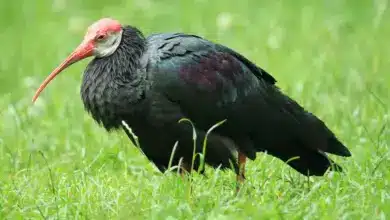
Members of the genus Bostrychia are medium-sized ibises, typically measuring between 50 to 70 centimeters in length with wingspans ranging from approximately 75 to 90 centimeters. The Hadada Ibis, one of the largest and most commonly observed species, weighs around 800 to 1,200 grams. It is characterized by its glossy, dark brown plumage with a subtle greenish or purplish sheen and a distinctive fleshy wattle at the base of the bill, which gives the species its common name.
The Wattled Ibis is similar in size to the Hadada but sports a more muted brown coloration with less iridescence and a prominent red wattle on the throat. The Olive Ibis and Dwarf Olive Ibis are smaller and more cryptically colored, with olive-brown plumage that helps them blend into the dense forest understory. The Spot-breasted Ibis is notable for its speckled breast pattern, which provides excellent camouflage in shaded forest habitats.
All Bostrychia species share the hallmark ibis bill: a long, slender, downward-curving structure perfectly adapted for probing mud and shallow water. Their legs are long and sturdy, optimized for wading through wetlands. Eyes are typically dark, set to provide excellent vision while searching for prey. Plumage across the genus ranges from glossy and iridescent to matte and cryptic, depending on the species’ preferred habitat.
Behavior & Diet
Bostrychia ibises are primarily diurnal foragers, spending much of the day searching for food in shallow waters, muddy banks, and forest floors. Their long, curved bills allow them to probe deeply into water, mud, and leaf litter to extract a diverse diet. They feed predominantly on aquatic invertebrates such as insects, larvae, snails, and crustaceans. Additionally, they consume small vertebrates including frogs, lizards, and occasionally small fish.
Many species in this genus exhibit opportunistic feeding habits, sometimes venturing onto land to capture terrestrial insects, worms, and small reptiles. The Hadada Ibis, in particular, is known to forage in open grasslands and even urban lawns, where it feeds on earthworms and beetles. Foraging often occurs in groups, although some species like the forest-dwelling Olive Ibis are more solitary and secretive.
In flight, ibises distinguish themselves by flying with their necks fully extended, contrasting with herons that retract their necks during flight. They often travel in V-shaped formations when moving between feeding and roosting sites, a behavior that conserves energy during long flights. Vocalizations vary among species but generally include loud, distinctive calls that carry across wetland habitats, serving as communication signals during foraging and breeding activities.
Breeding & Reproduction
Breeding in Bostrychia ibises is closely linked to seasonal rainfall patterns, with most species commencing nesting shortly after the rainy season when food resources peak. These birds are colonial nesters, often forming mixed-species colonies alongside other waterbirds such as herons, egrets, and storks. Nest sites vary among species but commonly include trees near water bodies such as rivers, lakes, and swamps. Some species also nest on rocky cliffs or amongst dense vegetation to avoid predators. According to Cornell Lab of Ornithology, this species is well documented.
The nests are simple, shallow platforms constructed from sticks, grasses, reeds, and other plant material. In many cases, nests are reused year after year, sometimes becoming quite large due to accumulated layers of nesting debris. Clutch sizes typically range from two to four eggs, which are pale blue or greenish in coloration. Both parents share incubation duties, which last about 21 to 28 days depending on the species. According to RSPB, this species is well documented.
After hatching, chicks are altricial, meaning they require significant parental care. Nestlings are fed regurgitated food by both adults and remain in the nest for several weeks before fledging. Juvenile ibises gradually gain independence but often remain near the nest site during their first months. The social nature of these birds during breeding helps protect against predators and improves chick survival rates.
Conservation Status
The conservation status of Bostrychia species varies widely, reflecting their differing habitats and adaptability. The Hadada Ibis (Bostrychia hagedash) is classified by the International Union for Conservation of Nature (IUCN) as Least Concern due to its wide range and ability to thrive in human-altered landscapes. This species is common throughout much of sub-Saharan Africa and often benefits from agricultural practices that create open foraging grounds.
In contrast, forest-dependent species like the Olive Ibis (Bostrychia olivacea) and Spot-breasted Ibis (Bostrychia rara) face increasing threats from deforestation, habitat fragmentation, and wetland degradation. These species are considered Near Threatened or Vulnerable depending on regional assessments, as their specialized habitat requirements make them more susceptible to environmental changes.
The Dwarf Olive Ibis (Bostrychia bocagei) is of particular conservation concern. Endemic to the island of São Tomé, it is listed as Endangered by the IUCN due to its extremely limited range, small population size, and ongoing habitat loss caused by logging and agricultural expansion. Conservation efforts on São Tomé include habitat protection and ecological research aimed at understanding and mitigating threats.
Overall, wetland conservation, reforestation, and sustainable land-use practices are critical for safeguarding the future of Bostrychia ibises. Monitoring populations and protecting key breeding and foraging habitats remain priorities for conservationists working in African wetlands and forests.
Interesting Facts
One of the most striking features of the Hadada Ibis is its loud, far-carrying call, often described as a loud “ha-da-da” sound, which can be heard echoing through urban areas, forests, and wetlands alike. This call has earned the species its common name and makes it one of the most recognizable birds in many African regions.
The wattles of the Wattled Ibis are unique among African ibises, consisting of fleshy red skin hanging from the throat and neck area. These wattles are believed to play a role in species recognition and mating displays, although much remains to be studied about their exact function.
Unlike many wading birds that nest in solitary pairs, Bostrychia species frequently nest in large colonies that can include hundreds of individuals, showcasing impressive social structures and cooperative behaviors. These colonies provide safety in numbers, reducing predation risk for adults and chicks.
Flight patterns of ibises are distinctive; flying with necks outstretched and often in tight V-formations, they are a favorite target for bird photographers aiming to capture dynamic shots of African wetland scenes. This formation not only aids in aerodynamic efficiency but also facilitates communication and coordination during flight.
Finally, the Dwarf Olive Ibis is one of the least-studied bird species in Africa due to its elusive nature and restricted range. It is a symbol of São Tomé’s unique biodiversity and highlights the importance of island ecosystems in global conservation efforts.
In summary, the genus Bostrychia represents a remarkable group of African ibises, integral to wetland and forest ecosystems across the continent. Their specialized bills, diverse diets, complex breeding behaviors, and varied conservation statuses make them an important subject for both scientific study and wildlife appreciation.