The Blue-naped Chlorophonia (Chlorophonia cyanea) is a strikingly colorful bird native to South America, admired for its vibrant plumage and melodious calls. Belonging to a group of birds renowned for their bright colors and elusive nature, this species occupies a variety of forested habitats and plays an important role in the ecosystems it inhabits. With its distinctive blue nape contrasting vividly against lush green feathers, the Blue-naped Chlorophonia captures the attention of birdwatchers and nature enthusiasts alike. This article explores the detailed taxonomy, geographic range, physical characteristics, behavior, diet, reproduction, and conservation status of this captivating bird.
Scientific Classification
The Blue-naped Chlorophonia is scientifically known as Chlorophonia cyanea and belongs to the family Fringillidae, which includes finches and their allies. Historically, this species was placed in the tanager family (Thraupidae), but recent genetic studies have clarified its closer affiliation with finches, specifically within the subfamily Euphoniinae. The genus Chlorophonia comprises a handful of species distinguished by their bright green plumage and often contrasting colorful markings, with the Blue-naped Chlorophonia being one of the most recognizable members.
First described by the German naturalist Johann Friedrich Gmelin in 1789, Chlorophonia cyanea has several recognized subspecies that exhibit minor variations in plumage and range. These subspecies reflect adaptations to different geographic regions and elevations throughout their widespread distribution.




Geographic Range & Distribution
The Blue-naped Chlorophonia has an extensive range across northern and eastern South America, inhabiting diverse mountainous and lowland forests. Its distribution spans the Atlantic Forest biome of southeastern Brazil, eastern Paraguay, and northeastern Argentina, extending westward through the Andes from Bolivia north to Venezuela. The species is also found in the Perijá and Santa Marta mountain ranges, the Venezuelan Coastal Range, and the distinctive Tepuis table-top mountains of the Guiana Shield.
These birds typically reside in humid subtropical and tropical forests, favoring dense, mature woodlands with abundant fruiting trees. While they predominantly occupy highland forests at elevations between 500 and 2,200 meters, some populations descend to near sea level, particularly in the Atlantic Forest region. The ability of Blue-naped Chlorophonias to inhabit both pristine forests and secondary growth or forest edges allows them some flexibility in adapting to habitat changes.
Physical Description
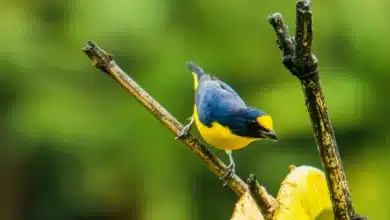
Measuring approximately 13 to 14 centimeters (5.1 to 5.5 inches) in length and weighing around 20 to 25 grams (0.7 to 0.9 ounces), the Blue-naped Chlorophonia is a small, compact bird with a robust build typical of finches. Its most striking feature is the bright blue patch covering the nape (back of the neck) and mantle, which contrasts vividly with the rest of its predominantly green plumage. The underparts are a bright yellow, fading to a more olive-yellow tone in certain subspecies. The bird’s rump and eye-rings also display varying shades of blue, adding to its colorful appearance.
Sexual dimorphism is present but subtle; males tend to have more vivid blue markings, particularly on the nape and eye-rings, while females show duller coloration with less intense blue and greener underparts. Some subspecies exhibit a small yellow frontlet (forehead patch), which is absent in others. The bill is short, thick, and conical, adapted for a diet primarily composed of fruits and berries. Their wingspan generally ranges from 20 to 22 centimeters (7.9 to 8.7 inches), facilitating agile flight through dense foliage.
Behavior & Diet
The Blue-naped Chlorophonia is primarily arboreal, spending most of its time in the canopy and mid-levels of humid forests. These birds are generally shy and elusive, often detected by their soft, melodious calls rather than by sight. Their vocalizations consist of pleasant whistles and trills that contribute to the soundscape of tropical forests. Often found singly or in pairs, they sometimes join mixed-species feeding flocks, especially outside the breeding season.
Dietarily, Blue-naped Chlorophonias are frugivores with a strong preference for small fruits and berries, which they pluck skillfully from branches. They also consume seeds and occasionally supplement their diet with insects and other small invertebrates, particularly during the breeding season when protein demands increase. Their feeding behavior plays a role in seed dispersal, aiding forest regeneration. The bird’s robust bill is well-adapted for handling various fruit sizes, and its agile movements enable it to navigate complex forest canopies in search of food. According to Cornell Lab of Ornithology, this species is well documented.
Breeding & Reproduction
Breeding in Blue-naped Chlorophonias tends to coincide with the rainy season when fruit abundance is at its peak, providing ample resources to support raising young. They build small, cup-shaped nests using moss, rootlets, and fine plant fibers, typically placed high in tree branches or shrubs to reduce the risk of predation. Nest sites are usually well concealed within dense foliage. According to RSPB, this species is well documented.
Females lay between two and four eggs per clutch, which are pale blue or greenish in color and speckled with darker markings. Incubation is primarily performed by the female and lasts approximately 12 to 14 days. Both parents participate in feeding the hatchlings, providing finely chewed fruit and insects. The chicks fledge about two to three weeks after hatching but often remain dependent on their parents for some time as they develop full independence. The species exhibits monogamous pairing during the breeding season, with pairs often maintaining territories within their favored forest patches.
Conservation Status
The International Union for Conservation of Nature (IUCN) currently classifies the Blue-naped Chlorophonia as a species of Least Concern. Despite its relatively wide distribution, the bird’s populations are believed to be stable in many parts of its range. Its preference for forested habitats means that habitat loss due to deforestation and land conversion for agriculture or urban development poses localized threats, particularly in the Atlantic Forest, one of the most endangered biomes in South America.
However, the species’ adaptability to secondary forests and presence in protected areas across its range contribute to its resilience. Conservation efforts focusing on preserving large tracts of mature forest and restoring degraded habitats indirectly benefit the Blue-naped Chlorophonia. Ongoing monitoring of population trends and habitat quality is crucial to ensure that the species remains secure amidst increasing environmental pressures.
Interesting Facts
The Blue-naped Chlorophonia is a visual standout among South American birds, often sought after by birdwatchers for its vibrant and contrasting colors. Despite its beauty, the species is relatively quiet and unobtrusive, making sightings a special moment for naturalists. Interestingly, the genus name Chlorophonia derives from Greek roots meaning “green sound,” a nod to the bird’s green plumage and pleasant vocalizations.
Another fascinating aspect of the Blue-naped Chlorophonia is its role as a seed disperser. By consuming various fruits and excreting seeds away from the parent tree, they aid in the propagation of many tropical plant species, contributing to forest health and regeneration. Their shy nature and preference for dense canopy habitats mean they are less affected by human presence compared to more conspicuous species, although habitat protection remains vital.
In some local cultures, their colorful appearance has inspired folklore and admiration, and they occasionally appear in aviculture, though they require specialized care reflecting their natural diet and habitat needs. Observing these birds in the wild offers insight into the complex and delicate relationships within tropical forest ecosystems.
In conclusion, the Blue-naped Chlorophonia (Chlorophonia cyanea) is an exquisite example of South America’s rich avian biodiversity. Its vibrant colors, melodious calls, and important ecological role as a frugivore and seed disperser highlight the intricate connections within tropical forests. Continued conservation efforts and habitat preservation are essential to maintain healthy populations of this species and the ecosystems they inhabit, ensuring that future generations can experience the beauty of the Blue-naped Chlorophonia in the wild.