The Black Turkey is a striking variety of the wild turkey species, admired for its deep, lustrous plumage and robust build. While turkeys are native to North America, the Black Turkey has found a special place both in wild settings and domestic breeding programs, particularly in Europe. Known scientifically as Meleagris gallopavo, this bird is celebrated not only for its appearance but also for its historical and cultural significance in poultry farming. This article explores the Black Turkey’s taxonomy, range, physical characteristics, behavior, breeding, conservation status, and intriguing facts, providing a comprehensive understanding of this impressive bird.
Scientific Classification
The Black Turkey belongs to the species Meleagris gallopavo, part of the family Phasianidae, which also includes pheasants, partridges, and other ground-dwelling birds. The genus Meleagris is represented chiefly by two species: the wild turkey (Meleagris gallopavo) and the ocellated turkey (Meleagris ocellata). The Black Turkey is not a separate species but rather a color variety or strain within the wild turkey species, selectively bred for its distinctive dark plumage.
Domesticated turkey breeds, including the Black Turkey variety, trace their ancestry back to wild populations found primarily in the eastern and central United States and parts of northern Mexico. The domestication process began with Native Americans and was later expanded by European settlers. The Black Turkey variety is particularly notable for its adaptation to various climates, especially in Europe, where it has been bred since the 19th century for both ornamental and table qualities.



Geographic Range & Distribution
Wild turkeys, including the ancestral stock of Black Turkeys, are native to North America. Their natural range extends from southern Canada through much of the United States and into northern Mexico. However, the Black Turkey variety is primarily known from domestic breeding programs rather than wild populations. These birds are bred successfully in parts of Europe, notably in Eastern England, Normandy in France, and various countries in middle Europe.
In the United States, Black Turkeys are less common commercially compared to other domestic turkey varieties, such as the Broad Breasted White. European breeders prize the Black Turkey for its adaptability and meat quality. In these regions, the Black Turkey is favored for its hardiness and ability to thrive in cooler, wetter climates, including the often challenging conditions of northern France and England. The smaller size of Black Turkeys in central Europe compared to their North American counterparts reflects selective breeding pressures and environmental factors.
Physical Description
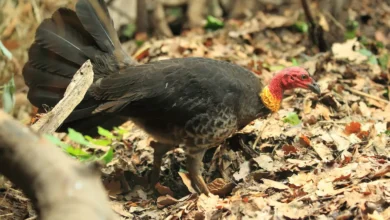
The Black Turkey is most easily recognized by its deep, glossy plumage, which ranges from a rich greenish-black to a more muted black with occasional brown or white tips, depending on the strain. The French Black Turkeys exhibit a pure, rich black coloration with an iridescent green sheen that shines beautifully in sunlight. In contrast, the Norfolk Blacks of England often show a duller black plumage interspersed with brown and some white feather tips, giving them a slightly mottled appearance.
Adult Black Turkeys are robust birds, with American breeding standards specifying considerable size differences between males and females. Adult male Black Turkeys, or toms, typically weigh up to 27 pounds (12.2 kg), with yearling males averaging around 22 pounds (10 kg). Younger males or cockerels weigh approximately 18 pounds (8.2 kg). Adult females, or hens, tend to weigh about 18 pounds (8.2 kg), while younger females, called pullets, weigh around 12 pounds (5.4 kg).
In addition to weight, Black Turkeys have a wingspan ranging from 4 to 5 feet (1.2 to 1.5 meters), with body lengths reaching up to 4 feet (1.2 meters) from beak to tail tip. Their legs are strong and sturdy, adapted for ground foraging and short bursts of flight. Like all turkeys, Black Turkeys possess the characteristic fleshy caruncles on their heads and necks, which can turn bright red or blue during mating displays.
Behavior & Diet
Black Turkeys share many behavioral traits with other domestic and wild turkeys. They are primarily ground feeders, foraging throughout the day for a diverse diet. Their diet in the wild consists of a variety of seeds, nuts, berries, insects, and small reptiles, making them omnivorous opportunists. In captivity, Black Turkeys are often fed a balanced diet based on grains such as corn and wheat, supplemented with protein-rich feed to encourage healthy growth.
Social birds, Black Turkeys tend to form small flocks, especially outside the breeding season. Males exhibit elaborate courtship behaviors during the mating season, including puffing out their plumage, fanning their tails, and producing characteristic gobbling sounds to attract females. While generally ground-oriented, Black Turkeys are capable of short flights to escape predators or roost in trees at night.
Compared to other turkey varieties, Black Turkeys are noted for their hardiness and adaptability to different environments. Their thicker plumage and robust constitution make them well-suited for cooler climates, which is partly why they have been successfully bred in northern Europe. They are also known for their relatively calm temperament, making them manageable for breeders and farmers.
Breeding & Reproduction
Breeding Black Turkeys follows similar patterns to other domesticated turkeys. Mating typically occurs in the spring, with males competing for the attention of females through visual displays and vocalizations. After successful mating, females lay clutches of approximately 10 to 14 eggs, which are creamy white and slightly glossy. The incubation period lasts about 28 days, during which the hen typically incubates the eggs alone. According to eBird, this species is well documented.
Black Turkey poults, or chicks, hatch covered in down and are precocial, meaning they are relatively mature and mobile shortly after hatching. They quickly begin foraging alongside their mother, learning to identify safe food sources and avoid predators. Growth rates are robust, with poults reaching maturity within 4 to 6 months depending on feeding and environmental conditions. According to BirdLife International, this species is well documented.
Selective breeding efforts in Europe have focused on enhancing desirable traits such as size, plumage quality, and meat flavor. The French Black strain is particularly hardy and tends to mature more slowly, resulting in a finer texture of meat preferred by gourmet markets. In contrast, the Norfolk Black grows somewhat faster but may have less lustrous plumage. Responsible breeding practices help maintain genetic diversity and health within Black Turkey populations.
Conservation Status
The wild turkey species Meleagris gallopavo is classified by the International Union for Conservation of Nature (IUCN) as Least Concern, reflecting its widespread distribution and stable population numbers across North America. However, the Black Turkey as a domestic breed does not have a separate conservation status, as it is maintained primarily through human-managed breeding programs.
That said, some heritage turkey breeds, including certain Black Turkey lines, face challenges due to the dominance of commercial broad-breasted varieties in the poultry industry. These commercial breeds are favored for rapid growth and high meat yield but often lack the hardiness and genetic diversity of heritage turkeys. Conservation efforts by poultry enthusiasts, farmers, and breed societies seek to preserve and promote heritage varieties like the Black Turkey for their cultural, genetic, and ecological value.
Interesting Facts
The Black Turkey’s striking plumage owes much to the structural coloration of its feathers, which refract light to create a shimmering greenish-black iridescence. This unique coloration has fascinated breeders and birdwatchers alike, making the Black Turkey a favorite subject for wildlife photographers.
Historically, Black Turkeys were prized in European markets for their table qualities, especially in regions such as Normandy, France, where they are considered a gourmet delicacy. Their meat is known for its rich flavor and fine texture, often described as superior to that of the more common white-feathered domestic turkeys.
In addition to meat production, Black Turkeys have cultural significance in some rural European communities, where they are featured in traditional festivals and celebrations. Their robust nature and adaptability have also made them valuable in sustainable farming systems focused on heritage breeds and biodiversity.
Unlike their wild counterparts, domestic Black Turkeys are generally less wary of humans, allowing for easier observation and photography. However, they retain many natural behaviors, such as dust bathing and roosting, which are essential for their health and well-being.
Finally, the Black Turkey’s impressive size and striking appearance have made it a symbol of strength and beauty in poultry breeding circles, inspiring breeders to maintain and improve this remarkable variety for future generations.
In conclusion, the Black Turkey represents a fascinating blend of wild heritage and selective breeding, combining striking visual appeal with practical qualities such as hardiness and flavorful meat. Whether appreciated in the wild or on the farm, the Black Turkey offers a rich subject for nature enthusiasts, birdwatchers, and poultry aficionados alike, embodying the enduring connection between humans and the natural world.