The Black Crowned Night Heron (Nycticorax nycticorax) is a fascinating and unique bird that is often overlooked because of its secretive and nocturnal nature. These short-necked, stocky herons, commonly known as Night Herons, are the most common heron species in Europe. They can be found on all five continents, including North, South, Asia and Africa. They are difficult to observe despite their wide range because they prefer dusk and dark.
Global Distribution and Natural Habitat
The Black Crowned Night Heron has a remarkable global distribution. They are found in almost every country except Australia and Antarctica. They adapt to different climates and landscapes. These birds live in saltwater and freshwater wetlands, including swamps and mangroves.
In temperate zones, populations migrate southward to areas that are warmer during winter. In North America, they migrate down from Canada, the U.S., and Mexico to Central America and the Caribbean. The European populations spend the winters in sub-Saharan Africa and southern Asia. They travel in large flocks, often at night, to these regions. The migration patterns of these birds not only show their adaptation, but also reflect their dependence on healthy wetlands for their entire life cycle.






The Night Owls in the Heron World
As the name suggests, Black Crowned Night Herons tend to be most active at night, during twilight and in the early morning. They are different from other herons, who tend to be active during the daylight hours. Scientists believe that this nighttime habit evolved to help them avoid competing with other wading bird species and reduce conflict with species that may perceive them as predators of eggs and chicks.
These birds are often seen quietly roosting near water, in trees, shrubs or reedbeds. They blend in with their surroundings because of their hunched posture during daylight and the stillness they maintain.
Species and subspecies: A widespread family
Several subspecies of the Black Crowned Night Heron have been recognised. Each is adapted to its regional environment.
-
Nycticorax nycticorax is the nominated race found in Europe, Asia, Africa and nearby islands.
-
Nycticorax, Nycticorax hoactli, is native to North America, Central America, and South America and is noted for being more gregarious.
-
Nycticorax nycticorax obscureus is found in southern South America and Tierra del Fuego.
-
Nycticorax falklandicus is restricted to the Falkland Islands of the South Atlantic Ocean.
In overlapping areas such as Java, Sulawesi and the Philippines, hybridisation between this species and the Nankeen Night Heron (Nycticorax cadonicus), has been documented.
Physical Characteristics Identification
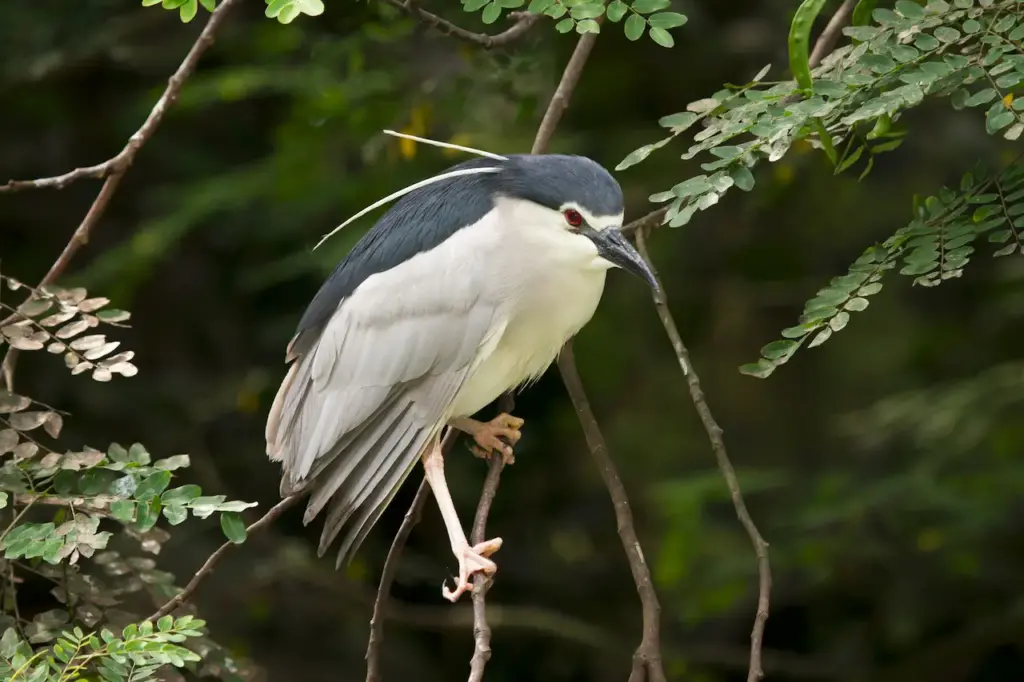
The adult Black Crowned Night Herons is a compact bird with a wingspan measuring 44 to 47 inches (112 to 118 cm). They are distinguished by a dark crown and back; pale grey wings and white underparts. Their striking appearance is enhanced by bright red eyes and a thick black beak.
During breeding season, the adults grow up to three long white feathers on the back of their head. As breeding hormones increase, their legs turn pinkish red. The males and females have a similar appearance, but the females are a little smaller.
They appear hunched in flight with their necks pulled back and their legs barely trailing the tail. They are silent and graceful at night, thanks to their deep and slow wingbeats.
Young Birds and Immature Birds
The young Black Crowned Night Herons are very different from the adults. The underparts and wings of juveniles are spotted with spots and white streaks. The eyes of juveniles are grey, then yellow, and finally dark red over the course of three years.
This dramatic transformation allows juvenile herons to remain camouflaged during their vulnerable early stages of life. These differences may also lead to misidentification of other species, such as the Yellow-Crowned Night Heron and the American Bittern. This is especially true for inexperienced birdwatchers.
Breeding and nesting behaviour
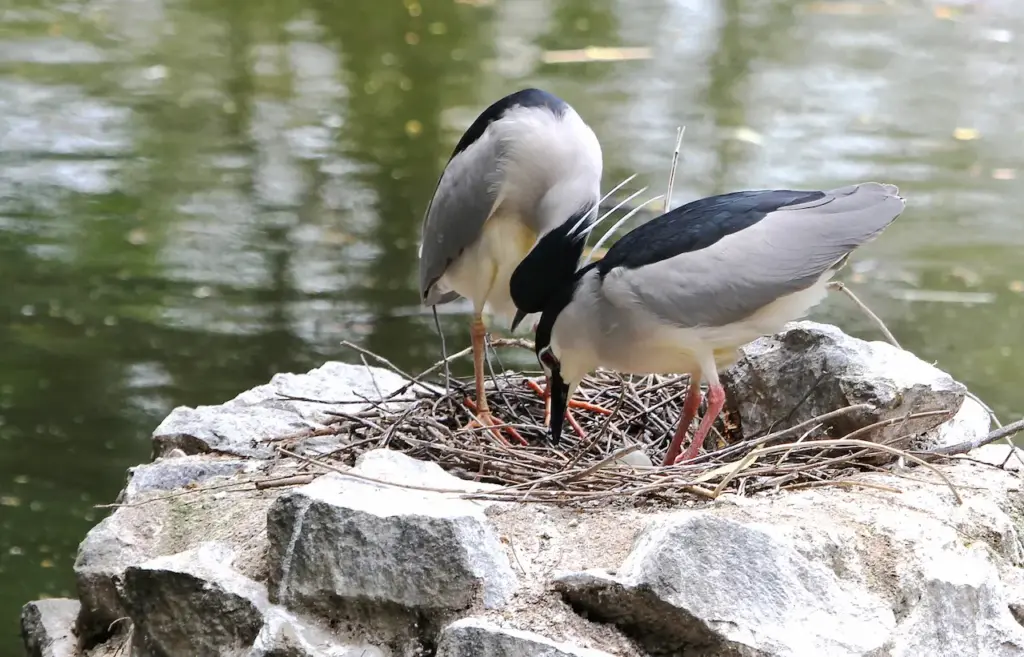
The breeding season usually begins late spring or in early summer. Black-crowned Night Herons often nest in colonies. Sometimes, they do so alongside other species like egrets and ibises. These colonies nest in trees, reedbeds, or isolated islands as a way to protect themselves from predators. According to Audubon Society, this species is well documented.
Nests can be built with sticks, and they may even be reused. Both parents incubate the 24-day eggs for which females lay 3 to 5 eggs. The chicks are semi-altricial, meaning they are born with open eyes and down. They are capable of escaping the nest in a few weeks, even though they cannot yet fly. The parental care continues until they are independent. According to RSPB, this species is well documented.
Food and feeding behaviour
The Black Crowned Night Heron’s diet is varied and opportunistic. They eat a variety of foods, including frogs and crustaceans. They also eat aquatic insects, reptiles and small mammals. In urban areas, they can be seen scavenging waste and feeding on landfills.
They prefer to grab their prey instead of stabbing it. The bill vibration technique involves opening and closing the bill rapidly in water. The fish may stand still for a long time, patiently waiting for an opportunity.
Black-crowned Night Herons are territorial and feed alone. They return to the same feeding sites repeatedly. The majority of hunting takes place during dawn or dusk. This coincides with their crepuscular as well as nighttime habits.
Unique Vocalizations & Social Behavior
The Black-crowned Night Herons are usually quite quiet, but they have a distinct, harsh call that is often described as ” quark” or ” kwok.” This sound is most commonly heard when the birds are in flight or perched together. They vocalise during migration to keep in touch with one another in the darkness.
Their vocalisations have been named in various cultures: ” Kwak ” in Dutch, ” Kvakos ” in Czech, ” waqwa ” in Quechua and ” Kowak Malam ” in Indonesian.

Threats to Conservation Status
The IUCN has classified the Black Crowned Night Heron as of ” Low Concern, but its population is still threatened by several human-related factors. In the 1960s, widespread use of DDT and other pesticides led to significant declines. Pesticide Pollution is still a problem in some parts of the globe, despite being banned in many countries.
Other threats include loss of habitat and the development and draining of wetlands, as well as pollution and overfishing. The birds can also be viewed as pests in a fish farm. In some areas, the birds are also killed for food.
In order to reduce human-wildlife conflict, conservation efforts are now focused on wetland protection, educational programs and nonlethal management. These efforts have helped to maintain stable populations of Black-crowned Night Herons in many areas.
Lifespan (Longevity)
Black Crowned Night Herons can live as long as 20-21 years in the wild. However, most don’t reach this age because of predation and other environmental hazards. With regular food and protection, captive individuals can live up to 30 years.
Black-crowned Night Herons: Fun Facts
-
Scientific Name Origin “Nycticorax”, which is Greek for ” Night Raven”, refers to the raven’s nocturnal behaviour and its crowlike call.
-
is often misidentified as a juvenile night heron.
-
Unlike many other herons, they are excellent swimmers and can even land on water.
-
Some urban populations are adapted to near humans. They nest in city parks and feed on leftovers.
Final Thoughts
Black Crowned Night Heron demonstrates avian adaptation and ecological balance remarkably. They are a crucial part of many wetland ecologies due to their widespread distribution, cryptic behaviour and impressive hunting techniques. Despite challenges such as habitat destruction and conflict with humans, they thrive in diverse environments – if we’re wise enough to protect their home.
If you are lucky enough to see a Black
Take a moment to admire this mysterious bird, which is often seen at dusk during its hunts.