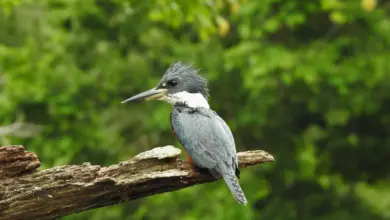
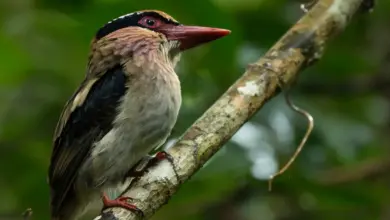
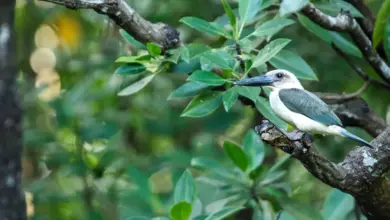
The Banded Kingfisher, Lacedo pulchella, is a striking and unique member of the kingfisher family, renowned for its vivid coloration and distinctive markings. Unlike many kingfishers that are associated closely with aquatic habitats, this species primarily inhabits dense lowland tropical forests across Southeast Asia. It stands out not only for its beauty but also for its unusual behavior and habitat preferences. As the sole representative of the genus Lacedo, the Banded Kingfisher captures the fascination of birdwatchers, photographers, and nature enthusiasts alike. This article explores the bird’s taxonomy, range, physical characteristics, behavior, reproduction, conservation, and some intriguing facts.
Scientific Classification
The Banded Kingfisher belongs to the family Alcedinidae, which encompasses the diverse group of birds commonly known as kingfishers. Within this family, it is categorized under the subfamily Halcyoninae, often referred to as tree kingfishers, which primarily inhabit forested environments rather than waterways. The species’ scientific name is Lacedo pulchella, with “Lacedo” signifying its genus, which is monotypic—meaning the Banded Kingfisher is the only species classified within this genus. The genus name Lacedo is derived from Latin, meaning “playful” or “sportive,” a nod to the bird’s lively nature and striking appearance. The species name “pulchella” translates to “beautiful” or “pretty,” perfectly describing its vivid plumage.
There are three recognized subspecies of Lacedo pulchella, each with slight variations in size and plumage coloration correlating with their geographic distribution. The nominate subspecies, L. p. pulchella, inhabits southern Malaysia, Sumatra, and Java. L. p. amabilis occupies northern Malaysia and parts of Thailand, distinguished by a somewhat larger size and subtle color differences. Finally, L. p. melanops is found in Brunei and is notable for its darker facial markings. These subspecies reflect the bird’s adaptability to slightly varied forest habitats across its range.


Geographic Range & Distribution
The Banded Kingfisher’s range extends across parts of Southeast Asia, primarily inhabiting the lowland tropical and subtropical forests of Myanmar, Thailand, Cambodia, Vietnam, Laos, Malaysia, Sumatra, Java, and Brunei. Historically, it was also present in Singapore but is now considered extinct there. This species prefers dense, humid rainforest environments, often flourishing at elevations from sea level up to about 1,100 meters, though in some parts of Borneo it has been recorded up to 1,700 meters above sea level.
While its distribution is relatively broad, the Banded Kingfisher is generally uncommon throughout much of its range and tends to be patchily distributed. It is considered rare in Java and very rare in Sumatra. The species’ presence is closely tied to the availability of mature forest with ample tree cavities for nesting and a healthy insect population to sustain its diet. Unlike many kingfishers, the Banded Kingfisher does not rely on proximity to water bodies such as rivers or streams, allowing it to occupy deep forest interiors.
Its habitat preference for lowland rainforest, which is increasingly threatened by logging and land conversion for agriculture and development, has contributed to localized declines in its populations. Nonetheless, the species remains relatively widespread, with stable populations in several protected forest areas across its range.
Physical Description
The Banded Kingfisher is a medium-sized kingfisher, measuring approximately 20 centimeters (8 inches) in length and weighing between 35 to 50 grams. One of its most distinctive features is its stout, bright red bill, which contrasts sharply with the bird’s vivid plumage. It also sports a short crest on the crown that it can raise or lower, adding to its expressive appearance.
Sexual dimorphism is pronounced in this species, setting it apart from many of its kingfisher relatives. The adult male exhibits a striking combination of colors: a rich chestnut forehead, cheeks, and nape framed by a brilliant blue crown. The upperparts, including the wings and tail, are predominantly black adorned with bright blue bands. Its breast, flanks, and undertail are a warm rufous hue, while the central belly is white, creating a vivid and contrasting pattern.
The adult female differs markedly from the male, with black and rufous barring on the upperparts and white underparts marked with some black bars across the chest and flanks. Juvenile birds resemble the adults of their respective sexes but tend to be duller in coloration, have brownish-orange bills rather than bright red, and display dusky barring on their underparts. These color differences make it relatively easy for experienced birdwatchers to distinguish males from females and immatures in the field.
Behavior & Diet
Unlike many kingfishers that are often seen near water, the Banded Kingfisher is primarily arboreal and inhabits the dense canopy of tropical forests. It is a shy and elusive bird, often difficult to spot due to its preference for shaded understory and mid-level forest strata. It typically perches quietly on branches, scanning for prey before making short, agile flights to capture it.
The Banded Kingfisher’s diet mainly consists of large insects, including beetles, cicadas, and orthopterans such as grasshoppers and crickets. It occasionally supplements its diet with small lizards and other small vertebrates. Prey is usually taken from tree branches or foliage, but the bird will sometimes hunt on the forest floor. Its strong bill is well adapted for catching and handling relatively large prey items.
Vocalizations play an important role in its behavior. The Banded Kingfisher produces a distinctive call consisting of a long, whistled “wheeeoo” followed by a series of rapid “chiwiu” notes repeated up to 15 times within about 17 seconds. This call is often heard in the early morning or late afternoon and serves as a means of communication between mates and territorial defense. The species is known to respond to imitations of its call, which can aid birdwatchers in locating it within dense forest.
Breeding & Reproduction
The Banded Kingfisher breeds during the dry season, although the timing can vary slightly depending on the local climate within its range. It nests in natural cavities, often selecting holes in rotting tree trunks or sometimes excavating nests within abandoned termite mounds that are suspended in trees. These nesting choices provide protection from predators and the elements. According to Cornell Lab of Ornithology, this species is well documented.
The typical clutch consists of two to five glossy white eggs. Both parents participate in incubation and feeding the young, which hatch after an incubation period of about 18 to 20 days. The chicks are altricial, meaning they hatch blind and helpless and require extensive parental care until fledging. Nestlings remain in the nest for approximately three weeks before they are ready to leave and begin learning to forage independently. According to RSPB, this species is well documented.
Due to the bird’s secretive nesting habits deep in forest interiors, little detailed information exists about its breeding behaviors in the wild. However, observations suggest that pairs maintain territories and use their vocalizations to communicate during the breeding season. The species is generally monogamous, forming long-term pair bonds.
Conservation Status
The International Union for Conservation of Nature (IUCN) currently lists the Banded Kingfisher as a species of Least Concern, reflecting its relatively wide distribution and presence in several protected areas. However, this status belies some regional challenges the species faces. Habitat loss from deforestation, logging, and conversion of forest land to agriculture is the principal threat to the Banded Kingfisher’s long-term survival.
While the species is uncommon in many parts of its range, it remains more secure in large tracts of undisturbed forest, such as in parts of Malaysian Borneo and protected reserves in Thailand and Vietnam. Its extinction in Singapore serves as a cautionary example of how urbanization and habitat destruction can eliminate sensitive forest species. Conservation efforts aimed at preserving lowland rainforests are critical not only for the Banded Kingfisher but also for the myriad other species dependent on these biodiverse ecosystems.
Ongoing monitoring of population trends, habitat protection, and research into its ecology will help ensure that this spectacular kingfisher continues to grace Southeast Asia’s forests. Birdwatchers and conservationists alike value the Banded Kingfisher for its beauty and ecological significance, making it a flagship species for tropical forest conservation.
Interesting Facts
The Banded Kingfisher exhibits several fascinating traits that set it apart from other kingfishers. One notable aspect is its independence from water for feeding. Unlike the classic image of kingfishers diving into rivers and lakes for fish, this species hunts exclusively in the forest, feeding on insects and small reptiles—a behavior more typical of tree kingfishers but still unusual within the family.
Its vibrant plumage and sexual dimorphism are also remarkable. The bright blue and chestnut colors of the male contrast boldly with the barred pattern of the female, providing an excellent example of sexual selection in action. The bird’s short crest, which it can raise and lower, adds an expressive element to its appearance that birdwatchers find endearing.
Additionally, the Banded Kingfisher’s call is unique and easily recognizable once learned, making it a favorite among auditory birdwatchers. Its willingness to respond to call imitations is an intriguing behavioral trait that facilitates study and appreciation by humans.
Finally, the choice of nesting sites—often within termite nests suspended in trees—is an unusual adaptation that offers protection from many predators and environmental hazards, highlighting the bird’s resourcefulness and ecological niche within tropical forest ecosystems.
In sum, the Banded Kingfisher is a jewel of the Southeast Asian forests, combining dazzling colors, unusual habits, and a reliance on threatened habitats. Its continued survival depends on preserving the rich biodiversity of the rainforests it calls home.
Conclusion
The Banded Kingfisher (Lacedo pulchella) is a captivating species that enriches the tropical forests of Southeast Asia with its brilliant plumage and distinctive behaviors. As the only species in its genus, it represents a unique evolutionary lineage within the kingfisher family. Its preference for dense lowland rainforest, lack of dependence on water bodies, and specialized diet make it an intriguing subject for study and conservation.
While currently not endangered, the Banded Kingfisher faces ongoing threats from habitat destruction and fragmentation due to human activities. Conservation efforts that protect primary forest habitats will be essential to preserve this species and the many others sharing its ecosystem. For birdwatchers and nature lovers, encountering a Banded Kingfisher in the wild offers a rare glimpse into the rich complexity of tropical biodiversity and a reminder of the importance of safeguarding these irreplaceable natural treasures.