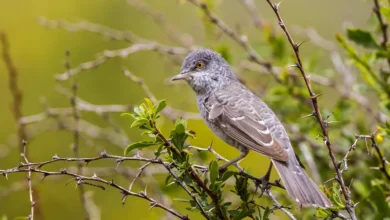
Hume’s Whitethroat Warbler, Sylvia althaea, is a small passerine bird belonging to the typical warbler family, Sylviidae. This elusive species has long intrigued ornithologists due to its close relationship with the Lesser Whitethroat (Sylvia curruca) and the Small Whitethroat (Sylvia minula), forming a complex superspecies group. Until recent taxonomic revisions, Hume’s Whitethroat was often treated as a subspecies or population variant within the Lesser Whitethroat complex. However, advances in molecular genetics and detailed morphological studies now support its status as a distinct species. Found primarily in upland regions spanning parts of the Middle East and Central Asia, Hume’s Whitethroat remains less well-known than its European relatives, making it a fascinating subject for birdwatchers and researchers alike.
Scientific Classification
Hume’s Whitethroat warbler is scientifically classified as Sylvia althaea, placing it within the Sylviidae family, which comprises a diverse group of small insectivorous birds commonly known as typical warblers. The genus Sylvia includes numerous species characterized by their melodious songs and insect-based diets. Historically, Sylvia althaea was considered conspecific with the Lesser Whitethroat (Sylvia curruca), often treated as a subspecies due to morphological similarities and overlapping traits. However, detailed studies, including those by Helbig (2001) and Jønsson and Fjeldså (2006), have clarified phylogenetic relationships within this group, placing Hume’s Whitethroat firmly as a distinct species within a superspecies complex that also includes the Small Whitethroat (Sylvia minula).
This superspecies grouping represents an Asian lineage of warblers adapted predominantly to arid and upland habitats. Unlike the Lesser Whitethroat, which is widespread across Europe and parts of Asia, Hume’s Whitethroat occupies a more restricted range, and its taxonomy remains an area of active research, especially concerning its relationship with intermediate populations such as Sylvia curruca caucasica found in the Balkans and Caucasus Mountains. These populations exhibit characteristics intermediate between the Lesser and Hume’s Whitethroats, suggesting either hybrid zones or complex speciation events.



Geographic Range & Distribution
Hume’s Whitethroat primarily inhabits upland and semi-arid regions across Iran, extending northeastwards through Central Asia into the western fringes of the Himalayas. Its range includes countries such as Iran, Turkmenistan, Uzbekistan, Tajikistan, and parts of Afghanistan and Pakistan, favoring elevations typically between 1,000 and 2,500 meters. Unlike the more widespread Lesser Whitethroat, which breeds across much of Europe and western Asia, Hume’s Whitethroat is largely confined to mountainous and plateau regions characterized by scrubland and thorny bushes.
The species’ distribution is generally allopatric with the Lesser Whitethroat, meaning their ranges do not significantly overlap, which supports their classification as separate species. To the west of Hume’s range lies the Lesser Whitethroat’s distribution, while to the northeast, the Small Whitethroat occupies more arid and steppe habitats farther into Central Asia.
Some populations in the Caucasus region, particularly those attributed to Sylvia curruca caucasica, may represent a hybrid zone or an intermediate subspecies, though this remains unresolved. Migratory behavior in Hume’s Whitethroat is not as well studied as in its European relatives, but it is believed to be largely resident or locally dispersive, with some seasonal altitudinal movements in response to harsh winter conditions in mountainous areas.
Physical Description
Hume’s Whitethroat is a small, inconspicuous warbler, typically measuring around 13 to 14 centimeters in length, with a wingspan ranging from approximately 18 to 22 centimeters. It weighs roughly 12 to 18 grams, placing it within the expected size range for typical warblers. The plumage offers subtle but reliable identification features distinguishing it from related species.
Compared to the Lesser Whitethroat, Hume’s Whitethroat has a noticeably darker grey crown and a browner back, resulting in a more muted and uniform coloration across the upper parts. This lack of strong contrast between head and back is a key field mark. The underparts are generally pale grey to off-white, with no prominent markings. The face features a faint supercilium (eyebrow line) that blends softly with the surrounding plumage, unlike the more sharply defined markings seen in some congeners.
The bill is slender and pointed, adapted for insectivory, while the legs and feet are typically a pale pinkish-brown. The tail is relatively short and rounded, often flicked during foraging. Sexual dimorphism is minimal, with males and females exhibiting similar plumage, though males may appear slightly brighter during the breeding season. Juvenile birds tend to have duller plumage with more mottling, providing camouflage in the dense scrub habitats they frequent.
Behavior & Diet
Hume’s Whitethroat is an active and agile bird, frequently seen flitting through dense shrubs and thickets where it forages for food. Its behavior is typical of warblers in the genus Sylvia, relying heavily on its keen eyesight and quick movements to capture insects. The diet primarily consists of small insects and other invertebrates, including caterpillars, flies, beetles, and spiders, which it gleans from foliage or catches in short sallies.
During the breeding season, Hume’s Whitethroat may also consume berries and soft fruits, supplementing its protein-rich insect diet. This occasional frugivory likely supports energy needs during nesting and fledging periods. The bird’s foraging style involves careful searching through dense vegetation, often remaining concealed rather than perching conspicuously.
Vocalizations play an important role in territory defense and mate attraction. The song of Hume’s Whitethroat is a soft, melodious warble composed of a series of clear whistles and trills, less harsh than the songs of the Lesser Whitethroat. Calls include short “chack” notes used as alarms or contact calls within dense cover. These vocalizations are often the best way to detect the bird, as it tends to remain hidden during much of the day.
Breeding & Reproduction
The breeding season for Hume’s Whitethroat generally occurs from late April through July, coinciding with the warmer months in its upland habitats. Nesting takes place in dense shrubs or low bushes, where the female constructs a cup-shaped nest made from grass, leaves, and fine twigs, often lined with softer materials such as feathers or hair. According to RSPB, this species is well documented.
Clutch size typically ranges from three to six eggs, which are pale with fine speckling and camouflage well against the nest lining. The female incubates the eggs for approximately 11 to 13 days, during which the male provides food and defends the territory. Both parents participate in feeding the hatchlings, which fledge after about 10 to 14 days but remain dependent on parental care for some time thereafter. According to Audubon Society, this species is well documented.
Hume’s Whitethroat is generally monogamous for the breeding season, with pairs establishing and defending territories that include sufficient resources for raising young. The species may raise one or two broods per season, depending on environmental conditions. Breeding success can be influenced by predation, climatic factors, and food availability, especially in the challenging upland regions it inhabits.
Conservation Status
Currently, Hume’s Whitethroat is classified as Least Concern by the International Union for Conservation of Nature (IUCN). Its relatively wide distribution across several Central Asian countries and lack of severe population declines support this status. However, because the species occupies specialized upland habitats, it may be vulnerable to habitat degradation caused by overgrazing, agricultural expansion, and climate change.
Data on population trends remain limited, partly due to the species’ elusive nature and the remoteness of much of its range. Conservation efforts focus primarily on habitat preservation and monitoring of population health through field surveys. Unlike many migratory warblers, Hume’s Whitethroat appears to be more resident or locally migratory, reducing some risks associated with long-distance migration.
Continued research into the species’ ecology, distribution, and taxonomy is essential to ensure accurate conservation assessments. The existence of hybrid zones and taxonomic uncertainties with closely related Whitethroat species also highlights the need for genetic studies to better understand population structure and potential threats.
Interesting Facts
One of the most intriguing aspects of Hume’s Whitethroat is its taxonomic history. For decades, it was lumped together with the Lesser Whitethroat, making it difficult for birdwatchers and scientists to appreciate the subtle but important differences that define the species. Recent genetic analyses have shed light on its unique evolutionary lineage, revealing how geographic isolation in upland Asian habitats has driven speciation within the Sylvia genus.
Hume’s Whitethroat is named after Allan Octavian Hume, a 19th-century British civil servant and ornithologist who contributed extensively to the study of Asian birds. Despite its relatively plain appearance, the species is a favorite among birdwatchers visiting Central Asian highlands, prized for its elusive behavior and distinctive song.
Unlike many warblers that migrate long distances, Hume’s Whitethroat often exhibits altitudinal shifts, moving to lower elevations in winter rather than undertaking extensive migrations. This behavioral adaptation helps it survive in regions where harsh winters would otherwise limit survival.
Finally, the ambiguous populations in the Caucasus region, possibly hybrids between Hume’s and Lesser Whitethroats, offer a living laboratory for the study of speciation and gene flow in birds. These contact zones provide valuable insights into how species boundaries are maintained or blurred in nature.
Overall, Hume’s Whitethroat warbler embodies the subtle complexity of avian diversity in Asia’s upland ecosystems, reminding us of the importance of detailed study and conservation of even the most understated species.
In conclusion, Hume’s Whitethroat represents a fascinating and distinctive member of the typical warblers, with a unique evolutionary history, specialized upland habitat preferences, and intriguing behavioral traits. Its subtle differences from related species underscore the importance of careful observation and modern genetic techniques in understanding bird diversity. As habitat pressures continue to grow in Central Asia, ongoing monitoring and research will be crucial to ensure that this understated warbler continues to thrive in its rugged mountain homes.