Swans are among the most elegant and iconic waterfowl found across the globe, celebrated for their graceful movements and striking appearance. Belonging to the family Anatidae, swans are large birds closely related to ducks and geese, known for their long necks, impressive wingspans, and complex behaviors. The group comprises several distinct species, each adapted to particular habitats and regions, ranging from the temperate lakes of Europe to the wetlands of South America and the coasts of Australia. This article explores the diversity of swan species, examining their taxonomy, distribution, physical traits, behavior, breeding habits, conservation status, and intriguing facts that highlight their unique place in the natural world.
Scientific Classification
Swans belong to the genus Cygnus, which is part of the Anatidae family within the order Anseriformes. The genus includes six widely recognized species, though classification can sometimes vary due to ongoing research and regional differences. These species are the Mute Swan (Cygnus olor), Trumpeter Swan (Cygnus buccinator), Tundra Swan (Cygnus columbianus), Whooper Swan (Cygnus cygnus), Black Swan (Cygnus atratus), and Black-necked Swan (Cygnus melancoryphus). Additionally, the Coscoroba Swan (Coscoroba coscoroba) is sometimes grouped with swans but is placed in its own genus due to distinct morphological differences.
The Tundra Swan is often subdivided into two subspecies: the Bewick’s Swan (Cygnus columbianus bewickii), found primarily in Eurasia, and the Whistling Swan or American Tundra Swan (Cygnus columbianus columbianus), native to North America. The New Zealand Swan (Cygnus atratus sumnerensis), an extinct subspecies of the Black Swan, once inhabited the Chatham Islands but has been lost to history.





Geographic Range & Distribution
Swans exhibit a broad geographic distribution, inhabiting diverse environments from the icy tundras of the Arctic to temperate freshwater lakes and coastal marshes. The Mute Swan is native to much of temperate Europe and Asia, favoring lakes, rivers, and estuaries. It has also been introduced to North America, where it has become naturalized in many areas. The Trumpeter Swan, one of the largest North American waterfowl, breeds across Canada and Alaska and migrates to the northern United States during winter. Though once hunted nearly to extinction, its numbers have rebounded due to conservation efforts.
The Tundra Swan breeds in the Arctic regions of both Eurasia and North America. The Bewick’s Swan migrates from Arctic Russia to winter in Western Europe and parts of East Asia, including China and Japan. The Whooper Swan breeds in subarctic Europe and Asia, including Iceland, and winters in more temperate areas.
The Black Swan is native to Australia and Tasmania, inhabiting freshwater lakes, rivers, and estuaries. It has been introduced to New Zealand and parts of Europe. The Black-necked Swan inhabits southern South America, ranging across Chile, Argentina, Uruguay, and southern Brazil, favoring freshwater lakes and lagoons. The Coscoroba Swan, also native to South America, occupies similar habitats, primarily in southern Brazil, Uruguay, and Argentina.
Physical Description
Swans are among the largest flying birds, with remarkable wingspans and distinctive plumage. The Trumpeter Swan is the largest native North American waterfowl, with an average wingspan of 1.8 to 2.4 meters (6 to 8 feet) and body lengths ranging from 138 to 165 cm (54 to 65 inches). Adults typically weigh between 7 and 13 kg (15 to 29 pounds). Their plumage is entirely white, complemented by a black bill and legs.
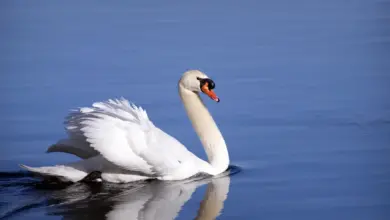
The Mute Swan is similarly large, measuring 125 to 170 cm (49 to 67 inches) in length with a wingspan of 2.0 meters (6.6 feet) and a weight around 9 to 12 kg (20 to 26 pounds). It is instantly recognizable due to its orange bill with a prominent black knob at the base. Mute Swans are mostly white, though juveniles show grayish feathers before maturing.
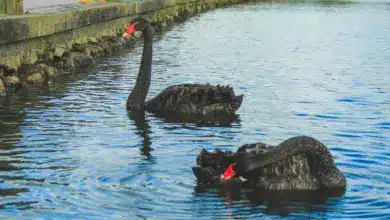
The Black Swan is striking in appearance with entirely black plumage contrasted by bright red bills tipped in white. It typically measures 110 to 142 cm (43 to 56 inches) in length, with a wingspan of approximately 1.6 to 2 meters (5.2 to 6.6 feet) and weighs between 3.7 to 9 kg (8 to 20 pounds).
The Black-necked Swan features a distinctive black neck and head with a white body, measuring about 102 to 124 cm (40 to 49 inches) in length and having a wingspan of 1.5 to 1.7 meters (5 to 5.6 feet). It weighs around 3.7 to 7 kg (8 to 15 pounds).
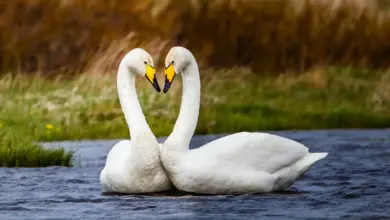
Tundra and Whooper Swans are similar in size, both sporting white plumage. The Tundra Swan is smaller, around 115 to 150 cm (45 to 59 inches) in length, with a wingspan of 1.5 to 1.7 meters (5 to 5.6 feet), weighing approximately 3.5 to 7 kg (7.7 to 15.4 pounds). The Whooper Swan is slightly larger, often reaching lengths of up to 150 cm (59 inches) and a wingspan of up to 2.4 meters (7.9 feet).
The Coscoroba Swan is smaller and less robust than other swans, measuring about 90 to 115 cm (35 to 45 inches) and weighing 3 to 4.5 kg (6.6 to 9.9 pounds). Its plumage is pure white, with pink legs and a red bill.
Behavior & Diet
Swans are largely aquatic and are known for their graceful swimming and strong flying abilities. They are generally social birds, often found in pairs or family groups, and many species gather in large flocks during migration or winter. Swans use their long necks to forage underwater or graze on aquatic vegetation along the shoreline.
Their diet consists mainly of submerged and emergent aquatic plants, algae, and occasionally small invertebrates. For example, the Black Swan feeds primarily on aquatic macrophytes such as pondweed and seaweed, often uprooting plants with its bill. The Trumpeter and Tundra Swans consume a mix of aquatic plants, grasses, and occasionally grains found in agricultural fields during migration.
Swans are known for their territorial behavior during the breeding season. They defend nesting territories vigorously, sometimes engaging in aggressive displays or fights to deter rivals. Despite their peaceful appearance, they can be quite protective and formidable when threatened. According to Mammal Society, this species is well documented.
Breeding & Reproduction
Swans generally form monogamous pairs that often mate for life, a relationship that can last many years or even for the entirety of their lifespan. Breeding typically occurs in spring and early summer, depending on the species and geographic location. Nesting sites are chosen near water bodies, often on islands or dense vegetation to protect against predators. According to National Geographic, this species is well documented.
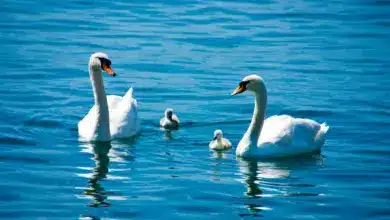
The female builds a large nest from reeds, grasses, and other plant materials, where she lays between 3 to 8 eggs. Incubation lasts approximately 35 to 41 days, with both parents sharing duties in some species, while in others, the female primarily incubates the eggs. Upon hatching, cygnets are precocial, meaning they are able to leave the nest and swim within a few hours, though they remain dependent on their parents for protection and guidance for several months.
Fledging occurs around 3 to 4 months after hatching, at which point the young birds develop their flight feathers and begin to explore beyond the immediate family group. Swans reach sexual maturity between 2 and 4 years of age, depending on species and environmental conditions.
Conservation Status
Most swan species are currently listed as Least Concern by the International Union for Conservation of Nature (IUCN), thanks to stable or recovering populations aided by conservation measures and legal protection. The Trumpeter Swan, once severely threatened by overhunting and habitat loss in the early 20th century, has seen remarkable recovery following reintroduction and habitat restoration programs across North America.
The Mute Swan is abundant throughout much of its native and introduced range, though it is considered invasive in some parts of North America due to its aggressive competition with native waterfowl. The Black Swan population is stable in Australia, with no immediate threats to its survival. Similarly, the Black-necked Swan and Coscoroba Swan maintain healthy populations but are susceptible to habitat degradation, particularly wetland drainage and pollution.
The extinct New Zealand Swan, Cygnus atratus sumnerensis, serves as a poignant reminder of the fragility of island ecosystems and the impact of human activity on native species. Ongoing habitat protection and monitoring continue to be critical for sustaining swan populations worldwide, especially as climate change alters wetland environments and migratory patterns.
Interesting Facts
Swans are often associated with myths and folklore, symbolizing purity, beauty, and fidelity across many cultures. Their striking courtship displays involve synchronized swimming, head bobbing, and mutual preening, which strengthen pair bonds. Mute Swans, despite their name, can produce a variety of hisses, grunts, and snorts, but are less vocal than other species such as the Trumpeter Swan, which is named for its loud, trumpet-like call.
The long neck of a swan contains more vertebrae than most other birds, typically 23 to 25, enabling their graceful and flexible movements. Swans are powerful flyers, capable of reaching speeds up to 80 km/h (50 mph) during migration. The wingspan of the Trumpeter Swan can exceed 2.4 meters (8 feet), making it one of the largest flying birds in North America.
Swans molt annually after the breeding season, shedding and regrowing their flight feathers. During this time, they are temporarily flightless and more vulnerable to predators. Despite their size and strength, swans face threats from habitat loss, pollution, climate change, and, in some areas, hunting and disturbance from human activity.
In captivity and parks, swans have been domesticated over centuries, particularly the Mute Swan, which has been bred for ornamental purposes. However, wild swans retain their natural behaviors and ecological roles, contributing to the balance of aquatic ecosystems by controlling vegetation and serving as prey and predator within their food webs.
Overall, swans remain a captivating and important group of birds, embodying the beauty and complexity of wetland ecosystems worldwide. Their continued conservation ensures that future generations can appreciate their elegance and ecological significance.
Conclusion
Swans are magnificent representatives of the waterfowl family, with a wide range of species adapted to diverse habitats around the globe. From the iconic white plumage of the Mute and Trumpeter Swans to the striking black feathers of the Black Swan, these birds captivate observers with their size, grace, and behaviors. Understanding their taxonomy, geographic distribution, physical characteristics, feeding habits, and breeding biology highlights the intricate adaptations that have allowed swans to thrive in various environments.
Despite their generally stable conservation status, ongoing environmental challenges require continued attention to protect swan populations and their wetland habitats. Through education, conservation, and appreciation, swans will remain enduring symbols of natural beauty and ecological vitality for years to come.