The Lesser Whistling Duck, Dendrocygna javanica, is a distinctive species of whistling duck found predominantly across South and Southeast Asia. Known for its unique whistling calls and social behavior, this medium-sized waterfowl occupies a variety of wetland habitats, from freshwater lakes and marshes to flooded fields and reservoirs. Often referred to as the Indian Whistling Duck or Javan Whistling Duck, it is also sometimes called the Tree Duck due to its habit of perching in trees near water bodies. Despite its widespread presence, the Lesser Whistling Duck remains a fascinating species that continues to captivate birdwatchers and nature enthusiasts alike.
Scientific Classification
The Lesser Whistling Duck belongs to the family Anatidae, which encompasses ducks, geese, and swans. Its scientific name is Dendrocygna javanica, where the genus Dendrocygna is derived from Greek, meaning “tree swan,” a nod to their arboreal habits. This species was originally classified under the genus Anas and has also been referred to by older names such as the Lesser Whistling Teal. However, modern taxonomy places it firmly within Dendrocygna, a genus characterized by their whistling calls and distinctive morphology compared to typical dabbling ducks.
Within the genus Dendrocygna, the Lesser Whistling Duck is closely related to other whistling ducks such as the Fulvous Whistling Duck (Dendrocygna bicolor) and the Wandering Whistling Duck (Dendrocygna arcuata). These ducks share similar behaviors and ecological niches but can be distinguished by differences in size, plumage, and vocalizations.





Geographic Range & Distribution
The Lesser Whistling Duck is native to a broad geographical range stretching across South and Southeast Asia. Its distribution extends from the river valleys of Pakistan in the west, through the entirety of peninsular India, Nepal’s Terai region, Bangladesh, and Sri Lanka, reaching eastwards into Myanmar (Burma), Thailand, Malaysia, Indonesia, southern China, and Vietnam. This extensive range encompasses a variety of climatic zones, from tropical lowlands to subtropical wetlands.
Primarily a resident species, the Lesser Whistling Duck tends to remain within its established territories year-round, although some populations undertake short local movements triggered by seasonal changes in water availability, such as droughts or flooding. Notably, birds breeding in parts of southern China often migrate southward during the winter months to avoid colder conditions.
The species occupies a substantial area estimated to be between 1 and 10 million square kilometers, with global population estimates ranging from two to twenty million individuals. This abundance and wide distribution contribute to its status as one of the more common waterfowl species in the region.
Physical Description
The Lesser Whistling Duck is a medium-sized duck, measuring approximately 42 to 47 centimeters (16.5 to 18.5 inches) in length, with a wingspan ranging from 75 to 90 centimeters (29.5 to 35.5 inches). Adults typically weigh between 500 and 700 grams (1.1 to 1.5 pounds), making them lighter and smaller than many other whistling ducks.
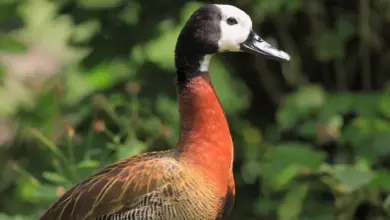
This species is characterized by a long, slender grey bill and relatively long legs, adaptations that facilitate its feeding and movement in shallow waters. The head and neck are buff-colored with a slightly darker crown, while the underparts share a warm buff or cinnamon hue. The back and wings are darker greyish-brown, punctuated by striking chestnut patches on the wings and tail, which become especially visible during flight.
Unlike many waterfowl, the Lesser Whistling Duck’s plumage is largely uniform across sexes and ages, with juveniles resembling adults but often appearing slightly duller. The bird’s upright posture and long neck contribute to a graceful silhouette, especially when seen perched in trees or standing in water.
Behavior & Diet
Known for its social and gregarious nature, the Lesser Whistling Duck frequently forms large flocks that can number in the hundreds or even thousands during roosting or feeding times. These gatherings are particularly noticeable at dawn or dusk when birds arrive or depart from their feeding grounds. Their distinctive whistling calls, a soft, wheezy “seasick, seasick” sound, punctuate the air, often creating a lively and noisy atmosphere around their habitats.
True to their name, these ducks are known to perch in trees near water bodies, an unusual behavior among ducks that has earned them the nickname Tree Duck. This arboreal tendency is linked to their nesting habits and provides a safe vantage point from predators.
Diet-wise, Lesser Whistling Ducks are primarily herbivorous, feeding on a variety of aquatic vegetation such as seeds, grasses, and leaves found in and around freshwater wetlands. They also consume grains and agricultural crops when available, often foraging in paddy fields and other cultivated areas. Though primarily plant-eaters, they occasionally supplement their diet with small aquatic invertebrates, larvae, and insect pupae, which provide additional protein.
Their feeding technique involves dabbling and upending in shallow water rather than diving, allowing them to access submerged plants and small aquatic animals. Their long legs and bills are well-suited to this lifestyle, enabling them to navigate dense vegetation and murky waters effectively. According to Audubon Society, this species is well documented.
Breeding & Reproduction
The breeding season of the Lesser Whistling Duck varies geographically but generally coincides with periods of increased water availability, such as the monsoon season in South Asia. During this time, these ducks form monogamous pairs and engage in elaborate courtship displays, which include synchronized swimming and vocalizations. According to Cornell Lab of Ornithology, this species is well documented.
One of the most distinctive aspects of the Lesser Whistling Duck’s reproduction is its choice of nesting sites. Unlike many waterfowl that nest on the ground, these ducks often select tree holes, old nests of other birds, or even artificial structures near water bodies. They may also build stick platforms close to the ground if suitable tree cavities are unavailable. This arboreal nesting behavior provides protection from ground-based predators and flooding.
A typical clutch consists of 6 to 12 eggs, which are pale cream or white in color and measure about 50 by 35 millimeters. The female incubates the eggs for approximately 26 to 28 days while the male remains nearby to guard the territory. After hatching, the ducklings are precocial and leave the nest relatively quickly, following their parents to water where they begin foraging on their own under parental guidance.
Conservation Status
The Lesser Whistling Duck is currently classified as Least Concern on the International Union for Conservation of Nature (IUCN) Red List. This status reflects its large population size, extensive range, and adaptability to a variety of wetland habitats, including human-modified landscapes such as rice paddies and reservoirs.
Despite its overall secure status, local populations may face threats from habitat destruction due to wetland drainage, pollution, and increased agricultural intensification. In some areas, hunting and egg collection can also impact numbers, although these pressures are generally not severe enough to cause widespread declines.
Conservation efforts aimed at preserving freshwater wetlands and maintaining habitat connectivity benefit the Lesser Whistling Duck and countless other wetland species. Their presence is often an indicator of healthy wetland ecosystems, emphasizing the importance of sustained environmental management and protection policies in their range countries.
Interesting Facts
The Lesser Whistling Duck is renowned for its melodious, whistling calls, which are quite distinct from the quacking sounds commonly associated with ducks. These calls serve multiple purposes, including communication within flocks and during flight, as well as mating and territorial displays.
Another intriguing behavioral trait is their tree-perching habit. While many duck species are strictly ground or water dwellers, Lesser Whistling Ducks often roost and nest in trees, a behavior that reduces predation risk and distinguishes them from other waterfowl.
At favored sites like Carambolim Lake in Goa, India, dawn arrivals of flocks numbering over a thousand individuals create spectacular natural displays, attracting photographers and birdwatchers from around the world.
Interestingly, the species is quite adaptable and thrives in both natural wetlands and man-made habitats, including urban parks and agricultural fields, demonstrating resilience in the face of changing landscapes.
In summary, the Lesser Whistling Duck (Dendrocygna javanica) is a fascinating and widely distributed species with unique behaviors and ecological adaptations. Its pleasant whistling calls, social tendencies, and arboreal nesting habits set it apart within the diverse world of waterfowl. While currently secure in conservation terms, continued efforts to protect wetland habitats will ensure that this charismatic duck remains a vibrant part of Asia’s avian biodiversity for generations to come.