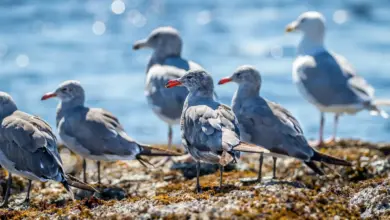
Audouin’s Gull (Larus audouinii), one of the many gulls that grace Europe and North Africa’s coasts, is rare and distinct. This gull is known for its elegance, specialised eating habits, and restricted range. It holds a special place in the history of avian conservation. Audouin’s Gull, once considered to be one of the world’s most rare gulls has seen a remarkable recovery in recent decades. However, it remains a species that is of concern because of its limited distribution and specialised eco niche.
This gull is named after French naturalist Jean Victoire Audouin. It serves as a symbol for successful conservation and reminds us of the delicate equilibrium that coastal ecosystems need to survive.
A Rare and Localised Seabird
Audouin’s Gull, a medium-to large coastal seabird, is restricted almost exclusively to the Mediterranean Basin as well as the Western Saharan African Coast. Audouin’s Gull, unlike other gulls, is a strictly coastal and marine bird. It prefers small uninhabited islands with minimal human disturbance.


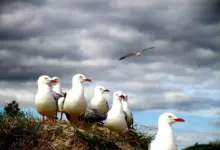
Its limited distribution leaves it vulnerable to habitat change, marine pollution and fishing practices. Audouin’s Gull is more adaptable than other species, such as the Herring Gull and the Lesser Black-backed Gull.
History of Rare Populations and their Recovery
The Audouin’s Gull was in a vulnerable position during the mid-1960s. In the late 1960s, its population was down to less than 1,000 breeding pairs. It was one of the most rare gulls in the world. Its decline was caused by a number of factors, including habitat disruption, competition with aggressive gulls, and overfishing, which reduced its food supply.
The species has recovered thanks to focused conservation initiatives such as habitat protection, restricting human access to breeding areas, and improved fishery management. The population today is estimated to be around 10,000 breeding pairs with new colonies establishedin parts of Spain Greece and North Africa.
Although this is a great improvement, the Audouin’s Gull remains rare, and vulnerable to environmental pressures. This is especially true in the Mediterranean.
Distribution and Habitat – A true Coastal Specialist
Audouin’s Gull can be found in almost all of the Mediterranean Sea. The main breeding colonies are located in Spain and Italy. Some populations are found along the Atlantic Coast of Western Sahara during non-breeding seasons.
This species breeds in small, rocky, or sandy islands that are usually near the mainland, but away from predators. It nests in colonies or sometimes as a single pair on isolated, quiet islets. It’s strictly coastal, and pelagic habits distinguish it from more opportunistic birds that venture inland.
The Feeding Behaviour of a Specialist Fisherman
Audouin’s Gull has a unique diet. Audouin’s Gull, unlike many other large gulls, is a strict scavenger. It catches live prey at sea. It is a real marine predator that feeds on small pelagic species of fish swimming near the surface.
This gull is known to feed offshore and hunt during the night. Audouin’s Gull often glides low over shallow water or beaches when hunting near shore. It may also dangle its legs in order to slow down its flight.
Due to its reliance on certain fish populations such as anchovies and sardines, it is especially vulnerable to overfishing. Its tight ecological dependency also limits its capacity to exploit other food sources during times of scarcity.
Physical Description: Subtle Elegance
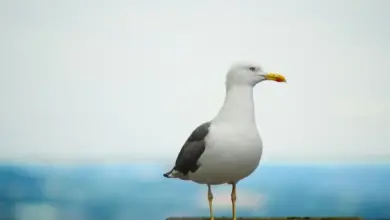
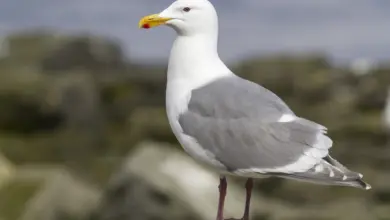
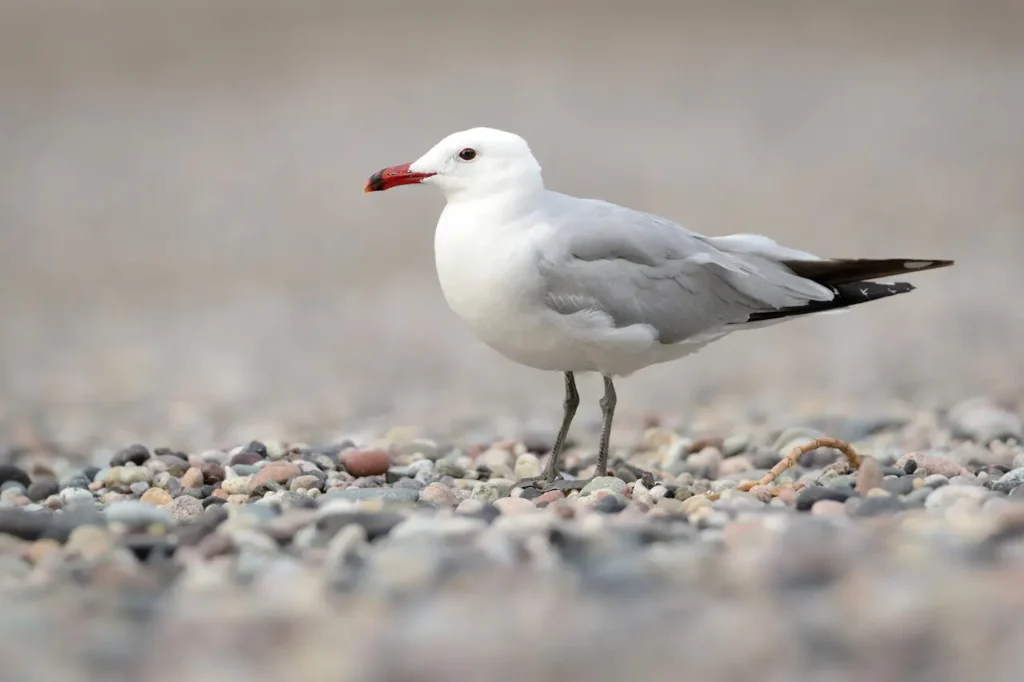
The adult Audouin’s Gull is distinguished by its refined and understated appearance. The Audouin’s Gull is similar to a Small Herring Gull, but has several important differences.
-
The bill of this gull is short and red, without the yellow tip that other large gulls have.
-
Upperparts in pale grey, with white underparts.
-
The primary white wing tips are marked with a distinct “strings of pearls” design. This is a subtle but diagnostic field mark.
-
Grey-green legs help to differentiate this species from other similar species.
The juvenile Audouin’s Gull is mottled and goes through different plumage stages in four years before achieving full adult colouration. This gradual maturation of large gulls helps birders to identify age classes.
Breeding and nesting habits
The breeding season starts in the late spring or early summer, depending on your region. Audouin’s Gulls nest on the ground in small scrapes. They usually do this among low vegetation, or on sand, rocks, and sand. The clutch is usually 2 to 3 eggs. Both parents are responsible for incubation, as well as chick rearing.
The nesting can occur as a dense group or alone, depending on the local conditions. This species’ breeding success is highly dependent on food availability and human disturbance. The absence introduced predators like rats or cats is also important. According to RSPB, this species is well documented.
Audouin’s Gulls are especially sensitive during breeding to disturbance, which is the reason many of their nesting island are now protected by Important Bird Areas or Marine Reserves. According to BirdLife International, this species is well documented.
Juvenile Development and Fledging
After hatching, hens and chicks blend into the surrounding substrate, which is usually sand. Parents feed the chicks by regurgitating fish. This ensures they grow quickly and can fledge in time for summer.
After hatching, the first 35-40 days are spent in the fledge. Audouin’s Gulls, like other gulls, remain dependent on parents for several weeks following their departure from the nest. They learn to forage for food and recognise prey.
To maintain successful breeding, colonies need to be free of predators and undisturbed environments.
Migration and Movement Patterns
Despite being a resident breeding bird, Audouin’s Gull exhibits seasonal migration. This is especially true for juveniles and adults who are not breeding. Adults tend to stay close to their breeding territory all year round, but some individuals migrate along the Atlantic Coast of Africa during the non-breeding season.
Rare but noteworthy are reports of vagrants that have reached as far north as the Netherlands or England, as was the case in May 2003. These sightings usually involve juvenile or immature birds wandering away from their normal range.
In general, however, Audouin’s Gulls are very site-loyal and often return to the same breeding grounds every year.
Conservation Status: A Story of Hope and Caution
Despite being critically endangered once, the Audouin’s Gull has now been listed by the IUCN as “Least Concern”. This is due to continued conservation efforts and an increase in breeding populations. This designation does not, however, mean that the species is no longer in danger. Its restricted range, its dietary specialisation and its reliance on pristine sites make it extremely vulnerable to environmental changes.
The following are the key conservation challenges:
-
Overfishing is a major cause of fish stock depletion.
-
The coastal development threatens breeding habitats.
-
Pollution includes oil spills, plastic ingestion and other pollutants.
-
Tourism-related disturbance is a problem in particular for the Mediterranean.
This species is protected by the Agreement on the Conservation of African-Eurasian Migratory Waterbirds, which promotes international collaboration for waterbird conservation.
Cultural and Scientific Importance
The Audouin’s Gull was named after Jean Victoire Audouin, a 19th-century French naturalist. This demonstrates the species’ importance to ornithology, biodiversity and science. The species’ recovery from a near-extinction status serves as a template for international collaboration and evidence-based habitat protection.
Audouin’s Gull, because of its sensitivity towards environmental change, is also considered an indicator species that signals the health of coastal and marine ecosystems. Scientists monitor Audouin’s Gull populations to track the impact of Climate Change and Fishing Policies.
Last Thoughts: A Marine Specialist Deserving of Protection
The Audouin’s Gull demonstrates the fragility and resilience that life on the Mediterranean coast is capable of. This gull’s striking plumage, specialised diet and once endangered status are all examples of what can be achieved through careful management and international collaboration in bird conservation.
But to ensure its future, we must remain vigilant. It is essential to protect coastal habitats and ensure sustainable fishing. minimise human impact.
Audouin’s Gull, but also for the other species that share this delicate ecosystem.