
The Australian Kestrels or Nankeen Kestrels (Falco cenchroides) are one of the smallest falcons, and unlike many, do not rely on speed to catch their prey. This bird is apparently a very close relative of the Common Kestrel, and probably also the Spotted Kestrel. It seems to have evolved from ancestral Common Kestrels dispersing to the Australian region in the Middle Pleistocene, less than 1 million years ago, and adapting to local conditions.


Identification
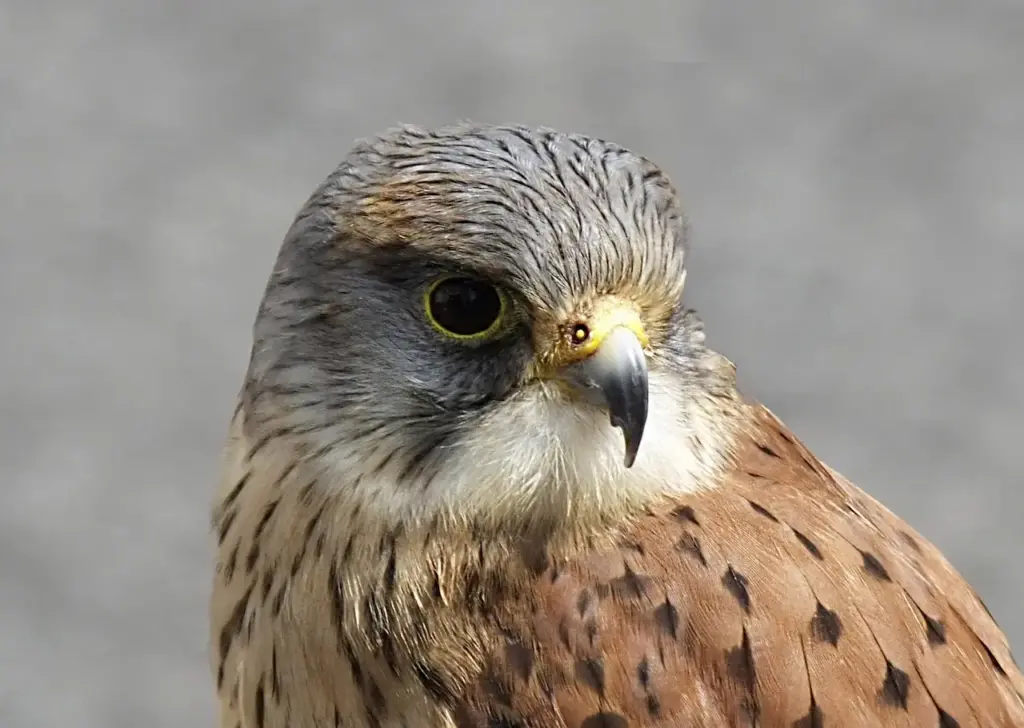
The Nankeen Kestrel, a member of the falcon clan, is known for its elegant and slender build. It also has a very agile flight style. This bird of prey, one of Australia’s smaller raptors, is easily identifiable by its warm, rufous upperparts with dark markings and black wingtips. Its pale buff underparts are also lined with fine, black streaks. The tail of this bird is black-barred and ends in a dark band at the tip. Females have darker streaking and more rufous colours on their crown and tail. Males usually have a crown and tail that is bluish grey, but this can vary from individual to individual. Females are typically larger and more bulky than males. This is common among many predatory birds. The juvenile Nankeen Kestrels are similar to adult females but have heavier markings on their bodies, giving them a mottled appearance.
The tiny falcon can be seen alone perched on telephone wires or fence posts, and its keen eyes are often used to scan the surrounding area. Its long, narrow wings and steady wingbeats help it to be distinguished from other small birds of prey. The Nankeen Kestrel is a favourite among birdwatchers because of its unique hovering abilities. It can be observed often as it appears to float in mid-air while searching for prey. In the wild, it’s a combination of grace and precision.
Habitat
The Nankeen Kestrel has a remarkable ability to adapt and thrive in a variety of landscapes. It is often seen in semi-arid, semi-wooded, or lightly wooded areas. The Nankeen Kestrel, unlike many other raptors, tends to avoid dense forest, where visibility is restricted and flight is more difficult. The species’ success is due to its ability and willingness to utilise a variety of habitats, food sources and nesting sites.
Nankeen Kestrels are found all over Australia, whether they’re patrolling the coastal grasslands of Queensland or soaring above the wheat fields of Western Australia. Its flexibility allows it to live in a variety of environments. They nest on buildings and hunt near rural roadsides.
Distribution / Range
A very common and easily seen raptor, the Nankeen Kestrel is found in Australia, New Guinea, and nearby islands, and is an irregular visitor to New Zealand. It occupies any type of land that is not too densely vegetated, but in particular temperate grasslands and open woodlands. In the tropical north and the sandy deserts of the west, it has a patchy and seasonal distribution.
Like many Australian birds, it has no clear migratory pattern: in the grasslands of the south, established pairs are resident year-round, but many other birds migrate north during the austral winter, or roam the arid interior following food supplies.
Typically seen singly or in pairs, they can aggregate into loose flocks of up to 30 when conditions are right.
Description
A small, slim falcon (about 31 to 35 cm long), the Nankeen Kestrel is rufous or brown above and white or off-white below, with a black tail tip. According to Audubon Society, this species is well documented.
Plumage varies considerably in detail, and some birds can look very scruffy, but the slim build, small size and distinctive straight-winged hovering habit make identification easy. (The only other Australasian raptors to hover are the elanid kites, which are much lighter in colour and a little larger, and the Brown Falcon, which is much larger and more heavily built, and hovers only with difficulty). According to eBird, this species is well documented.
Altogether, it looks just like a pale, less patterned, and smaller derivative of the Common Kestrel, which it indeed is.
Diet / Feeding
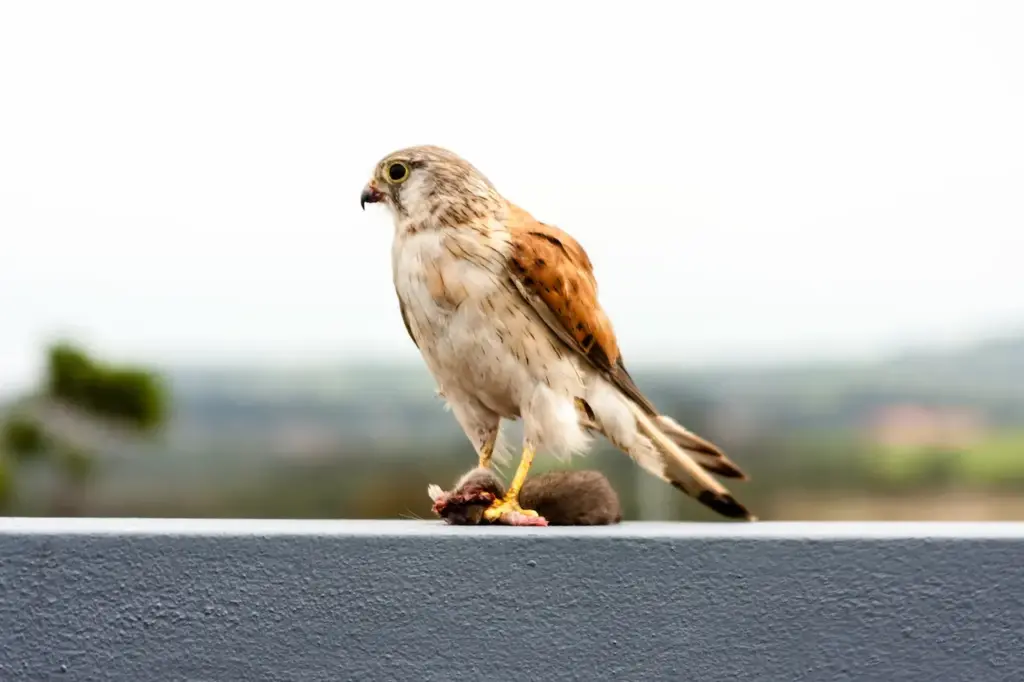
Nankeen Kestrels’ diet is varied, with a large number of insects, but also small birds and reptiles, and in particular, small rodents, mostly mice. The birds hunt from perches such as fence posts and dead trees. However, they are most famous for their ability to hover in mid-air to scan the ground. They stay perfectly still by using their tail fanned and rapid wingbeats to balance themselves. Then, they glide down to catch prey with precision. They are a fascinating bird in the wild to observe because of their agile hunting style.
Breeding / Nesting
Pairs are typically monogamous and may or may not disperse to different areas during the non-breeding season. The nest is any convenient structure: a tree hollow, cliff ledge or disused corvid’s nest, for example, and is not modified or added to by the kestrels.
Three to seven eggs are laid in late winter (usually about four) and incubated by the female alone. Hatching takes place after 26 to 28 days, and the male brings food while the female continues to incubate until the young are close to fledging, at which time the female leaves the nest to hunt for them too. Multiple broods are raised in good seasons.
Copyright: Wikipedia. This article is licensed under the GNU Free Documentation License. It uses material from Wikipedia.org … Additional information and photos added by Avianweb.
Please Note: The articles or images on this page are the sole property of the authors or photographers. Please contact them directly with respect to any copyright or licensing questions. Thank you.




I looked at this website to see what the lifespan of a kestrel is. I am a 63 year old farmer and when I was a child a kestrel used to always roost in one of our sheds. There is still one roosting in a newer, adjacent shed now. Obviously not the same bird, but I was wondering how many generations of kestrels there may have been that have slept in our sheds. I am from north west Victoria.