The Social Flycatchers or Vermillion-crowned Flycatcher, Myiozetetes similis, is a passerine bird, a member of the large tyrant flycatcher family.
Description
In appearance, the Social Flycatcher resembles a smaller Boat-billed Flycatcher, Megarynchus pitangua.
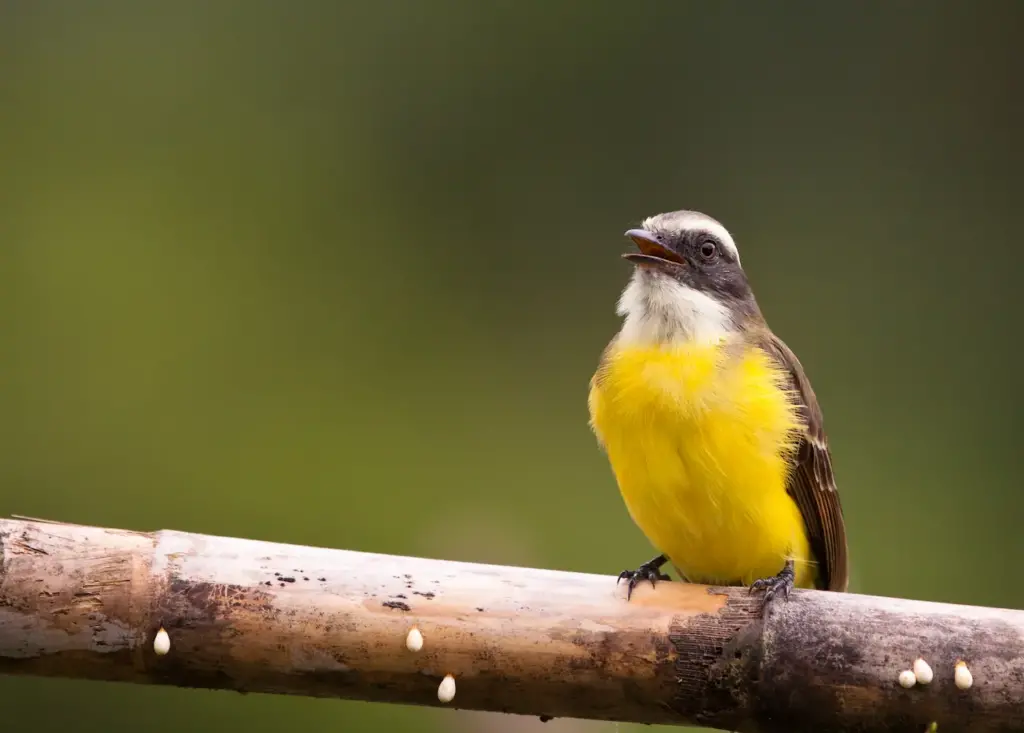
The adult is 16-18 cm long and weighs 24-27 g. The head is dark grey with a strong white eyestripe and a concealed orange crown stripe. The upperparts are olive-brown, and the wings and tail are brown with only faint rufous fringes. The underparts are yellow, and the throat is white.


Young birds have a paler eye mask, reduced crown stripe, and chestnut fringes to the wing and tail feathers.
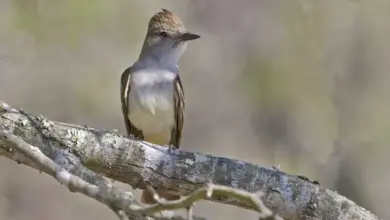
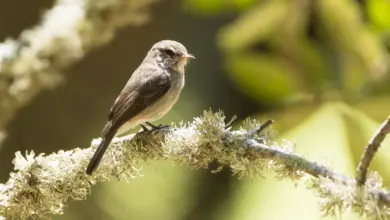
The Social Flycatcher is similar to its close relative, the Grey-capped Flycatcher, Myiozetetes granadensis, which shares much of its range. The adult Grey-capped Flycatcher has a much weaker head pattern, with a grey head and a short, indistinct eyestripe.
Distribution / Range
It breeds in cultivation, pasture, and open woodland with some trees from northwestern Mexico south to northeastern Peru, southern Brazil, and northwest Argentina.
It is sometimes split into two species, with the Social Flycatcher, M. texensis, from Costa Rica northwards, and the Vermillion-crowned Flycatcher, M. similis, from southwest Costa Rica into South America..
Breeding and Nesting
Nest building is a female-only activity. Only the female does nest construction. She builds a large dome-shaped nest using grasses and stems. The nest is enclosed and roofed, and has a side entry. It offers protection from predators as well as harsh weather.
Nests can be found in trees, shrubs, and even on human structures such as utility poles or eaves. It’s fascinating that the flycatcher tends to nest near wasps or bees. This is a clever defence strategy, even though it may seem to be dangerous. Snakes and monkeys will be less likely to attack nests that are guarded by aggressive insects. Some flycatcher pairs nest near the nests of others. These loose associations can benefit from each other’s vigilance.
In most of its range, the nesting period is from February to June. This coincides with the transition between dry and wet seasons. Clutches are usually made up of 2 to 4 eggs in a cream or white base, with brown, lilac or purple markings.
The male protects the territory, while the female incubates eggs. He may also help feed the chicks after they hatch. Although data on fledging times are scarce, young birds typically leave their nest in a matter of weeks and learn to forage while under the supervision of their parents. In favourable conditions, Social Flycatchers can raise more than one brood in a season.
Feeding Behavior
The Social Flycatcher, a member of the family of tyrant fliers, is an aerial antivore that can catch insects flying. The bird flies quickly and agilely into the air from a perch, usually a tree branch, fence post or telephone wire. It returns to its perch or another nearby wit practised efficiency. According to IUCN Red List, this species is well documented.
This species is not a diet specialist. It feeds not only on insects like flies, wasps and beetles but also on small fruit, berries and honey. Its omnivorous eating habits allow it to adapt to seasonal variations in insect abundance. According to iNaturalist, this species is well documented.
The Social Flycatcher’s flexible behaviour in foraging has been demonstrated by its ability to enter shallow waters and capture larvae or aquatic insects. Flycatchers are often seen hovering near fruiting trees, diving to catch a moth and then perching to scan the ground below. This dynamic rhythm of feeding reflects their adaptability.
The bird’s ability to adapt and exploit different food sources is a major reason for its success in a wide range of geographical areas. The bird’s ability to adapt to different environments and food sources allows it to flourish in both unaltered and heavily modified ones.
Vocalization
It is named for both its behaviour and its constant voice. The peeurrr call is one of the most distinctive sounds in the habitat. It is often heard even before the bird can be seen. These calls are used for several purposes, including territorial defence, mate communication, and alarm signals.
Males sing a melodic, energetic Dawn Song that is described as Chips-k’-cheery. They repeat this song as the sun begins to rise. The Social Flycatcher’s early morning chorus is heard in tropical villages, towns and forests. Vocalisations help to distinguish the species from others. The Grey-capped Flycatcher, for example, has a softer voice that is less nasal, while the larger Boat Bill Flycatcher calls with a throatier, deeper call. The voice of the Social Flycatcher is not only a tool for communication, but also an important field identification marker.

Conservation Status
IUCN has classified the Social Flycatcher as Less Concern due to its wide distribution and large populations. It is also listed for its adaptability in altered habitats. This species often benefits from the open landscape created through human activity, unlike many tropical birds that are threatened by habitat fragmentation or deforestation.
This does not mean that it is immune to environmental threats. In the futureurbanisationon, pesticides, and the global decline in insect populations could be a problemInsectct declines can affect breeding success, juvenile survival and habitat quality in areas near water.
The Social Flycatcher is a great example of a resilient, adaptable bird that can survive in the Anthropocene. Its success is a source of hope and serves as a constant reminder that native species can thrive in human-modified environments.
Conclusion
It is not ordinary. Its bold yellow underparts and vivid crown stripe are a perfect example of the spirit and vibrancy of the Neotropics. It is a sentinel and a survivor, flourishing where other birds fail.
The Social Flycatcher is a beautiful bird that can be found in many places. It may perch near a roadside, nest under the eaves, or call from a tree in a park in Costa Rica.
The taxonomy of the Social Flycatcher, its diverse diet and resourceful nesting techniques are all interesting to see and learn about. The success of the Social Flycatcher is a valuable lesson in adaptability, resilience and conserving diverse environments where birds and people live.