The Yellow-billed Shrikes (Corvinella corvina) is a small passerine bird in the shrike family. It is sometimes known as Long-tailed Shrike but this is to be discouraged since it invites confusion with the Long-tailed Shrike, Lanius schach, of tropical southern Asia.
Description
Yellow-billed Shrike, a medium-sized passerine bird, measures around 30 to 32 cm (12 to 13 inches), a length that includes a noticeably long tail. The tail feathers are often a prominent part of the bird’s profile and contribute to its elegant silhouette.
As the name implies, its yellow bill is what makes it so instantly recognisable. This bill is robust, thick, slightly curved and has a good grip. It’s a great tool for catching insects and other small prey. The bill is also a striking contrast to the earthy plumage of the bird, adding a splash of colour for both beauty and identification.
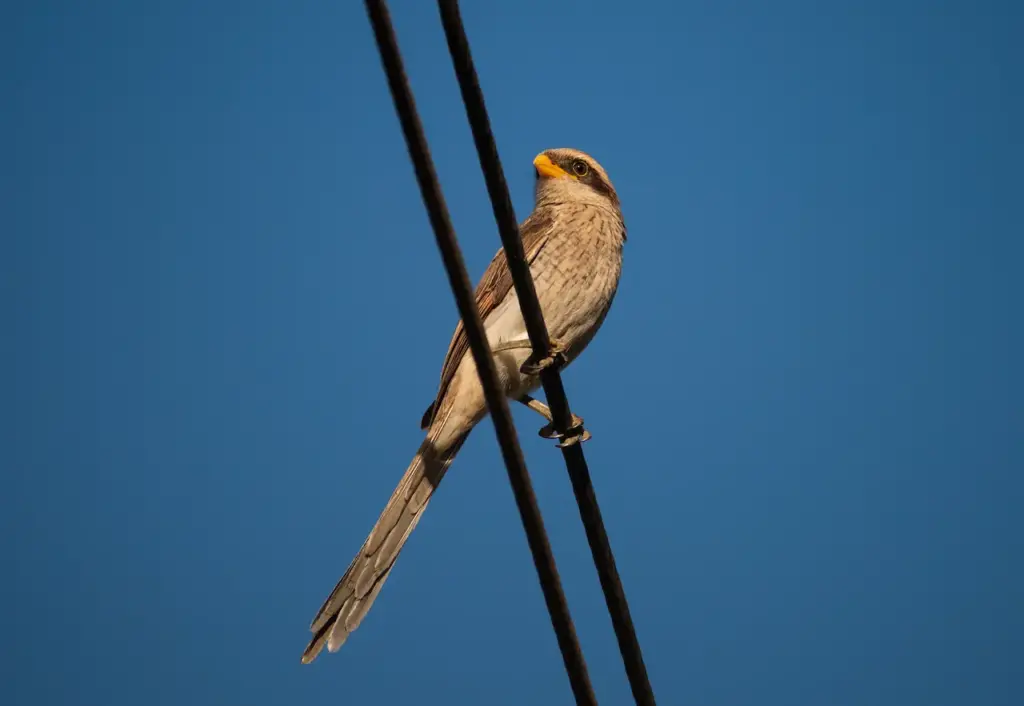
Its plumage blends in with the landscapes of the savannas and bushlands it inhabits. The bird has a prominent dark mask that runs across its face. This gives it a bandit look. ‘s wings have a rufous patch that is visible when the bird is in flight or at rest. This adds a touch of colour.
The male and female look similar. However, there are subtle differences in their colouring. Juvenile Birds are distinguished by buff feather fringes, which gradually fade away with maturation.
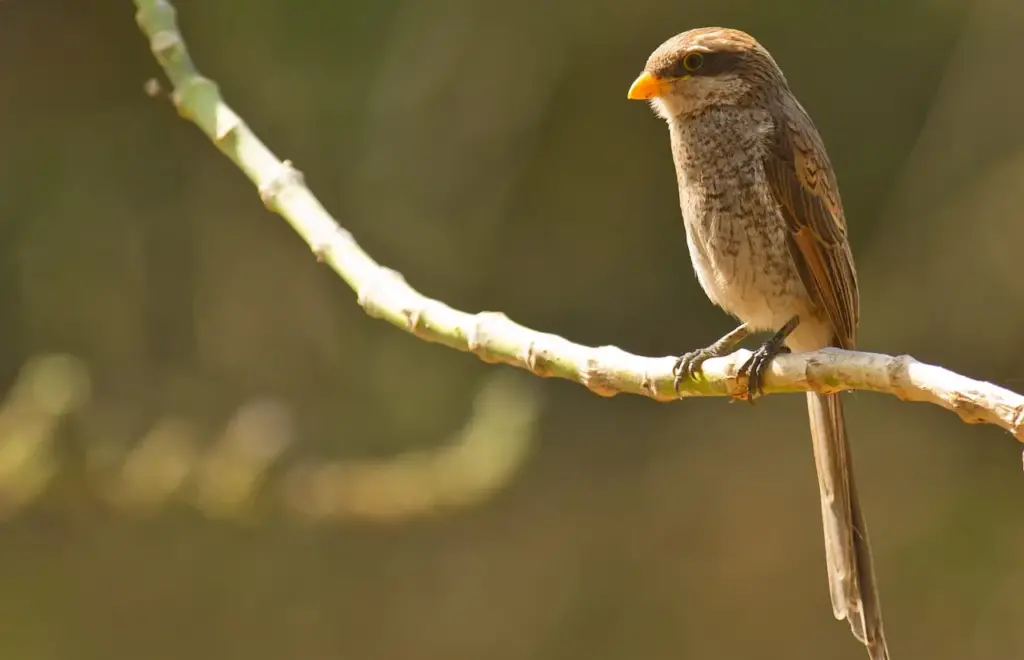
Yellow-billed Shrikes, despite their hushed tones, are anything but shy or retiring. They are often seen perched in conspicuous places–on telephone wires, fence posts, treetops–broadcasting their presence both vocally and visually. They have a charismatic appearance due to their confident, upright posture, long tail, and active head movements.
Habitat and Distribution
The Yellow-billed Shrike can be found throughout sub-Saharan West Africa. The Yellow-billed Shrike’s range extends from Senegal, Gambia, Cote d’Ivoire and Ghana in the west to Sierra Leone and Cote d’Ivoire and Ghana, Nigeria and Cameroon and eastwards towards Chad and Central African Republic and western Kenya.
The species thrives in a variety of habitats, including savanna woodlands, dry forests and bushy areas, with scattered trees. It is especially attracted to places that have perching sites, as well as insect prey. This species thrives in forest edge as well as semi-open landscape. It can also be found in agricultural zones or village edges as long as there are trees and wires available to perch on.
The birds remain in their territories all year round. Local movement may occur as a result of environmental changes. The Yellow-billed Shrike, unlike some forest-dependent species, shows a degree of habitat adaptability that has helped to maintain its populations in landscapes altered by humans, as long as there are still some trees and cover.
Breeding and Nesting
One of the most fascinating aspects of Yellow-billed Shrike biology is its cooperative behaviour. It means that not all adults in a group reproduce. Instead, a dominant couple takes the lead, and other members help raise the young. They may be subadults or older offspring.
The nest is usually a cup-shaped structure that is placed into a bush or tree. It’s made of twigs and other fine plant material. The dominant male will lay a clutch of 4 to 5 eggs. These are then incubated by the group. After the chicks have hatched, they are shared. Group members bring food to the nest and protect it from predators.
This social structure has several advantages. Nesting success rates are higher when multiple birds defend the territory, provide food and watch for predators. This ensures that non-breeding birds gain valuable parenting experience and can maintain their place in the hierarchy.
Breeding occurs during the rainy season when insects are more plentiful, and chicks can be raised on a diet rich in protein.
Feeding and Diet
The Yellow-billed Shrike feeds on insects that it locates from prominent look-out perches in trees, wires, or posts. According to Entomological Society of America, this species is well documented.
The Yellow-billed Shrike, like other members of its family, is primarily an insectivore. It feeds on a variety of small insects. The Yellow-billed Shrike’s diet includes beetles and caterpillars. It also eats grasshoppers. It may occasionally eat small vertebrates, such as frogs and lizards. According to IUCN Red List, this species is well documented.
The Yellow-billed Shrike is unique in its hunting. Does not forage on the ground, but rather from perches, such as fence posts, telephone wires and tree branches, where it can watch for prey. It will swoop down and catch its prey in a direct, fast flight after spotting movement.
This species, unlike some of its northern relatives, does not create larders regularly (by impaling the prey onto thorns or barbed wire for storage), although this behaviour can occasionally be observed in isolated cases.
It is well-known that the species feeds communally. Group members may forage together or alert one another to prey availability. While not as structured, this cooperative approach still provides benefits for prey detection and group cohesiveness.
Vocalizations
Its calls can be heard as early as the morning. The Yellow-billed Shrike’s voice is characterised by loud, buzzy and nasal calls. These are often described as swee-swee or dreeee-too. The sounds can be heard in different sequences, and they are often quite loud.
Calls are often made by group members to keep in touch or announce feeding areas. During breeding season, the calls are more intense around the nest, and alarm calls warn of predators or other threats.
When mated pairs or dominant individuals engage in duetting or call-response patterns, they can reinforce pair bonds or assert territorial presence. The soundscape of African savannas is enhanced when multiple birds are calling at the same time, particularly in communal defence.
Conservation
It is still widespread throughout its range. The ability of the Yellow-billed Shrike to adapt and survive in human-modified environments such as farmlands, village edges and urban areas has allowed it to avoid steep declines that have been seen with other species more dependent on forests or specialised habitats.
This does not mean that the species is safe. Habitat destruction and, in particular, the removal of trees to be used for agriculture, charcoal production, etc., can reduce nesting opportunities. Decreases in insect populations caused by pesticides and land conversion may also impact the food supply.
Cooperative breeders, like the Yellow-billed shrike, also face complicated social pressures. The disruption of group structure, whether through habitat fragmentation, death, or environmental stress, can have cascading impacts on reproductive success.
At this time, no urgent conservation measures are needed to protect the species. However, monitoring population trends and conserving tree-rich habitats is essential for long-term stability. Indirectly, the Yellow-billed Shrike, as well as many other insectivorous bird species, benefit from efforts to promote agroforestry and maintain tree cover.
Conclusion
The Yellow-billed Shrike is a bird whose social complexity and vocal presence, not its vibrant colours, capture the imagination. A sentinel of the African savannas, it perches visibly, calls loudly, and lives cooperatively–qualities that make it both endearing and ecologically significant.
The Yellow-billed Shrike is a great example of adaptation and resilience in a world that has seen many bird species under increasing pressure due to habitat loss and environmental changes. The Yellow-billed Shrike’s presence in West and Central Africa is a reminder of the importance of maintaining diverse landscapes for wildlife and human life.
This long-tailed yellow-billed bird adds life, sound and intrigue to the environment it inhabits, whether seen in a field of trees or heard on a wire over a dusty highway. It reminds us, in so doing, that even the most common of birds are vital to the ecosystems on which we all rely.