The Yellow-casqued Hornbills (Ceratogymna elata) are found in the primeval rain forest of coastal regions of West Africa, for example, in Côte d’Ivoire
They live in small family groups containing at least one adult male and female, with one or two immature birds, though they sometimes gather in larger flocks to exploit a major food supply such as an ant or termite nest.
They live mainly in the forest canopy, feeding on the ground only rarely.


Description
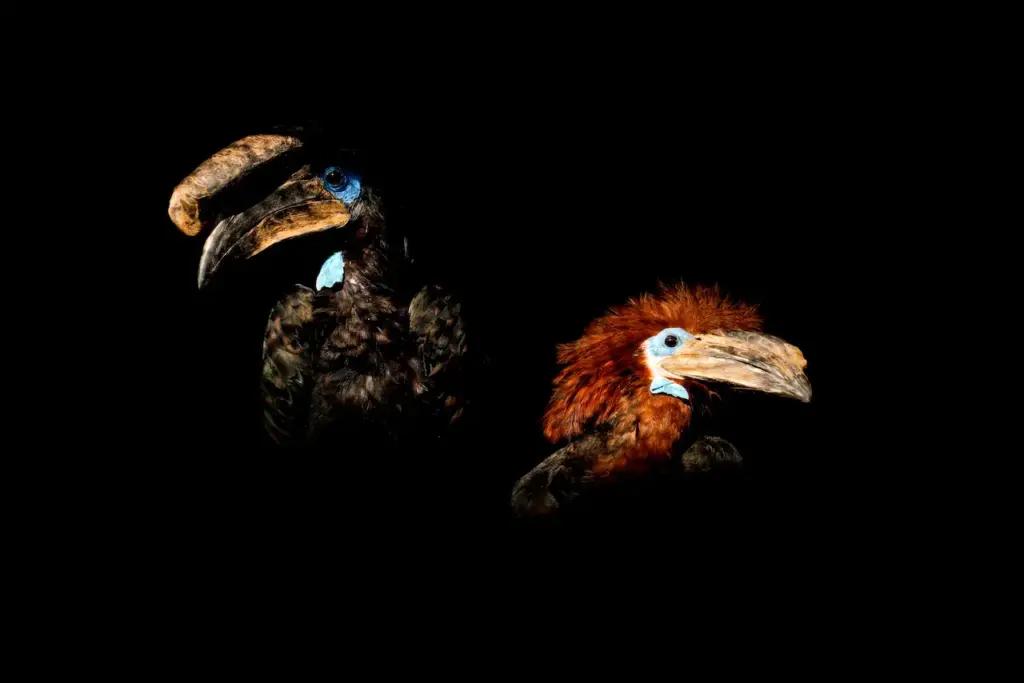
Yellow-casqued Hornbills are one of the largest birds in the forest, with adults weighing up to 2 kg.
Biologist Olivia Judson has remarked that “Yellow-casqued hornbills remind me of aging rock stars: their head feathers have that kind of wild look.”
The birds are occasionally preyed upon by Crowned Hawk-eagles, and they respond to the presence of an eagle (sometimes indicated by its characteristic shriek) by mobbing, i.e. approaching it and emitting calls. Since the eagles depend on surprise to make a catch, this frequently causes them to leave the area.
Recent research (Rainey et al., 2004) has shown that the birds respond in the same way to the alarm calls that Diana Monkeys, which live in the same areas, emit if they notice an eagle, and that they can distinguish the calls made by the monkeys to the presence of eagles from those they make in the presence of leopards, which prey on the monkeys but not on the hornbills.
References
- BirdLife International (2004). Ceratogymna elata. 2006. IUCN Red List of Threatened Species. International Union for Conservation of Nature (IUCN) 2006. Retrieved on 11 May 2006. Database entry includes a brief justification of why this species is near threatened
Habitat and Distribution
Yellow-casqued Hornbills are found in the rainforests of West Africa’s coast. Populations have been confirmed in iCôte d’Ivoirere and Liberia. The birds are closely linked to old-growth tropical forests, where the towering trees provide food and shelter.
Yellow-casqued Hornbills spend most of their time in the canopy, high above the forest floor. The birds are seldom seen foraging in the forest, which makes them stand out from other species.
They prefer to nest in mature forests that are not disturbed or only lightly disturbed. It is important to have mature trees for both nesting and fruiting trees, as well as insect populations.
They may form large flocks, even though they usually live in smaller family groups, which are typically composed of one adult male, a female adult, and one or more immature birds. The larger flocks are formed when food is abundant, like an ant nest or a termite’s nest.
Breeding and Nesting
Yellow-casqued Hornbills exhibit fascinating breeding behaviour, such as using natural cavities within large trees to nest. These cavities offer protection against predators and harsh conditions, allowing the young to grow in a safe environment.
During breeding season, a female hornbill seals herself inside the nest cavity with a mixture made of mud and droppings. The male is only allowed to pass food through a small opening. This behaviour is common in hornbills and serves to protect females and their chicks against predators at a time when they are most vulnerable. According to eBird, this species is well documented.
The male is responsible for providing food to the female and the chicks until they are ready to leave the nest. When the chicks are large enough and the female leaves the nest, both parents will continue to feed and care for the young until the time comes when they can take care of themselves. According to RSPB, this species is well documented.
Small family groups are social and cooperative. The immature birds will sometimes help to care for the new chicks. This shows a complex social system within the species.
Feeding and DietYellow-casqued Hornbill consists of a variety, but is heavily dependent on fruit and insects that are found in the forest canopy. The hornbills feed on the fruits of forest trees. They are frugivorous.
They also eat insects, such as termites and ants. Sometimes, birds will form temporary flocks and exploit large insect colonies to take advantage of these rich food sources. The birds use this opportunistic behaviour to exploit the abundance of insects during the breeding season, when demand for protein is high.
Yellow-casqued hornbills are mostly canopy feeders. However, they may sometimes descend to the forest floor to forage. This behaviour is rare and usually limited to situations when food is scarce.
They can eat a wide variety of foods, including hard fruits and small vertebrates. They are also important in maintaining forest biodiversity because they disperse seeds.
Vocalizations
The vocal repertoire is an important part of the yellow-casqued hornbill’s behaviour and social interaction. The loud, resonant calls of these birds can be heard for long distances.
Their calls have multiple functions, such as communication, territorial defence, alarm signalling, and group cohesion. Their calls are a distinctive and loud sound in the West African rainforest.
Recent research has revealed an unusual interspecies communication dynamics between the Yellow-casqued Hornbill and another forest resident, the Diana Monkey. The monkeys will emit a specific alarm call when they spot predators like the Crowned Hawk Eagle, which is a common prey for both species. Hornbills can distinguish between monkeys’ calls for eagles and leopards that do not feed on hornbills. The hornbills mob the predators or take evasive actions when they hear the eagle’s alarm call. This shows their impressive ability to understand and respond to interspecies messages within their shared habitat.
This behaviour adaptation highlights the complex communication and ecological networks that develop in dense rainforest environments.
Conservation Status
Yellow-casqued hornbills are vulnerable because they depend on mature tropical forest habitats, which are under increasing pressure from human activities. The fragmentation of habitat is caused by logging, agricultural expansion and mining.
The removal of large trees reduces nesting sites, but also the fruiting trees that are essential to the diet of the hornbill. In the past, pressures from hunting and capture for the pet trade have also affected populations. However, hunting is less prevalent than other threats.
The Yellow-casqued Hornbill’s survival depends on conservation efforts that preserve the remaining forests in West Africa. To protect these birds, protected areas, sustainable forestry, and community involvement in conservation are essential strategies.
Research and monitoring continue to provide data that are crucial for conservation planning. Campaigns that promote the charismatic and ecologically important hornbills also help to build local and global support.
Conclusion
Yellow-casqued hornbill is an icon of West Africa’s rainforests, both for its physical presence and its crucial ecological role. These birds are more than just forest dwellers; they play a vital role in maintaining rainforest biodiversity.
From their unique behaviour, such as cavity nesting and cooperative breeding, to sophisticated responses to predators and interspecies communications, they reveal a species that is finely tuned to the environment. Their survival is also inextricably tied to the health of the forests that they call home.
The Yellow-casqued Hornbill is a reminder that we need to protect the natural treasures of our forests, as humanity struggles with the balance between development and conservation. These “aging rock stars” in their natural habitat are not only a source of joy, but also a call to act–to protect and celebrate the beauty and complexity of life found in tropical rainforests around the world.