The Samar Tarictic Hornbills (Penelopides samarensis), or simply Samar Hornbill, occur naturally in forests on the islands of Samar, Calicoan, Leyte, and Bohol in the east-central Philippines.
As is the case with all Philippine tarictic hornbills, it has been considered a subspecies of Visayan Tarictic hornbills (Penelopides panini). Alternatively, it is considered a subspecies of the Mindanao Tarictic Hornbill (Penelopides affinis).
The Walsrode Bird Park in Germany is the only place where the bird can be seen outside the Philippines. They have only one male.


Description
The Samar Tarictic Hornbill, by Philippine standards, is a medium to small hornbill. The Samar Tarictic Hornbill is smaller than most Bucerotidae species, but still exhibits many of their characteristic features. These include a large bill that is carried prominently, an elongated casque on the bill (though modest), bare patches of flesh around certain parts of the head, and sexual dimorphism of plumage.
The males and females have a noticeable difference in appearance. The male is pale (often creamy or pale tones), with pale underparts, head and cheeks. His upperparts are black or dark. The tail is buffy or pale with a black tip. Males have pale blue skin on the cheeks. The females tend to be darker: the plumage of females is uniformly darker, but their tails retain a buff stripe, and their facial skin is a darker shade of blue. The male’s underparts and head are brighter than the female. The coloratcolourationenile the birds can be similar to females or muted until they reach maturity.
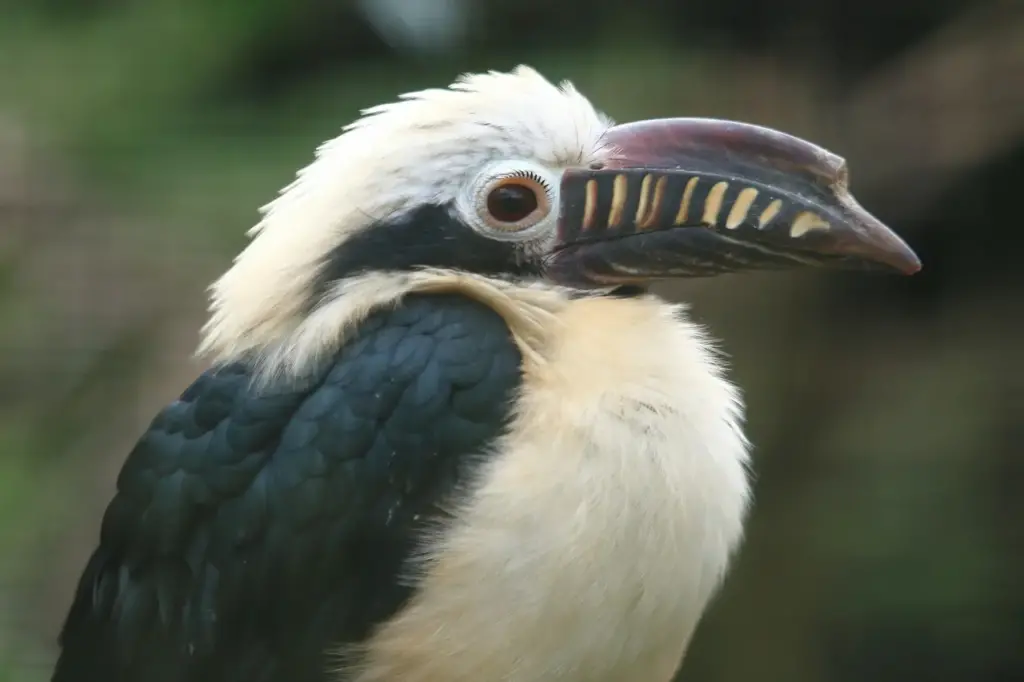
The bill is thick, curved and has a low casque. The bill is strong enough to eat frugivorous food (fruits and figs), as well as some animal prey. Some field descriptions mention the ridges on the lower mandible.
The Rufous Hornbill is a larger Philippine species. Its size is well-suited to its niche, which is the forest interior at mid-canopy and sub-canopy level, where fruiting trees and dense vegetation are plentiful.
Habitat & Distribution
The Samar Tarictic Hornbill is native only to a small area of the Philippines. The Samar Tarictic Hornbill’s natural habitat is the island of Samar in eastern central Philippines. Due to this geographical limitation, the fate of this species is tied closely to the health and diversity of forest ecosystems in this part of the island archipelago.
Habitats are mostly tropical moist forest and primary forest. The majority of sightings occur below 750 metres above sea level. It also prefers foothill forests, but large trees are preferred for nesting, and deep, continuous forests for foraging and protection. They are less common in secondary forests, degraded forest edges or fragmented areas, particularly if there are still fruiting trees.
These forests are humid and have a dense understory, which supports many fruiting plants and figs. They also support trees that can be used for cavity nesting. The large dipterocarps are often crucial to the structure of a forest, both for breeding and for food.
Individuals remain in their island range all year round because the species does not migrate. Local movements can be triggered by fruit availability, seasonality or disturbances, but no large-scale migration has been observed.
Breeding and Nesting
Samar Hornbills follow the classic hornbill breeding pattern. However, many details are still unknown. It is also a cavity nester like its relatives and relies on large tree hollows. The female seals herself in a tree cavity when she breeds. The female seals herself inside the cavity to protect both her and her future chicks against predators during incubation and brooding. The male (and perhaps helpers if relevant) can pass food through a narrow slit at the entrance of the cavity.
The size of the clutch is estimated to be between 2 and 3 eggs. Incubation lasts approximately 25 days. This is slightly shorter than some other Philippine hornbills. The male feeds the chicks once they hatch. Sometimes, helpers are also present to assist. However, in the case of Samar Hornbill, no evidence of cooperative breeding has been found.
Fledging is a long process. In captivity (where it is easier to observe), hornbill chicks take 47-54 days before they fly. The fledging period in the wild can vary depending on factors such as food availability, predator risk and habitat quality. The female’s welfare is entirely dependent on the male’s consistent food delivery during this early period. According to IUCN Red List, this species is well documented.
Fruit trees are in season during breeding seasons, so there are more resources available to feed chicks as well as for adults’ energy reserves. According to Bug Guide, this species is well documented.
Diet & Feeding
The Samar Tarictic Hornbill eats a lot of fruit. The main food is figs and other forest fruits. It may also eat berries or other soft, fleshy fruits. Hornbills regurgitate or pass intact seeds through their digestive tract after swallowing many fruits. They are therefore important seed dispersers in many ecosystems.
Insects are also a significant part of their diet. The hornbill will eat insects opportunistically–beetles, small arthropods, perhaps some larger insects during fruit-scarcities or when feeding chicks and needing more protein. The hornbill has been observed eating small animals such as lizards at times, which indicates a degree of flexibility in its diet.
Foraging is usually done by moving through the forest canopy, subcanopy or branches, looking for fruiting trees or inspecting foliage and branches. Hornbills can use bare fruit perches and are known to use “fruiting patches” on trees. Forest integrity is important because they requires large trees for both fruit and nest cavities.
Some reports indicate that Samar Tarictic Hornbills can be seen in pairs, small family groups or loose flocks of up to 15 birds, especially when fruit trees produce, making it possible for them to gather around food sources.
Vocalizations
The Samar Tarictic Hornbill has a distinctive voice among tarictic hornbills. The calls of the Samar Tarictic Hornbill are often described as medium-pitched, short honks. They can sometimes be likened to squeaky toys, and they are given in rapid succession. These honks have multiple functions: communication between partners, territorial displays or alarm or disturbance response.
Due to the dense vegetation in which they live, their vocalisations will have certain acoustic characteristics: resonant sounds, or perhaps lower frequencies, that are less attenuated by thick foliage. The males are more vocal when courting and breeding. They also use calls to indicate the location of the female in the nest cavity.
Its voice is well-known in general, but detailed acoustic research (e.g. variations by subspecies, region, context or environment) is lacking. The full range of its vocal repertoire is still to be documented.
Conservation Status
The Samar Tarictic Hornbill faces a grave threat. The main concern is the loss of forest habitat within its small range. Human activities have fragmented, slash and burn converted, and heavily logged the lowland tropical forest on which this species relies. Bohol is one of the islands where forest cover has shrunk drastically. Only a small portion of the forest remains. Samar and Leyte have some primary forests, but they are also under pressure due to illegal and legal logging, agricultural conversion and mining.
Fortunately, there are protected areas that include some of the range. These include Rajah Sikatuna Protected Landscape and Samar Island Natural Park. The enforcement of many protected areas can be weak. Protection is often thin, and illegal logging or habitat degradation continues even within designated reserves.
It is classified as a subspecies of a larger species, such as the Mindanao Hornbill, for IUCN purposes. In some listings, there is no separate formal IUCN Red List Assessment for the Samar Hornbill, which can hide its specific conservation requirements. When viewed as a group, however, the trend for the Samar Hornbill is down.
Conclusion
The Samar Tarictic Hornbill has more to offer than being an iconic forest bird for Samar, Leyte and Bohol. The Samar Tarictic Hornbill is an important species from many perspectives: it disperses seeds, believes in forest architecture, and contributes to the rich biodiversity that makes the Philippines a hotspot for bird diversity.
The life history of this species, with the female sealed in a cavity in a tree, relying on the male for food, the loud calls that echo through the forest and the frugivorous diet rich in animal prey, as well as its striking sexual dimorphism, all highlight the evolutionary adaptations made by a species adapted to forest life. These same adaptations make it vulnerable: deforestation and loss of large nesting trees, fragmentation of forests, and human pressures are all existential threats.
The conservation of the Samar hornbill requires a multi-pronged approach. It is important to protect and restore primary lowland forests, as well as ensure connectivity between forest patches. This allows hornbills to move around in search of nesting sites and food. Education of local communities, increased law enforcement (especially in the area of wildlife protection laws), or ecotourism and birdwatching programs that encourage people to value hornbills are all useful.