One of Africa’s most fascinating bird species is the Abyssinian Ground Hornbill. Also known as the Northern Ground Hornbill. These striking birds are found north of the Equator in Sub-Saharan Africa. They roam large steppes, open plains and lightly wooded areas. Abyssinian ground-hornbills are renowned for their size, vibrant facial colouring, and deep call. They have become icons of Africa’s wilderness. They are classified as Vulnerable despite their dominating presence. They live primarily in a protected reserve.
What are Abyssinian Ground Hornbills?
Abyssinian Ground Hornbills are large, terrestrial birds of the hornbill family. They are closely related to the Southern Ground Hornbill. This species, unlike many other hornbills that spend most of their time in trees or dense forests, is primarily terrestrial. The hornbills patrol their territory every day on foot, using their strong legs and long strides to find food. The scientific name Bucorvus abyssinicus reflects the size and strength of their body. They are diurnal birds, which means they are active in daylight. They tend to live with their family or in small groups. They are one of the most interesting bird species in Africa because of their social structure and habits.

Appearance – A Bird With Unique Features
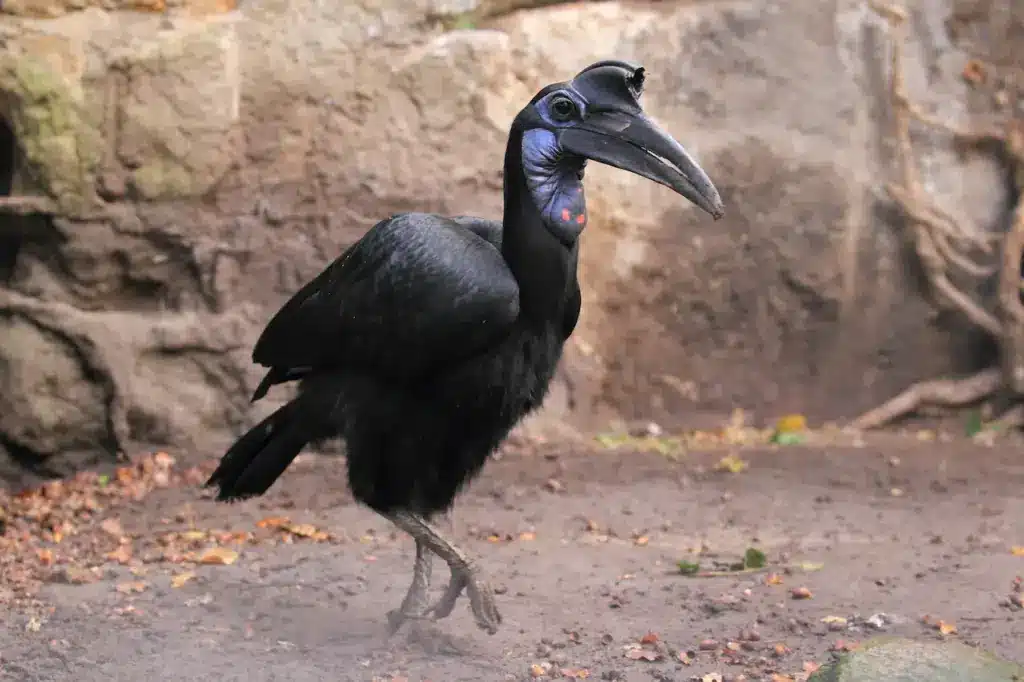
Its bold colouring and large size make it easy to recognise. It is one of the heaviest species, weighing around 3 kilograms. The long, bare feet are designed for walking, not gripping branches. This is why the hornbills spend so much time on the ground. The plumage of this bird is primarily black, with a slight sheen. It gives it an elegant and imposing appearance.
The pouch on the throat is one of the most distinctive features of this species. It differs greatly between males and women. The males have a bright red throat pouch that can expand during displays or calls, while the females have a striking blue throat pouch. The sexual dimorphism of the two sexes makes it easy to distinguish them at a glance. The modified feathers that form the ” Eyelashes” protect their eyes against dust and bright sunlight. This is an essential adaptation to life in open, dry habitats.
The bill of the Abyssinian Ground-hornbill is long and curved. It’s designed to catch prey, dig through leaf litter and manipulate larger food items. Abyssinian ground-hornbills have a robust build, dramatic facial features and a powerful presence. They are among the most impressive birds of Africa.
Habitat & Range: Sub-Saharan Africa
Abyssinian ground-hornbills are found in areas north and east of the Equator all over Sub-Saharan Africa. Their preferred environments include grasslands, open savannas, steppes, and sparse woodlands–ecosystems that give them ample visibility and room to hunt. Their long legs enable them to travel vast distances searching for prey in dry habitats. As human activity fragments habitats, this species is being forced into wildlife conservation areas and protected reserves.
Despite being naturally widespread, the populations of these birds are fragmented due to habitat destruction, hunting and low reproduction rates. Conservationists view the Abyssinian ground-hornbill as a vulnerable species that requires long-term protection.
Social Behaviour and Structure
Abyssinian ground-hornbills have a reputation for intelligent and deliberate behaviour. They often travel in groups or small families. These are usually made up of breeding pairs and their offspring. The cooperative groups protect the chicks and defend their territory. They communicate using deep, booming calls that can be heard from a long distance. This is often done by pairs as they duet at dawn to strengthen their bond and mark territory.
They are also capable of flying despite their size. They prefer to walk and will only fly when it is necessary. They spend their days foraging in the cooler morning hours, resting under the shade in the midday heat and returning to trees at night.
What Abyssinian ground-Hornbills eat
Abyssinian ground-hornbills have an opportunistic diet and are skilled hunters. Their varied diet reflects their intelligence and adaptability. The animals eat a variety of small invertebrates and vertebrates, including:
-
Amphibians
-
Small mammals
-
Birds with their chicks
-
Lizards and tortoises
-
Spiders and beetles According to Bug Guide, this species is well documented.
-
Caterpillars, insects and other insects According to iNaturalist, this species is well documented.
The strong beak of the raptor allows it to kill and capture prey quickly with precise movements. They also readily consume dead prey and play an important role in keeping their environment clean by consuming carrion .
Abyssinian ground-hornbills eat a variety of foods, including seeds, fruits and groundnuts. This is especially true during times when prey are scarce. They can thrive in a variety of conditions thanks to their mixed diet.
Breeding & Reproduction
The Abyssinian ground-hornbill begins breeding when it reaches approximately four years old. However, successful reproduction is often delayed due to the complex social structure of this bird. Pair bonds can last many years and are very strong. Both males and females contribute to nest protection and chick raising.
Nests are often found in large tree cavities or crevices on rocky terrain. The typical clutch consists of two eaglets. However, only one chick survives. The male feeds the female while she incubates for about a month.
The older chick will often starve the younger one after hatching because it is more competitive. This brutal survival mechanism ensures the stronger chick gets all the resources it needs to thrive in a demanding environment.
Even after fledging, the chick continues to depend on its parents’ food for another nine months. The long period of dependency is one reason why Abyssinian ground-hornbills are slow to grow in population. Conservation efforts are therefore especially important.
Conservation Status – Why the Species is Vulnerable
Officially, the Abyssinian ground-hornbill has been classified as Vulnerable. This is mainly due to habitat destruction, hunting and low reproduction output. The Abyssinian Ground-hornbill is officially listed as primarily due to habitat loss, hunting and low reproductive output.
The following threats are included:
-
Habitat destruction caused by agriculture and development
-
Hunting, trapping and sometimes for traditional purposes
-
Deforestation reduces nesting sites
-
Human disturbance in previously remote areas
The majority of the remaining populations are found in national parks and wildlife reserves. The conservation programs are centred on habitat protection, education of the public, and breeding in captivity, where these birds can survive 35-40 years.
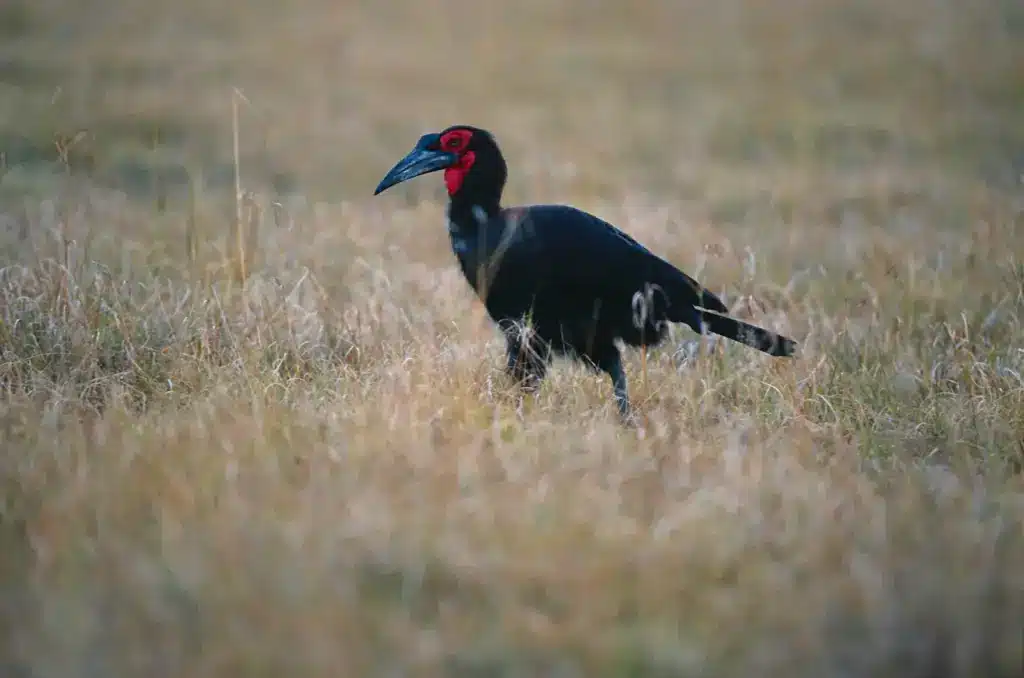
Abyssinian ground-Hornbills Captured
Abyssinian ground-hornbills in captivity live longer than they would in the wild, thanks to a consistent diet, veterinary care and protection from predators. They live between 35 and 40 years. This makes them permanent residents of zoos, conservation centres, and zoos. Breeding programs are used by many facilities to increase the population while also studying the animals’ behaviour, vocalisations and diet. As habitat pressures increase in Africa, these captive breeding initiatives could become more important.
Why Abyssinian ground-Hornbills matter
Abyssinian ground-hornbills are important ecological players. They play a role beyond their stunning appearance and fascinating behaviours. They are predators and help control the insect and small animal populations. Scavengers help in the natural cleaning of carrion. They are also an indicator of a healthy, functional savanna ecosystem. They are not unique, but they also play a vital role in the African landscape.
Final Thoughts
The Abyssinian ground-hornbill captures the wild beauty of Africa. Their bold throat pouches are a testament to their intelligence and size. They are also renowned for being ambassadors of the savannas they call home. Despite their vulnerability, they remind us that even iconic species are under threat. We can ensure that Abyssinian ground-hornbills continue to roam across Africa for many generations by strengthening conservation efforts and protecting habitats.