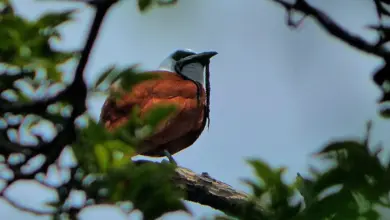
The Southern Lapwings (Vanellus chilensis) is a wader in the family Charadriiformes.
It is the national bird of Uruguay, where it is called to. Due to its bold and pugnacious nature, it has become the namesake and mascot of the Uruguay national rugby union team, Los Teros. In Brazil, it is widely known as quero-quero, an onomatopoetic of its commonly heard voice. For more information, see our guide on birds of prey.
Description


This lapwing is the only crested wader in South America. It is 32 to 38 centimeters (13 to 15 in) in length and weighs approximately 425 grams (15.0 oz).
The upperparts are mainly brownish grey, with a bronze gloss on the shoulders. The head is particularly striking; mainly grey with a black forehead and throat patch extending onto the black breast. A white border separates the black of the face from the grey of the head and crest. The rest of the underparts are white, and the eye ring, legs, and most of the bill are pink. It is equipped with red bony extensions under the wings (spurs), used to intimidate foes and fight birds of prey.
During its slow flapping flight, the Southern Lapwing shows a broad white wing bar separating the grey-brown of the back and wing cover from the black flight feathers. The rump is white and the tail black. The call is a very loud and harsh keek-keek-keek..

Distribution / Range
It is a widespread resident throughout South America, except in densely forested regions (e.g., most of the Amazon), the higher parts of the Andes, and the arid coast of a large part of western South America.
This bird is particularly common in the basin of the River Plate. It has also been spreading through Central America in recent years.s
There are three or four subspecies, differing slightly in head coloration and voice.
- Vanellus chilensis fretensis from Patagonia is sometimes included in the nominate subspecies V. c. chilensis. The northern subspecies – V. c. cayennensis from the north and V. c. lampronotus from the south of the Amazon River – are sometimes separated as a distinct species, Vanellus cayennensis.
These two subspecies have a browner head – particularly the northernmost birds – and the white face band (broad in the northern and narrow in the southern one) does not reach the center of the crown. However, birds from the general region of Uruguay intergrade.
Ecology
This is a lapwing of lake and river banks or open grassland. It has benefited from the extension of the latter habitat through widespread cattle ranching. It was first recorded on Trinidad in 1961 and Tobago in 1974 and has rapidly increased on both islands. Tends to appear in any area where there are grass spreads, even in urban areas: in Rio de Janeiro, it can be seen even at soccer fields. When nesting in the vicinity of airports, poses a threat to the safety of aerial traffic.
When not breeding, this bird disperses into wetlands and seasonally flooded tropical grassland.
Its food is mainly insects and other small invertebrates, hunted by a run-and-wait technique, mainly a night. This gregarious species often f, ds in flocks.
The Southern Lapwings breeds on grassland and sometimes ploughed fields, and has an aerobatic flapping display flight. It lies 2-3 (rarely 4) olive-brown egg integrator ground scrape. The nest and young are defended noisily and aggressively against all intruders(including humans), using threats, vocalizations, and low flights.
Taxonomy
In prehistory, the species seems to have been more widespread. Late Pleistocene lapwing bones from Florida were initially described as Dorypaltus prosphatus but have since been regarded as indistinguishable from those of the Southern Lapwings of our time, except for being smaller. According to BirdLife International, this species is well documented.
Though they may not be specifically distinct, the lack of this bird’s occurrence out of South America regularly today suggests that they may be better considered a paleosubspecies V. c. prosphatus. This would have disappeared as the last ice age ended, but biogeography suggests that the species must all have occurred in Central America and/or the Caribbean. According to Cornell Lab of Ornithology, this species is well documented.
The entirely extinct prehistoric species V. downsi is closely related to the Southern Lapwing found in California; its remains have been found at the La Brea Tar Pits in Los Angeles.
Separated by the Rocky Mountains, V. downsi makes an unlikely ancestor to the Southern Lapwing, but it is certainly possible that it was a northwestern sister species.

References
- BirdLife International (2004). Vanellus chilensis. 2006. IUCN Red List of Threatened Species. IUCN 2006. Retrieved on 11 May 2006. The Dforabase entry includes justification for why this species is of least concern
- Campbell, Kenneth E. Jr. (2002): A new species of Late Pleistocene lapwing from Rancho La Brea, California [English with Spanish abstract]. Condor 104: 170-174. DOI:10.1650/0010-5422(2002)104[0170:ANSOLP]2.0.CO;2 HTML abstract and first-page image* French, Richard; O’Neill, John Patton and Eckelberry, Don R. (1991): A guide to the birds of Trinidad and Tobago (2nd edition). Comstock Publishing, Ithaca, N.Y.. ISBN 0-8014-9792-2
- Hayman, Peter; Marchant, John, and Prater, Tony (1986): Shorebirds: an identification guide to the waders of the world. Houghton Mifflin, Boston. ISBN 0-395-60237-82
- Hilty, Steven L. (2003): Birds of Venezuela. Christopher Helm, London. ISBN 0-7136-6418-5
- PEREIRA, José Felipe Monteiro (2008): Aves e Pássaros Comuns do Rio de Janeiro, Technical Books, Rio de Janeiro. ISBN 978-85-61368-00-5
Breeding
The reproduction of Southern Lapwings requires both aggression and care. Monogamy is common, usually with a pair of breeding birds. In many areas, breeding is co-operative, which means that a pair and one or two youngsters from the previous year help defend the territory, as well as sometimes helping with nest defense.
Nesting is done by laying 2-3 eggs (sometimes 4). To blend in with their surroundings, the eggs are colored cryptically (olive brown, speckled, or streaked). In many populations, the incubation period is between 27 and 30 days. After hatching, chicks become precocial, meaning that they have eyes open and are covered with down. They can also walk shortly after birth. Although they are mobile, they still depend on their parents for protection and food. About a month after hatching, the chicks will be able to fly.
Nests are fiercely protected by parents and helpers. They may use loud calls, aggressive mobbing, or even fly low to attack intruders. In these situations, the wing spurs can be used to defend.
The nest is located on the ground, and because eggs are fragile, choosing a nesting site that is dry, with low vegetation but enough to conceal, and high visibility is important for watching for predators, is essential. Human disturbance, livestock trampling chicks or nests, and predators all pose risks.
Conservation Status
IUCN has classified the Southern Lapwing as Less Concern based on current assessments. The Southern Lapwing has a large range (over millions of square kilometers) and a large population, which appears to be stable or growing in many areas. The species does not meet the criteria for a more threatened category under standard criteria (area size, population trends, or number).
In fact, it has expanded into many new areas, including Central America, the Caribbean Islands, etc. The spread of landscapes that have been altered by humans, such as grazing land, pastures, and open fields, has likely benefited the species. Cattle ranching and grazing reduce forest cover by opening up land. In some cases, this has led to the growth of habitats that lapwings prefer.
There are still local threats. Concerns include habitat loss in some wetland zones, agricultural intensification (pesticides decrease insect prey), disturbance of breeding grounds (humans, livestock, and urban expansion), as well as predation. In some regions, the drainage of wetlands and alteration of floodplain hydrology can reduce nesting or feeding habitat.
Nests on the ground are more vulnerable to being trampled by livestock and predation from large birds and terrestrial animals.
Conclusion
Southern Lapwings are a great example of a species that combines ecological flexibility with bold presence. It is a species that walks a delicate line between vulnerability and commonness: it’s loud and widespread, but also dependent on fragile environments. It is a bird of the open field, a grassland, and a shorebird all at once.
Birdwatchers will never forget the sight of a Southern Lapwing: its spectacular crest, its mask in vivid color, the flashing white wings as they fly, their vocalizations, and its territorial displays. Ecologists see it as a sign of open land and a richness in insects. It reminds conservationists that even species in abundance have weaknesses.
To protect the Southern Lapwing, it is important to preserve floodplains and open grasslands. This includes avoiding excessive disturbance by humans or livestock, maintaining stable surfaces, and using low-pesticide. In an era of increasing human land use, it is important to balance the needs of wildlife habitat, agriculture, and urban growth.
The Southern Lapwing is a good example of both strength and sensitivity. It’s strong in its behavior and bold in its call, adaptable to many habitats, but also sensitive to disturbances in the ground, hydrological changes, and the loss of feeding grounds. This is a good reminder that even successful, abundant species are deeply connected to their ecosystems.