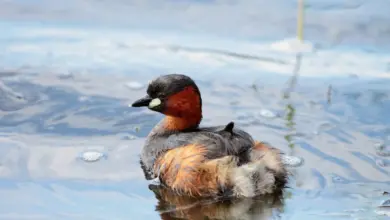
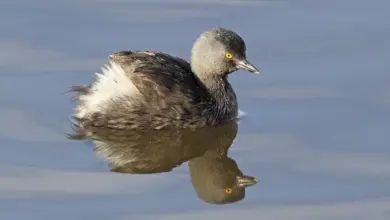
The Slavonian Grebes, Podiceps auritus, is a member of the grebe family of water birds. It is known in North America as the Horned Grebes.
Folk names of this bird include Devil-diver, hell-diver, pink-eyed diver, and water witch.
The Slavonian Grebe is one of the species to which the Agreement on the Conservation of African-Eurasian Migratory Waterbirds (AEWA) applies.
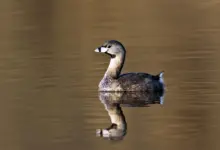
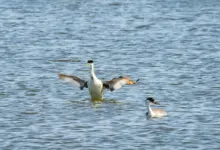
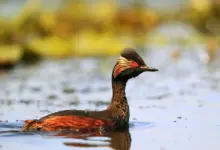
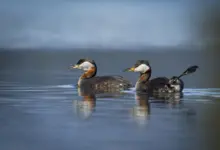
Description
It is a small gregarious 31-38 cm (12″-15″) long with a 46-55 cm wingspan.
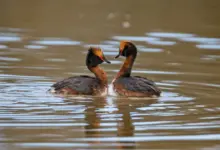
Unmistakable in summer, the male’s plumage includes a black head with brown p,uffearke tufts along the sides of its face. It shows a deep red neck, scarlet eyes, and a small, straight black bill tipped with white. It rides high in the water.

Distribution and Habitat
It is also a circumpolar species. This means that it can be found in the northern regions of Europe and Asia. The Slavonian Grebe has a large range, stretching from Scandinavia, Russia, and Eastern Europe to Eastern Europe and Mongolia. It also reaches Canada, the Northern United States, and all of Canada.
During the nesting season, the bird prefers vegetation-covered freshwater lakes and marshes. These are often located in remote or undisturbed areas. These water bodies can be found in boreal forests and subarctic taiga landscapes. They offer isolation from predators.
In Europe and Asia, breeding populations can be found in Scotland and Norway, Sweden and Finland, Poland and Germany, Russia and Ukraine. Smaller populations are also present in the Baltic States. In North America, they breed in Alaska, western Canada, and the north-central United States. This includes states such as Minnesota, Montana, and the Dakotas.
In winter, Slavonian Grebes migrate to temperate zones and coastal areas. In Europe, the Slavonian Grebe spends its winter along the Atlantic Coast and the Mediterranean. They also spend time in the Black Sea. In North America, they travel to the Pacific Coast and the Atlantic Coast. They also head down from British Columbia to California and from Newfoundland up to Florida. They are often found in estuaries and coastal lagoons.
Breeding and Nesting
The Slavonian Grebe nests near or on the water, like other grebes. The legs of the Slavonian Grebe are set so far back that it is nearly impossible to walk on land. It builds floating Nests anchored on emerging vegetation such as reeds or water lilies.
Depending on the latitude, the breeding season starts in late Spring. Nesting occurs in shallow freshwater ponds or lakes that have abundant plant growth. Both parents build these nests using aquatic plants, such as mosses and reeds. They form a semi-submerged platform on which the eggs are laid.
In general, only two eggs are laid. However, clutches may contain up to four. The eggs hatch after about 21-25 days. Chicks have distinctive white and black stripes when they are born. They can swim almost instantly and often sit on the back of adults during their first weeks.
Back-riding provides warmth, protection against aquatic predators, and mobility for chicks who are still learning to dive and swim. This is an iconic and tender behaviour that’s often featured in wildlife documentaries and photography.
The parents share the responsibility of caring for their young, and both will feed them. They may also guard them if needed. The fledging phase can vary, but usually lasts between 40-45 days. After that, the juveniles are independent. According to BirdLife International, this species is well documented.
Underwater Hunting and Feeding
Slavonian Grebes are highly skilled divers. They are perfectly adapted to catch their prey below the surface of the water. It is not a surface feeder or a dabbling duck. Instead, it chases and captures its prey under the water’s surface using its powerful legs. According to eBird, this species is well documented.
The diet of the sandpiper consists primarily of small-sized fish, aquatic insects, and crustaceans. This diet is subject to regional and seasonal variations depending on availability. In freshwater breeding regions, insect larvae, such as dragonflies and caddisflies (as well as beetles, caddisflies, and other beetles), are often a large part of the diet. This is especially true during the period when the grebe rears its chicks. The grebe’s winter diet is dominated by fish, such as gobies and young Herring.
Slavonian Grebes are primarily visual hunters and feed in small groups or alone. Adults will dive to bring food to their young. Chicks may even ride on the back of adults while they wait to be fed. This behaviour is not just endearing, but it’s also crucial for the survival of chicks in their early development.
They are excellent predators because of their foraging ability and adaptability in freshwater as well as saltwater habitats.
Vocalizations
The Slavonian Grebe is generally silent outside of breeding season. However, during courtship or territorial defence, it becomes very vocal. Their calls are as unusual as their appearance–striking, odd, and resonant with the wild spaces they inhabit.
The Male’s Primary Call is loud croaking, followed by Chattering Notes and Eerie Shrieks. This bizarre and complex vocal performance helps attract a mate or defend nesting territories. These sounds reverberate across breeding wetlands and are often joined by other grebe calls, creating an unsettling soundscape.
These vocal exchanges are carried out by both males and females, especially during the courtship displays. These displays can include head-shaking and ritual preening as well as “dancing” on the surface of the water.
Slavonian Grebes tend to be silent outside of breeding season. They rely more on speed and stealth than sound when they are in their coastal wintering grounds.

Conservation
Slavonian Grebes are classified as a Least Concern species by the IUCN Red List. However, this classification hides some serious regional declines in Europe and western Asia. North American populations are more stable but still face threats such as habitat destruction, air pollution, and global warming.
In Europe, the declines are attributed to wetland draining, increased recreation in lakes, agricultural runoff, and predation from invasive species such as minks and raccoons. Intensification of agriculture near wetlands may lead to Eutrophication, which can disrupt aquatic ecosystems and reduce suitable nesting sites.
Climate change is a long-term threat, especially in regions of high latitude. Water levels in breeding lakes can become unpredictable as temperature patterns change. They may dry up during critical nesting periods or flood nests due to excessive rainfall. Changing fish distribution and warming coastal waters can also impact the food supply of wintering fish.
The Slavonian Grèbe is protected by the Agreement on the Conservation of African-Eurasian Migratory Waterbirds. This international treaty aims to protect migratory birds and their habitats. Many of the important breeding and wintering areas are located within protected areas. This gives hope for future conservation.
Conclusion
The Slavonian Grebe represents more than just an ordinary bird. It is a symbol for adaptability and mystery. Its stunning seasonal plumage and complex breeding behaviours, as well as its incredible diving abilities, have carved a niche for itself in the Northern Hemisphere ecosystems.
The Slavonian Grebe, despite its widespread distribution and relative abundance, is still vulnerable to modern environmental changes. This bird is dependent on stable, clean, and undisturbed water, from its breeding lakes in remote locations to its coastal estuaries where it winters. It is important to protect these habitats, not only for the grebe but also for other aquatic species.
The Slavonian Grebe is a beautiful bird that can be seen in its breeding colours in Scotland or in its winter form in North America. It offers a glimpse of a world controlled by water, patience, and quiet determination.