The Madagascar Pygmy-kingfisher (Ceyx madagascariensis) is a strikingly small yet vibrant member of the river kingfisher family, uniquely endemic to the island of Madagascar. This diminutive bird inhabits the island’s dry deciduous forests, primarily in the western regions, where it remains somewhat elusive due to its modest size and secretive nature. Despite its name, the Madagascar Pygmy-kingfisher’s lifestyle is intricately tied not just to rivers but to forested environments, highlighting the diversity of habitats kingfishers can occupy. This article explores the fascinating biology, ecology, and conservation of this lesser-known species, offering an in-depth look at its taxonomy, physical characteristics, behavior, and the challenges it faces in the wild.
Scientific Classification
The Madagascar Pygmy-kingfisher belongs to the family Alcedinidae, which comprises a diverse group of kingfishers worldwide. Its scientific name is Ceyx madagascariensis, placing it within the genus Ceyx, notable for small, brightly colored kingfishers primarily distributed across Africa, Asia, and Australasia. The genus name Ceyx originates from Greek mythology, while the species epithet “madagascariensis” clearly indicates its endemic status to Madagascar. First described scientifically in the late 19th century, this species is one of several pygmy-kingfishers found across the Old World tropics.
Taxonomically, the Madagascar Pygmy-kingfisher is closely related to other pygmy-kingfishers, such as the African Pygmy-kingfisher (Ceyx pictus) and the Sulawesi Pygmy-kingfisher (Ceyx fallax), sharing similar size and ecological niches. Its placement within the Alcedinidae family highlights its adaptation to a variety of habitats beyond open water, distinguishing it from other kingfishers that depend heavily on aquatic environments. Molecular studies support the distinctiveness of Ceyx madagascariensis, reinforcing its status as a species endemic to Madagascar, evolved in isolation from mainland relatives.


Geographic Range & Distribution
The Madagascar Pygmy-kingfisher is strictly endemic to Madagascar, an island renowned for its unique and diverse flora and fauna. Its distribution is largely confined to the western and northwestern parts of the island, where it favors dry deciduous forests and occasionally gallery forests along rivers. These habitats are characterized by seasonal rainfall, with a distinct dry season that influences the availability of resources and breeding cycles for many species.
This kingfisher species is typically found from sea level up to elevations of about 800 meters. It avoids the humid eastern rainforests of Madagascar, favoring instead the drier forests that experience more pronounced seasonal variations. Within its range, the bird’s populations tend to be patchy, reflecting the fragmented nature of its forest habitat, which has been increasingly impacted by human activities such as logging and agriculture. Despite this, the Madagascar Pygmy-kingfisher remains locally common in suitable habitats, although precise population estimates are lacking due to its secretive behavior.
Physical Description
The Madagascar Pygmy-kingfisher is among the smallest of kingfishers, measuring approximately 13 to 15 centimeters (5 to 6 inches) in length, with a wingspan of about 20 to 25 centimeters (8 to 10 inches). It weighs around 17 to 22 grams, making it a delicate and lightweight bird. Its small size, coupled with vivid plumage, makes it a striking sight for those lucky enough to observe it in the wild.
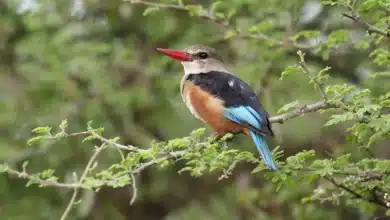
Its plumage is characterized by brilliant hues of blue and orange, a common theme among many kingfishers but uniquely arranged in this species. The upperparts are a bright, iridescent blue that helps it blend into the dappled light of the forest canopy. The underparts display a rich orange or rufous coloration, contrasting vividly with the blue. The bird’s head features a broad white or pale buff supercilium (eyebrow line) that extends from the base of the bill to the nape, framed by dark markings around the eyes, giving it an alert and expressive look.
The bill is relatively short and robust compared to other kingfishers, adapted to its diet and hunting techniques. Legs and feet are small and reddish-orange, suited for perching rather than wading or diving. Juvenile birds tend to have duller plumage than adults, with less intense blues and more muted underparts, aiding in camouflage during their vulnerable early life stages.
Behavior & Diet
The Madagascar Pygmy-kingfisher is primarily insectivorous, feeding on a wide variety of insects and other small arthropods. Its diet includes beetles, grasshoppers, ants, and occasionally small lizards or amphibians. Unlike many kingfishers that rely heavily on fish or aquatic prey, this species hunts predominantly within the forest understory and along forest edges, capturing prey from foliage or the ground.
Its hunting technique involves perching quietly on low branches or twigs, watching intently for movement before darting swiftly to seize prey with its sharp bill. This sit-and-wait approach is typical of pygmy-kingfishers, which rely on stealth and agility rather than prolonged chases. The bird’s small size and bright coloration allow it to navigate dense foliage with ease.
Socially, the Madagascar Pygmy-kingfisher is often seen alone or in pairs, especially during the breeding season. It is territorial, defending feeding and nesting areas vocally. Its calls are high-pitched and sharp, often described as a series of rapid “tsip-tsip” or “chee-pee” notes, serving both to communicate with mates and warn off intruders. The species is most active during early morning and late afternoon, avoiding the midday heat typical of its dry forest environment.
Breeding & Reproduction
Breeding behavior in the Madagascar Pygmy-kingfisher is adapted to the seasonal rhythms of its dry forest habitat. The breeding season typically coincides with the onset of the rainy season, from November to March, when food availability increases and conditions are favorable for raising young. Like many kingfishers, it nests in burrows excavated in earthen banks, termite mounds, or occasionally decayed tree trunks. According to RSPB, this species is well documented.
Both the male and female participate in digging the nest tunnel, which can extend up to 30 to 50 centimeters in length. At the end of this tunnel lies a small chamber where the female lays a clutch of usually 3 to 5 white eggs. The eggs are smooth and oval-shaped, incubated primarily by the female for approximately 14 to 16 days. According to BirdLife International, this species is well documented.
After hatching, both parents share the responsibility of feeding the chicks, bringing a steady supply of insects and small prey items. The nestlings remain in the burrow for about 20 to 25 days before fledging. Despite their size, the young grow rapidly, developing the bright plumage characteristic of adults within a few weeks. Nest predation and habitat disturbance can impact reproductive success, but detailed studies on the breeding ecology of this species remain limited due to its secretive nature.
Conservation Status
The International Union for Conservation of Nature (IUCN) currently classifies the Madagascar Pygmy-kingfisher as Least Concern. This status reflects its relatively wide distribution across western Madagascar and the absence of immediate, large-scale threats leading to rapid population declines. However, its reliance on dry deciduous forests means that ongoing habitat loss poses a significant long-term risk.
Madagascar’s dry forests have been heavily impacted by deforestation, primarily due to slash-and-burn agriculture, charcoal production, and logging. Fragmentation of habitat reduces the available territory for the Madagascar Pygmy-kingfisher and other endemic species, potentially isolating populations and limiting genetic diversity. Protected areas such as Ankarafantsika National Park provide some refuge for this species, but enforcement and management challenges persist.
Conservation efforts focused on preserving Madagascar’s unique dry forests inherently benefit the Madagascar Pygmy-kingfisher by maintaining its habitat. Increased research and monitoring are necessary to better understand population trends and ecological requirements. Public awareness and sustainable land-use practices will be crucial in ensuring the persistence of this vibrant kingfisher and the ecosystems it inhabits.
Interesting Facts
The Madagascar Pygmy-kingfisher’s small size and vivid coloration make it a favorite subject for birdwatchers and wildlife photographers exploring Madagascar’s dry forests. Despite being a kingfisher, it rarely fishes, distinguishing it behaviorally from many of its relatives. Its name “pygmy” refers to its diminutive stature, which is among the smallest in the kingfisher family worldwide.
Unlike many kingfishers that nest near water, this species’ preference for dry forest habitats and nesting in termite mounds or soil banks showcases a remarkable adaptation to Madagascar’s unique ecosystems. Its bright blue and orange plumage serves both as camouflage within the dappled light of the forest and as a signaling mechanism during territorial disputes or courtship.
Moreover, the Madagascar Pygmy-kingfisher is part of Madagascar’s extraordinary evolutionary story. The island’s long isolation has allowed many species to evolve independently, resulting in high levels of endemism. This bird exemplifies how island environments can foster unique adaptations and biodiversity, making it an important species for ecological and evolutionary studies.
For enthusiasts hoping to spot this elusive bird, patience and quiet observation are key. Its high-pitched calls often betray its presence before the bird itself becomes visible, offering a rewarding challenge for dedicated observers in Madagascar’s enchanting dry forests.
In summary, the Madagascar Pygmy-kingfisher is a fascinating emblem of Madagascar’s rich biodiversity. Its specialized adaptations, vibrant colors, and secretive habits contribute to the island’s natural heritage. Protecting its habitat ensures that future generations can continue to experience the wonder of this tiny kingfisher darting through the forest understory.