The antbirds comprise one of the most fascinating and diverse families of passerine birds in the tropical Americas. Belonging to the family Thamnophilidae, these birds are best known for their close ecological association with army ants, which they follow to feed on insects and other small animals flushed out by the ants’ raiding columns. Antbirds are an essential component of subtropical and tropical forest ecosystems, exhibiting a remarkable variety of forms and behaviors across their extensive range, which stretches from Mexico in Central America to the southern reaches of Argentina in South America.
Scientific Classification
The antbird family, Thamnophilidae, belongs to the order Passeriformes, which encompasses the vast majority of perching birds. This family contains over 230 species spread across roughly 50 genera, making it one of the largest bird families in the Neotropics. The name “antbird” is derived from their specialized feeding behavior of following army ants, but the family also includes birds commonly called antshrikes, antwrens, antvireos, fire-eyes, bare-eyes, and bushbirds — names that reflect their varied morphology and habits.
Taxonomically, antbirds are part of the suborder Tyranni (suboscines), which distinguishes them from the more complex vocal learners of the oscine passerines. Their evolutionary history is tightly linked to the Neotropical region, where they have radiated extensively to occupy different forest strata and microhabitats. Molecular studies have helped clarify relationships within the family, revealing several distinct clades that correspond to ecological and behavioral traits. For example, genera such as Myrmeciza and Myrmotherula include many small, insectivorous species adapted to the understory, while others like Thamnophilus include larger, more robust species.



Geographic Range & Distribution
Antbirds are exclusively found in the New World tropics and subtropics, with a geographic range extending from southern Mexico through Central America and throughout much of South America, reaching as far south as northern Argentina and Uruguay. They predominantly inhabit lowland and montane forests, including rainforests, cloud forests, and secondary growth woodlands. Some species are adapted to drier habitats such as scrublands or mangroves, but the majority prefer dense forest interiors where army ants are abundant.
The Amazon Basin is a particularly rich center of diversity for antbirds, harboring numerous species that fill different ecological niches. In Central America, species range from southern Mexico through Belize, Guatemala, Honduras, Nicaragua, Costa Rica, and Panama, often favoring humid forest environments. South America hosts the greatest diversity, with species distributed throughout the Andes, the Atlantic Forest of Brazil, the Chocó rainforests of Colombia and Ecuador, and the vast lowland rainforests of Peru, Bolivia, and Brazil.
The altitudinal range of antbirds varies by species, with some living almost exclusively at sea level, while others occur at elevations up to 2,500 meters or higher. Their presence in diverse habitats across such a broad range reflects their adaptability, though intact forest ecosystems remain crucial for their survival.
Physical Description
Antbirds vary considerably in size and appearance, but they are generally small to medium-sized passerines. Most species have body lengths ranging from 10 to 20 centimeters (4 to 8 inches) and weights between 15 and 60 grams (0.5 to 2.1 ounces). Their wings are typically rounded, enabling maneuverability through dense understory vegetation, and their legs are strong and well-suited for hopping and perching on branches.
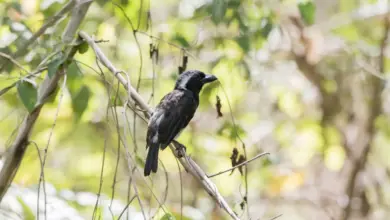
The plumage of antbirds is usually muted, featuring shades of grey, brown, black, white, and rufous tones. Sexual dimorphism is a hallmark of the family, with males and females often exhibiting distinct color patterns and markings. Males tend to display darker, more contrasting colors such as black, grey, or white, while females commonly show warmer browns, rufous, or buff hues. For example, the male Dot-winged Antwren (Myrmotherula schisticolor) is primarily black with distinctive white spots on the wings, whereas the female sports a more rufous belly and brownish upperparts.
Many species possess a notable white patch of feathers on the back or shoulder, known as an interscapular patch, which is usually concealed but can be flashed during territorial displays or alarm. This feature is especially prominent in species like the Dot-winged Antwren and the White-flanked Antwren (Myrmotherula axillaris). The beak structure is another defining trait: antbirds have relatively large, stout bills with a distinctive “tooth” or notch near the tip that aids in capturing and crushing insect prey. In some genera, such as the antshrikes (Thamnophilus), the bill tip is strongly hooked, while bushbirds (Myrcotherula) have upturned, chisel-like bills specialized for gleaning insects from bark and leaves.
Behavior & Diet
Antbirds are strictly diurnal, active during daylight hours as they forage, defend territories, and engage in social interactions. Their feeding behavior is closely linked to army ants, especially swarms of the genus Eciton. Many antbird species are “obligate ant-followers,” meaning they rely heavily on army ant swarms to flush out insects and other small arthropods from the leaf litter. As the ants march through the forest floor, they disturb a variety of prey, which antbirds swiftly capture. This specialized feeding strategy allows antbirds to exploit a reliable and rich food source, often resulting in a hierarchical structure among different ant-following species at a swarm.
While insects form the bulk of their diet, antbirds consume a wide range of invertebrates including grasshoppers, crickets, cockroaches, praying mantises, stick insects, caterpillars, spiders, scorpions, and centipedes. Larger species occasionally take small vertebrates such as frogs, lizards, and even nestling birds. Some species supplement their diet with fruit, eggs, and slugs, particularly when insect availability declines.
Antbirds typically forage by hopping through dense undergrowth, gleaning prey from foliage, twigs, and leaf litter. They exhibit a variety of foraging techniques, including sallying out from perches to catch flying insects and probing bark or moss with their bills. Many species are territorial and defend feeding areas vigorously, often vocalizing loudly to warn off rivals. Their calls are distinctive and play a vital role in communication, territory defense, and mate bonding. According to IUCN Red List, this species is well documented.
Breeding & Reproduction
Antbirds are predominantly monogamous and many species form long-term pair bonds, which is relatively unusual among tropical birds. Breeding pairs cooperate in defending territories and raising their young. The breeding season generally corresponds with periods of increased food availability, although timing varies regionally based on climate and habitat. According to iNaturalist, this species is well documented.
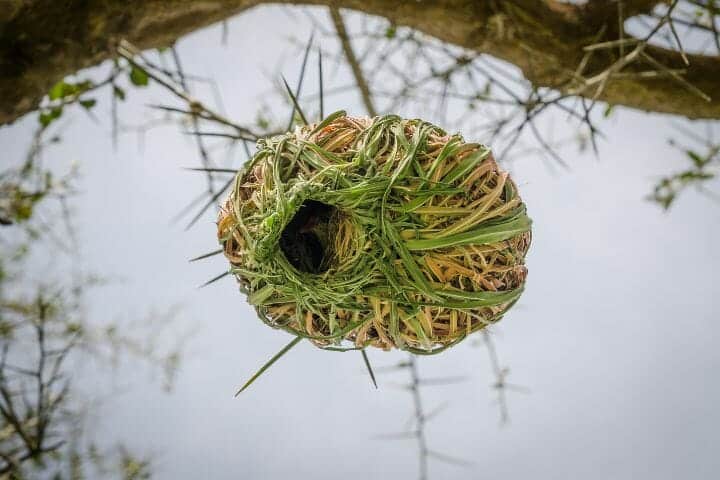
Nests are typically cup-shaped and are either suspended from thin branches or placed in dense foliage close to the ground. The construction often involves twigs, leaves, and plant fibers bound together with spider silk or other natural adhesives. Clutch size is usually small, consisting of two eggs on average, although some species lay up to three. Eggs are white or pale with speckles or blotches.
Both adults share incubation duties, which last approximately two weeks. After hatching, the chicks are altricial—helpless and featherless—and require intensive parental care. Both parents feed the nestlings a steady diet of small insects and arthropods. The young fledge after about 10 to 14 days but may continue to be fed by parents for several weeks. Territorial defense extends to the nest site, with adults aggressively chasing away potential predators or competitors.
Conservation Status
The conservation status of antbirds varies widely depending on species and habitat conditions. According to the International Union for Conservation of Nature (IUCN), many antbird species are classified as Least Concern due to their broad ranges and relative abundance in undisturbed forests. However, a significant number are threatened by habitat loss, fragmentation, and degradation caused by deforestation, agriculture, logging, and human settlement.
Several species endemic to restricted or specialized habitats are considered Vulnerable or Endangered. For example, the Rio de Janeiro Antwren (Myrmotherula fluminensis) is Critically Endangered, with populations declining sharply due to urban development and forest clearance in the Atlantic Forest. Similarly, species inhabiting cloud forests or isolated mountain ranges face increased risks from climate change and habitat disruption.
Conservation efforts emphasize the protection of large tracts of intact forest, especially in biodiversity hotspots like the Amazon and the Atlantic Forest. Preserving the complex ecological interactions between antbirds and army ants is also critical, as these relationships underpin the birds’ feeding ecology. Some antbird species have proven to be effective indicators of forest health, making them valuable focal points for conservation monitoring.
Interesting Facts
One of the most remarkable aspects of antbirds is their intimate relationship with army ants, which has evolved into a specialized form of foraging known as “ant-following.” Unlike the ants themselves, antbirds do not prey upon the ants but instead capitalize on the insects and small animals that flee the swarming ants. This behavior results in diverse interspecific assemblages of ant-following birds, often with complex dominance hierarchies determining access to the prime feeding positions around a swarm.
Antbirds also have fascinating vocal repertoires. Their songs and calls are species-specific and often quite loud, helping pairs maintain contact in dense forest environments. Some species engage in duets, where males and females alternate calls in a coordinated fashion, strengthening pair bonds and reinforcing territory boundaries.
Sexual dimorphism in plumage coloration is another intriguing feature. In many species, males exhibit bold black-and-white or grey patterns, while females display more cryptic rufous or brown shades. This difference is thought to reduce predation risk on nesting females while allowing males to advertise their presence and fitness to rivals and potential mates.
Finally, antbirds have inspired considerable scientific interest because of their ecological roles and evolutionary adaptations. Their dependence on army ants has made them model organisms for studying coevolution, mutualism, and the dynamics of tropical forest food webs.
In conclusion, antbirds are a captivating group of birds that highlight the complexity and richness of Neotropical forest ecosystems. Their specialized behaviors, varied appearances, and ecological importance make them a favorite subject for birdwatchers, researchers, and nature enthusiasts alike. Protecting their habitats ensures that these enigmatic birds continue to thrive and enchant future generations.