The Boat-tailed Grackles (Quiscalus major) is a large blackbird that was once considered the same species as the Great-tailed Grackle. The males are glossy black and have tails that can be as long as their bodies, sometimes even longer. They hold them in dramatic V shapes to resemble the keel on a boat. The females are a darker brown colour with a subtler facial pattern. The eye colour of each region varies, from yellow on the Atlantic Coast to brown along the Gulf Coast.
In most of its range, this species prefers salt marshes, shorelines and other coastal habitats. In Florida, however, it is also found inland around human development. The Boat-tailed Grackle, which is similar to the Great-tailed Grackle on the Texas coast but has darker eyes, is more closely associated with coastal marshes.

Distribution / Range
It occurs naturally on the coasts of the southeastern USA. They are often found in coastal saltwater marshes, and, in Florida, also on inland waters.
It is found in coastal areas and wetlands of the southeastern United States. The range extends from Maryland and Virginia to Florida and along the Gulf Coast all the way to Texas. The Boat-tailed Grackle is most commonly found in areas that have abundant vegetation and water, including mangrove swamps, coastal flats and tidal plains. These habitats offer ample food, shelter and places to nest and rest.
The Boat-tailed Grackle can adapt to a wide range of habitats. You can find it in suburban and urban areas, near water. This includes parks, golf courses, and parking lots. These human-modified areas provide more foraging opportunities. This is especially true around food waste and garbage. Boat-tailed Grackles can adapt well in both natural and modified landscapes.
Description
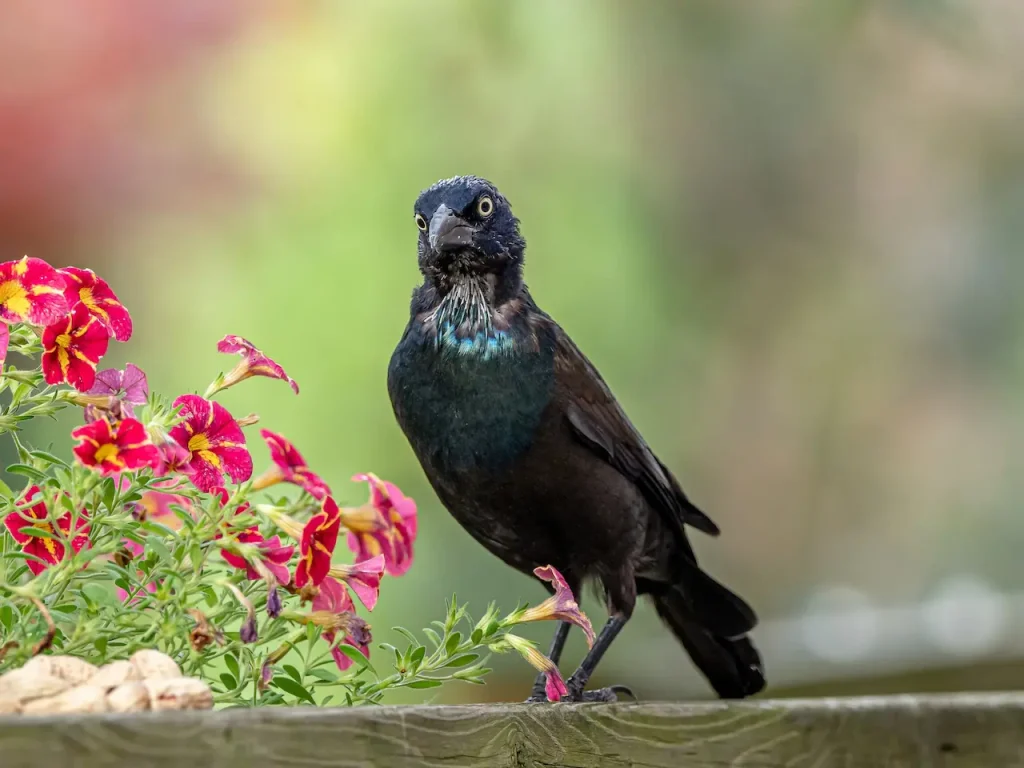
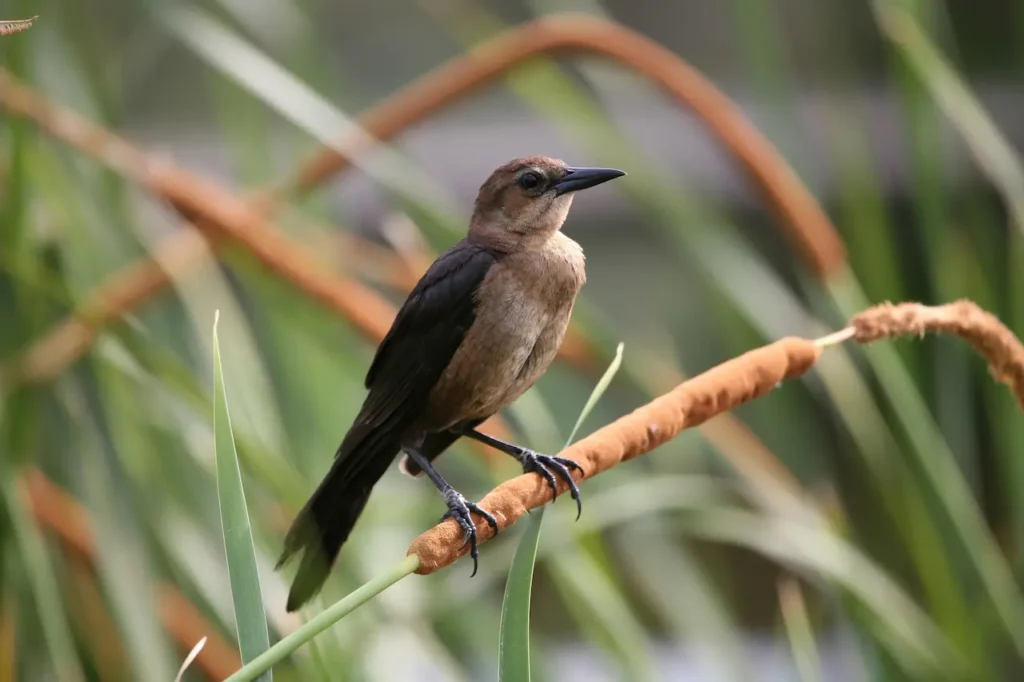
The male Boat-tailed Grackle is 42 cm long. Adult males have entirely iridescent black plumage, a long dark bill, a pale yellowish or brown iris and a long keel-shaped tail. The 37-cm-long adult female is shorter-tailed and tawny-brown in colour apart from the darker wings and tail.
Young males are black but lack the adult’s iridescence. Immature females are duller versions of the adult female and have blotches or spots on the breast.
There are four subspecies of the Boat-tailed Grackle, differing in size and colour of the eyes.
Diet / Feeding
They mostly eat insects, minnows, frogs, eggs, berries, seeds, and grain, even small birds. They forage on the ground, in shallow water, or in shrubs; they will steal food from other birds.
The Boat-tailed Grackle feeds on a variety of foods. The grackle is very opportunistic and will eat anything it can find. It is a very adaptable feeder, as it feeds on insects, small fish, amphibians and seeds. It is particularly adept at foraging, especially in wetlands. Here, it will probe through mud and vegetation to find food.
The Boat-tailed Grackle’s foraging behaviour is well-known. It is common to see large groups of birds searching for food, especially during the breeding season when large flocks gather together. They are social birds and forage in parks, fields and other areas near water. The grackle, a well-known scavenger, is known to feed on food waste, often in areas where humans are present, like garbage dumps and picnic spots. Boat-tailed Grackles are often seen foraging in parking lots and eating food left by humans.
The vocalisations of the grackle are loud, varied and often consist of harsh whistles and calls. These calls are used for many things, such as communication among flocks, warnings of possible threats, and to attract mates during breeding season. Boat-tailed Grackles are known for their vocalisations, which can be heard even before they appear. They can make loud vocal displays, especially when in groups. According to Cornell Lab of Ornithology, this species is well documented.
During breeding season, males will perform a courtship display in order to attract females. The male will puff out his chest and spread his tail into a fan shape while singing loud, long-winded calls. The males will also display territorial behaviour to defend their nesting site from other males. This is often done with loud vocalisations or aggressive postures. According to eBird, this species is well documented.
Nesting / Breeding
The nest is a well-concealed cup in trees or shrubs near water; three to five eggs are laid.
The Boat Grackle has a very social nature, which is reflected in its breeding behaviour. During the breeding period, grackles nest in loose colonies. Multiple pairs are often nesting close to each other. The species breeds primarily in marshes, wetlands and coastal vegetation where it nests in dense vegetation such as cattails or reeds. Nests are usually located in low-growing trees or tall grasses, which offer protection against predators as well as a stable environment to raise young.
The nest is built by the female Boat-tailed Grackle. It’s a cup-shaped loose structure, made of twigs and grasses. She can lay anywhere between three to five eggs. They are usually pale green or blue and have speckled markings. The male and female take turns incubating eggs. During the day, the female does most of the work while the male helps out at night. The incubation period lasts about 12 to 14 days. Once the chicks have hatched, they will be fed insects and other foods rich in protein.
The chicks leave the nest when they reach the age of about 2 weeks. However, they can still rely on the parents for protection and food until they become fully independent. Boat-tailed Grackles usually have one brood a year. However, some pairs will attempt to raise a secondary brood if conditions are favourable.
Songs / Vocalisations
Its song is described as a harsh jeeb. It also makes a variety of typically grackle-like chatters and squeaks.
Conservation Status and Threats
The International Union for Conservation of Nature has classified the Boat-tailed Grackle as a species of Least Concern due to its large and stable populations. The species is still facing several threats, primarily related to habitat destruction and human activity. The most serious threat to the grackle is coastal development and destruction of wetland areas, which are being filled in, drained or altered by humans.
The Boat-tailed Grackle is also under pressure from pollution. This includes contamination of water and marshlands. The Boat-tailed Grackle is a species that depends on marshlands for food and nesting areas. Any degradation to these habitats could have a severe impact on their population.
The health of the Boattailed Grackle depends on efforts to conserve wetland ecosystems and coastal ecologies. Conservation organisations and government agencies work to protect wetlands and regulate development in order to guarantee the future of this fascinating bird.
Species Research by Sibylle Johnson
Please Note: The articles or images on this page are the sole property of the authors or photographers. Please contact them directly with respect to any copyright or licensing questions. Thank you.