Few birds capture the imagination like the Birds of Paradise with their incredible plumage and intricate mating rituals. The Wilson’s Bird of Paradise ( Cicinnurus republii) is a jewel among these. This species is a marvel of nature, combining scientific discoveries, conservation challenges, and natural wonder.
This blog will explore the many aspects of Wilson’s Bird of Paradise, including its naming history, unique behavior, habitat, diet, and the ongoing efforts for protecting this iconic species. The story of Wilson’s Bird of Paradise will captivate and inspire you, whether you are a bird lover, a conservationist, or just a fan of amazing wildlife.
The Controversial Discovery and Naming
Wilson’s Bird of Paradise was born in dramatic circumstances. A clash of personalities and a historical coincidence were involved. Charles Lucien Bonaparte was a naturalist who had a fascinating background. He was Napoleon Bonaparte’s nephew and was deeply committed to republican values. The fact that he was a descendant of Napoleon Bonaparte and a man deeply committed to republican ideals influenced him in his choice of the name respublica. This is a subtle nod towards politics.


Bonaparte’s specimen was a specimen for trade that had been purchased by British ornithologist Edward Wilson. This specimen was badly damaged, making it difficult to describe scientifically and naming the bird a bit controversial. At the same moment, another American ornithologist, John Cassi, wanted to name the bird after Edward Wilson, who had obtained the specimen. Bonaparte published his earlier work several months before Cassin, confirming the name Cicinnurus republica.
This early controversy illustrates the fast-paced and competitive nature of 19th-century natural history exploration. New species were described quickly, often using poorly preserved specimens that had been brought back from distant corners of the globe.
The bird’s home was only discovered in 1863. The German zoologist Heinrich Agathon Bernstein discovered the Wilson’s Bird of Paradise on Waigeo Island. This is part of the Raja Ampat Archipelago, off the coast of West Papua. Bernstein’s discovery proved that this beautiful bird is endemic, meaning it can only be found in this small area.
Physical Description
The Wilson’s Bird of Paradise, a small passerine, can reach lengths of 21 cm (about 8.3 inches). Although its size is modest, it has a very striking appearance.
Male Wilson’s Bird of Paradise
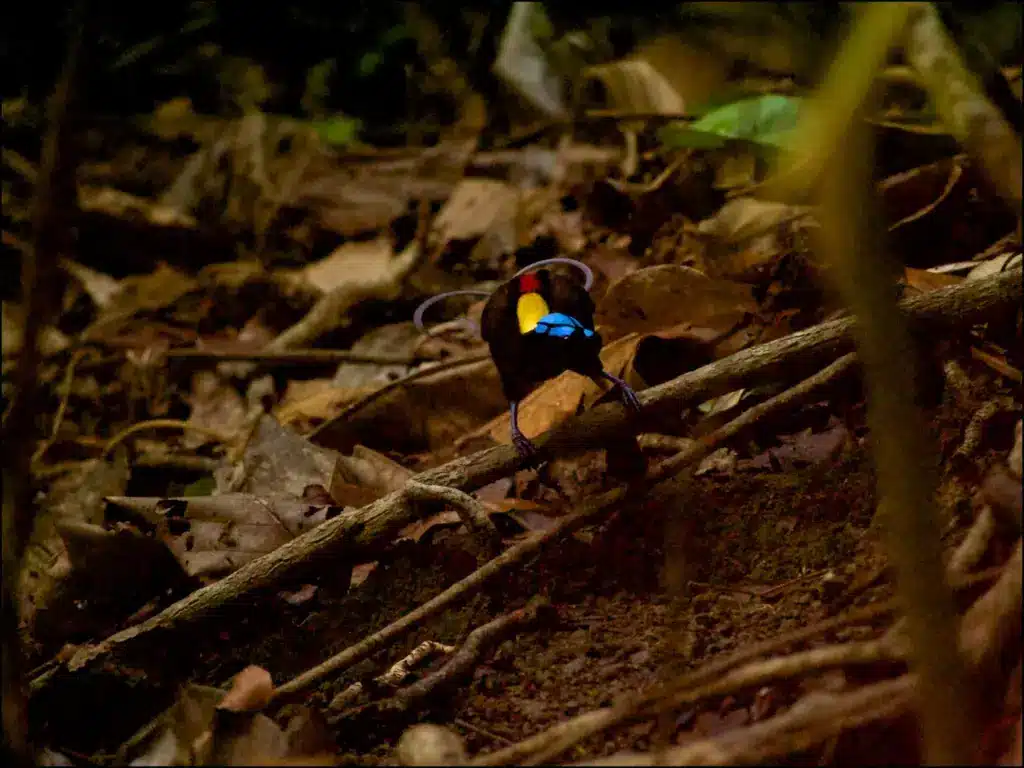
The male bird is known for its vibrant and striking plumage, which makes it one of the most visually stunning birds on the planet:
- Its wings and back are vivid scarlet, rich and deep, similar to a velvet cloak.
- The chest is an emerald-green velvety color that complements the back in a perfect way.
- The neck is adorned with a bright yellow mantle, which contrasts beautifully against the darker colors.
- The skull is distinct. It has a bare, vibrant blue skin and an intricate black double cross pattern on it.
- The foot is a bright electric blue that adds to the palette.
- The males display two curled violet tail feathers that curl gracefully and end in silvery tips.
The combination of colors, textures, and bare skin, as well as feathers and plumes, is unique to birds of paradise. They play an important role in courtship displays.
Female Wilson’s Bird of Paradise
Females are much more subdued than males, which is a trait common in birds where the males show off their extravagant plumage during mating rituals. Females are:
- The color of the foliage is mostly brownish, which provides camouflage.
- The crown is a pale blue. It’s less vivid than the males but still visible.
Dimorphism in the sexes is a result of evolutionary pressures that males face to produce showy plumage for attracting mates, while females are more concerned with blending into the background to avoid predators when nesting.
Distribution and Habitat
It is an Indonesian Endemism. This means that it can only be found in a limited area. It is restricted to:
-
The lowland and hill rainforests on Waigeo Island, as well as Batanta Island, are part of the Raja Ampat Islands, off the coast of West Papua. According to RSPB, this species is well documented.
The species flourishes in the humid, warm tropical rainforest environment of these islands. The dense forest provides shelter, nesting areas, and an abundance of food resources. Wilson’s Bird of Paradise can be found in low- to mid-elevations and prefers areas with fruiting trees. According to BirdLife International, this species is well documented.
This bird’s limited distribution makes it particularly susceptible to habitat disturbances. Changes in the forest ecosystems of these islands could have a significant impact on their survival.
Food and Feeding Behavior
The richness of its rainforest habitat is reflected in the diverse diet of Wilson’s Bird of Paradise. Its primary sources of food are:
- Fruits: Small soft fruits are a major part of the diet. Birds are important in the seed-distribution process, which helps maintain forest plant diversity.
- Small Insects: These insects provide essential proteins, especially during breeding seasons when energy requirements are high.
Wilson’s Bird of Paradise, like many other birds of paradise, forages in the forest canopy. It hops between branches, collecting insects from bark, leaves, and flowers. The mix of insects and fruit in their diet supports the birds’ energetic displays.
Behaviour and Breeding
The complex courtship routines are a trademark of the Paradisaeidae. To attract females, the males display highly complex displays that include posture, movement, and feather presentations.
During breeding season, the males create a court of display on the forest floor, or a low branch, where they perform repeatedly:
- Spreading the wings to show off the vibrant colors and patterns
- Tail feathers twirling and waving to create mesmerizing results
- Use vocalizations and calls to attract potential partners
These displays bring out the bright colors, especially the silver tail tips and blue skin on the face.
The quality of the performance is a good indicator of the health and genetic fitness of the male.
The female is usually the one who builds nests. She will build a cup-shaped nest out of dense foliage rn tree forks. She typically lays 1-2 eggs, which she incubates alone.
Conservation Status
The Wilson’s Bird of Paradise is a beautiful bird with an iconic status. However, it faces serious threats, which have led to its classification as Near Endangered in the IUCN Red List.
The following threats are included:
- Loss of habitat: Deforestation caused by agriculture, human settlement, and logging is the main threat. Habitat fragmentation is a major issue because of the limited range.
- Extortion: In years past, collectors prized the feathers of birds of paradise, and they were used in traditional ceremonial clothing.
- Limited distribution. Due to the fact that it is endemic only on two islands, any natural disaster or human impact can endanger the entire population.
The species is listed in Appendix 2 of CITES, which regulates international trade and prevents exploitation.
Conservation efforts:
- The protected areas on Waigeo & Batanta are intended to conserve habitats critical for the conservation of wildlife.
- Awareness is raised by local community involvement in ecotourism and sustainable land use.
- Research continues to monitor population trends and ecological needs.
The Wilson’s Bird of Paradise in Culture and Science
The bird’s vibrant colors and rarity have made it a topic of fascination for both scientific and cultural circles. Its naming story adds intrigue and drama to the story. Meanwhile, its beauty represents the amazing biodiversity of Indonesian rainforests.
Conclusion
The Wilson’s Bird of Paradise stands as a testament to evolution, specialization in ecology, and conservation. It reminds us of some of the most magnificent creatures that live in the most fragile and limited environments.
These habitats are vital to the survival of not only birds, but also an ecosystem that includes countless species. Bird lovers, conservationists, and nature enthusiasts will all enjoy this book.