The White-cheeked Barbet is an endemic forest bird of southern India. Its distinctive plumage, loud calls, and ecological role as a seed disperser make it a familiar sight in the wooded landscapes of the Western Ghats. This species, which is known for its bright green plumage and loud, repetitive calls and plays an important ecological role in dispersing seeds, can be found throughout the Western Ghats, as well as surrounding hills. The White-cheeked Barbet is often hidden among the foliage but becomes more noticeable during breeding season, when its vocalizations dominate the forest sounds.
Scientific Classification and Taxonomy
The White-cheeked barbet is a member of the Megalaimidae family, which includes Asian Barbets. The scientific name Megalaima visiridis reflects the colouration of this species. This species has been confused in the past with the Brown-headed Barbet, also known as the Large Green Barbet. Although they have similar voices and appearances, the two species are recognised as separate species. They also have different geographical ranges.
Relationship to the Brown-headed Barbet
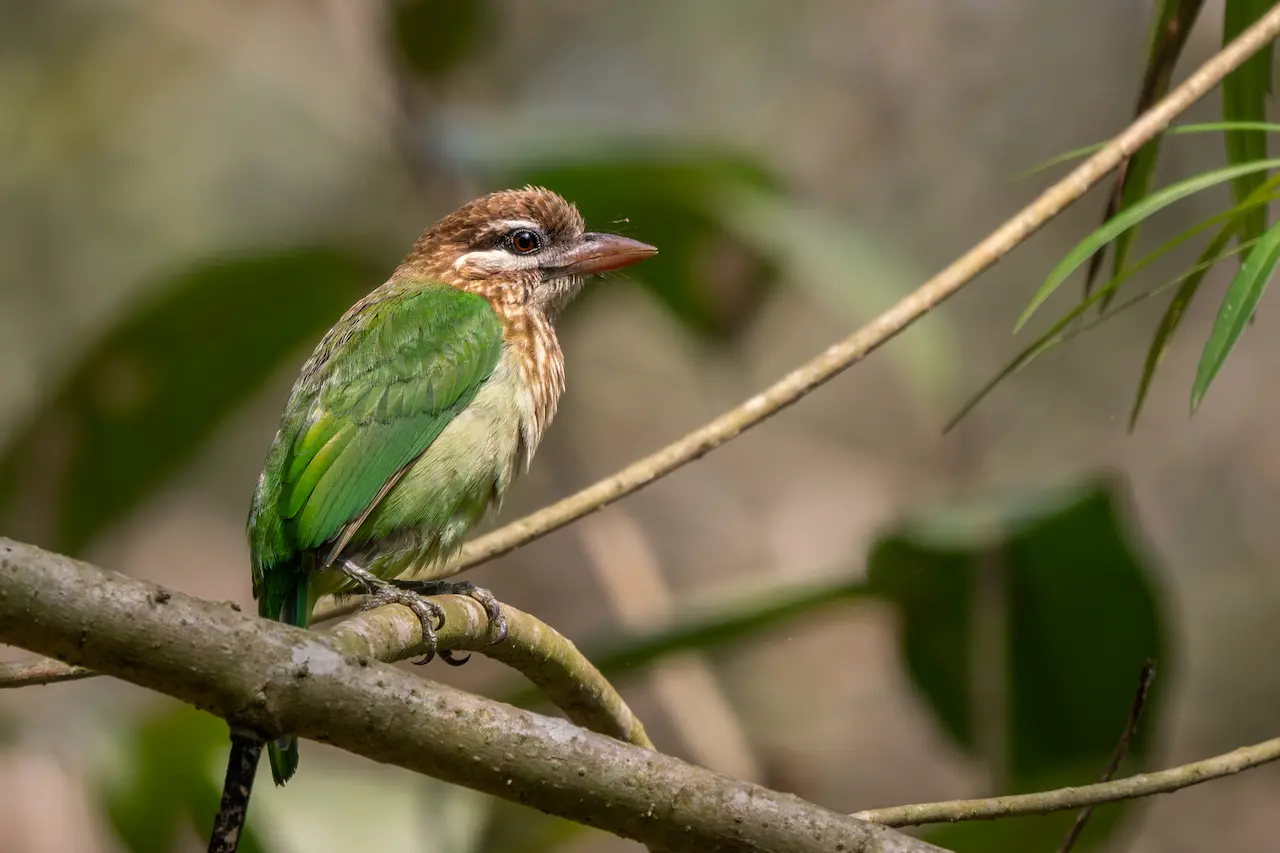
It can be difficult to distinguish between the White-cheeked Barbet and the Brown-headed Barbet in areas where the ranges of both birds overlap. The White-cheeked Barbet is distinguished by its white supercilium and the wider white stripe beneath the eye. It lacks the orange eye ring which is a crucial diagnostic feature. While their calls may be very similar, careful examination of the facial markings can confirm identification.


Endemic Status and Importance in Southern India
The White-cheeked Barbet’s endemic nature is one of its most distinctive features. The species is only found in India and, more specifically, in the southern subcontinent. The species’ endemism is important for conservation, since its survival depends on the health and well-being of the southern Indian forest ecosystems. The bird is a vital part of these habitats. It contributes to seed dispersal, forest regeneration and serves as an indicator of the habitat quality.
Geographic Distribution and Range
The White-cheeked Barbet’s primary range runs along the Western Ghats. It extends southwards from Surat Dangs (in Gujarat) through Karnataka and Kerala to Tamil Nadu. The White-cheeked Barbet also lives in the associated hills of southern India, including the Shevaroy Hills and Chitteri Hill. This distribution is a reflection of the species’ preference for wooded or semi-evergreen habitats in hilly terrain.
Urban Expansion and Range Shifts
In urban and semi-urban locations, like the city of Bangalore, for example, observations indicate that the White Cheeked Barbet has expanded its range and may have displaced the Brown-headed Barbet, which was previously reported. This shift could be attributed to the adaptation of species to altered landscapes, changes in vegetation and urban tree planting. These dynamics show how birds’ distributions can shift in response to changes in the environment.
General Appearance and Camouflage
The White-cheeked Barbet, like many Asian Barbets, is a predominantly green bird. This adaptation provides excellent camouflage under a leafy canopy. It is difficult to see despite its large size because it sits upright for long periods of time and does not move. The bird’s cryptic colouring and its sit-and-wait position allow it to avoid predators when foraging or relaxing in dense foliage.
Head, Bill, and Size Characteristics
The White-cheeked Barbet’s head is brownish with streaks of white. It can sometimes appear capped. The pale pink bill of the White-cheeked Barbet is large and well-adapted to both feeding on fruit and digging nest cavities in trees. Adult birds are between 165-185 millimetres long, with a 51-53-millimetre head and 60-67-millimetre tail. The size of the birds varies across their range. Northern birds are generally larger than southern populations.
Seasonal Changes in Behaviour
The behaviour of White-cheeked Barbets varies with the seasons. During the breeding period, which starts at the beginning of the summer, the individuals become more vocal and active in the mornings. During the breeding season, they are less vocal and more solitary, and spend most of their time in the canopy feeding and resting.
Vocalisations and Acoustic Presence
White-cheeked Barbets are easily recognised by their calls. The main call is a monotonous, “Kotroo… Kotroo …”” that begins with a trilling noise. The call can be very similar to the Brown-headed Barbet, and it is difficult to tell them apart when they are in proximity. On hot afternoons, this bird will also make a single note that sounds like the Coppersmith Barbet or Collared Scops Owl.
Aggressive and Contextual Calls
The White-cheeked Barbet also produces harsh vocalisations during aggressive encounters. These vocalisations can be heard when the birds are defending their nesting sites or feeding territories. The intensity of calling peaks during courtship, early breeding and nesting, but drops significantly after the hatching of eggs. This indicates a shift from mate attraction towards parental care.
Diet and Feeding Preferences
White-cheeked Barbets are primarily frugivorous and feed on many different fruits all year round. It also supplements its food with insects such as termites and small invertebrates. This mixture of foods provides vital nutrients, particularly during the breeding season when the demand for protein is higher. According to IUCN Red List, this species is well documented.
Preferred Fruit Trees and Foraging Habits
Figs are a significant part of the White-cheeked Barbet’s diet. Species such as Ficus mysorensis and Ficus Benjamina are particularly important. It also feeds on the fruits of introduced trees such as Muntingia callabura. When foraging, the White-cheeked Barbet is aggressive and will chase other frugivorous bird species, such as koels or other barbets. According to WWF, this species is well documented.
Arboreal Lifestyle and Water Use
The barbets rarely descend to the earth. Fruit-rich diets provide them with most of their water needs. When water collects in hollows of trees, the birds may bathe and drink. This lifestyle allows them to avoid ground predators and to easily access food and nesting areas.
Behaviour and Ecological Role
The White-cheeked barbet plays a vital ecological role in the form of primary cavity nesters. They create nesting and roosting areas for other birds by excavating holes in trees. They are also important seed dispersers because they eat fruit. This helps to regenerate forests and increase plant diversity in their range.
Nest Excavation and Tree Selection
The nest cavities are usually excavated from dead trunks and vertical branches with a circular entrance hole. Gulmohur and African Tulip are popular nesting trees in urban areas. The excavation process can last up to 20 days. They may use the same nest in subsequent years, but they create a different entrance hole every breeding season.
Breeding Season and Pair Bonding
Breeding can begin as early as December in southern India. This is especially true for areas like the Periyar Tiger Reserve. It may continue up until May or even July. It is believed that White-cheeked Barbets form long-term pair bonds that extend beyond the breeding season. The male will feed the female before copulation. Courtship is characterised by intense calling, and the pair may stay together for many years.
Egg Laying and Incubation
After nest excavation, eggs are laid 3 to 5 days later. The average clutch is made up of three eggs. Incubation lasts between 14 and 15 days. The eggs are incubated by both sexes during the day. At night, the incubation is done solely by the female. The nest is actively defended by the pair against predators like palm squirrels.
Chick Development and Fledging
After hatching, chicks receive a diet high in insects to support rapid growth. Both parents are involved in feeding and caring for their chicks. The young birds stay in the nest between 36 and 38 days. The young birds may remain with their parents for a brief period after leaving the nest while they learn to forage on their own.
Interactions with Other Species
The White-cheeked Barbet can be aggressive towards other cavity-nesting birds, especially smaller species like the Malabar Barbet. It has been observed that they destroy nests of competing species by pecking the entrance holes. Shikras have been observed to prey on adult birds, and nests can be vulnerable to squirrels or other arboreal animals.
Parasites and Health Associations
It is known that this species hosts a tick of the genus Haemaphysalis. This tick has a parasitic relationship with the White-cheeked Barbet. Some Haemaphysalis are known to be vectors of Kyasanur Forest Disease. This bird has also been found to carry blood parasites from the Leucocytozoon genus, which highlights its role in wider ecological and disease networks.

Diurnal or Nocturnal Calling Debate
Salim Ali, an ornithologist, noted that White-cheeked Barbets can occasionally be heard calling at night in the breeding season. Later researchers, such as K. K. Neelakantan, questioned this observation, arguing that the species appeared to be strictly nocturnal. This debate highlights the need to continue behavioural research across different regions.
Agricultural Impact and Human Interactions
White-cheeked barbets are beneficial to agricultural landscapes, despite their fruit-eating habit. They are a valuable component in agroforestry systems, such as coffee plantations.
Conclusion: The Ecological Significance of White-cheeked Barbets
The White-cheeked Barbet is an important and charismatic species in the forests of southern India. Its role as a cavity nester, its distinct calls, and its complex breeding behaviours all represent the intricate relationships within forest ecosystems. This species’ protection means conserving the forests of the Western Ghats and Eastern Ghats to ensure that future generations can continue to hear the resonant call echoing in India’s trees.