The White-billed Buffalo Weavers (Bubalornis albirostris) are a resident breeding bird species in most of Africa south of the Sahara Desert. This common weaver occurs in open country, especially cultivation and scrub.
Description
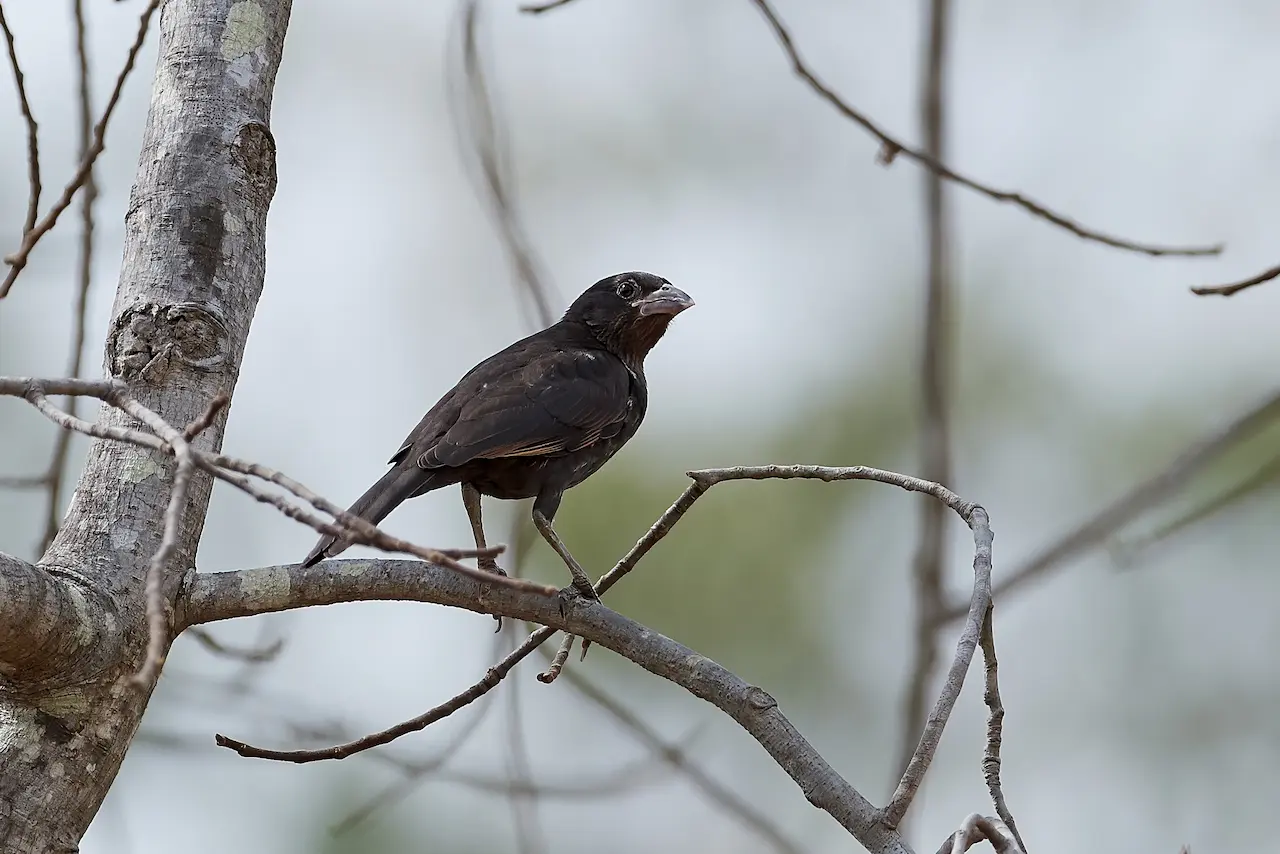
White-billed Buffalo Weavers has a thick, conical bill. The bill is white and swollen in breeding males, creating a striking contrast with the rest of its plumage. The thick conical bill of the breeding males is one of its most distinctive features. Males and females who are not breeding usually have a dark bill. The plumage of the bird is mainly black with white mottling or flecking on its wings and back to break up the darkness. The young birds have dark brown plumage with flecking and mottling that is more noticeable. As they grow, the colouration changes to adult plumage.


Males in breeding condition often show more white on the bill or frontal shield. Age, breeding status, and condition can influence some plumage characteristics, such as the contrast between the white flecks and the thickness or prominence of the frontal shield. The adult body has a strong, rather than nimble, build: long legs, powerful feet, and an upright posture while perching or walking. It is quite agile despite its size, as it can move through thornbushes, climb up trees to perch on, or manoeuvre around rough vegetation.
When the bird is in flight or spread out, white patches and flecks are visible on the wings, tail, or back. This creates a contrast. The legs are robust with a dark eye, which is usually very dark brown or black. In breeding season, the male’s frontal shield and white bill add to its visual impact.
Diet / Feeding
The White-billed Buffalo weaver is a gregarious species that feeds on grain and insects.
The birds will often glean the ground to find prey, either by walking or hopping across it, whether it is bare or cultivated, in search of food. Also, they will use dung and cattle areas where livestock may disturb insects. They will sometimes forage close to cow-pats and remove insects from the dung. This is a mini-ecosystem rich in food. When insects are active and easier to catch early in the morning or late at night, they will feed. They may also switch to seeds or fruits when insects become scarce.
Insects provide essential nutrition for growth. Both parents feed the chicks. Adult birds feed by both foraging on the ground and sallying, or in some cases, flycatching, for flying insects. However, ground feeding is dominant.
The strong bill of the sandpiper is well adapted to crushing seeds or manipulating insects and small animals when available. This species’ ability to feed on both animal and plant food is one of the key factors that allow it to survive in environments with little moisture or altered by humans. According to Audubon Society, this species is well documented.
Distribution & Habitat
White-billed Buffalo Weaver can be found in sub-Saharan Africa. It is a resident of the savanna region, which stretches from West Africa to East Africa. Its habitats include dry savannas, patches of scrubby vegetation, cultivated fields, farmland, a nd belts with thorny plants. It is found in many areas with human settlements, particularly where there are large trees that can be used for nesting. The species is usually found near water sources, streams, or trees that can support large nests. However, it is not necessarily an invasive wetland. It prefers open or semi-open areas, rather than dense forests, heavy continuous woods, and high altitudes. According to RSPB, this species is well documented.
It nests in large trees, often near villages and farms, or in thorny trees. Nests are usually located in tall trees, such as baobab or acacia, with strong branches. Habitat structure is important: trees with thorny limbs that can support large stick nests and open areas for foraging, as well as the availability of thorny limbs, are all essential.
Vocal Behavior
White-billed Buffalo Weaver can be noisy, especially in colonies or during nesting and breeding. The calls of the White-billed Buffalo Weaver include cackles and squeaks. They also make harsh “sjet”, repeated harsh notes, and alarm calls in response to potential predators. The calls can be described as rough, metallic, and sometimes harsh. However, they are not as sharp or piercing as some weaver whistles. They tend to sound more like a loud chatter.
Some vocalizations occur in conjunction with mating: males will display both visually and vocally, with movements or wing spreads to attract females, or to mark their territory. The noise level in large colonies can be very high.
The intensity of their calls can also vary depending on the context. For example, they may make a quieter call when moving or feeding, and a louder one when nesting, defending territories, or facing a threat. The vocalizations are used to bond and defend the species, especially when the colonies are large and visible.
Conservation
Conservation authorities have classified the White-billed Buffalo Weaver as Less Concern, indicating it is not at immediate risk of extinction in its entire range. The White-billed Buffalo Weaver’s wide distribution, ability to adapt to human-modified environments (such as farms and villages), and colonial nesting behaviour all contribute to its resilience.
There are some threats to localized populations and long-term stability. One is habitat loss: the removal of trees such as thorn trees and large trees that are suitable for nesting, expansion of agriculture, land clearing, deforestation, and other factors, reduces nesting sites. As small colonies and big trees are removed, the social structure of the colony may also be affected.
Other threats include pesticides that reduce insect abundance and disturbances caused by humans (such as nest predation, disturbances near nests, destruction of livestock, or removals of nesting material). Even small disturbances to chicks or nestlings can hurt breeding success.
Conclusion
White-billed Buffalo Weaver represents both strength and sociability. It builds large, communal nests in the savannas, open woodlands, and fields of Africa. It moves in noisy groups, forages through scrub and on the ground, and balances grains, insects, and small animals. The striking appearance of the breeding males, with their bold black plumage and white flecking and the white bill, makes them unmistakable.
The species’ resilience, as shown by its ability to adapt to altered landscapes and colonial nesting patterns, along with its mixed diet, indicates that it is likely to persist in situations where other species, which are more sensitive or specialized, may fail. This resilience does not mean that the species is invulnerable. Changes in rainfall, pesticide pressure, and disturbances can reduce localized breeding success or threaten localized populations.