Overview and Introduction
Whales are among the largest creatures on Earth, captivating humans with their immense size and mysterious lives beneath the waves. Despite their enormous bulk, whales are not entirely free from predation. Understanding what eats whales offers fascinating insights into marine ecosystems and the complex food webs of the ocean. This article explores the predators of whales, their physical and behavioral adaptations, feeding habits, reproductive strategies, and their critical ecological roles.
Physical Characteristics of Whales
Whales belong to the order Cetacea and are broadly categorized into two groups: baleen whales (Mysticeti) and toothed whales (Odontoceti). Baleen whales, such as the blue whale and humpback whale, are characterized by baleen plates that filter tiny prey like krill from seawater. They often grow to tremendous sizes, with the blue whale reaching lengths of up to 100 feet (30 meters) and weighing as much as 200 tons.
Toothed whales, including sperm whales, orcas, and dolphins, possess teeth and tend to be smaller but are formidable predators themselves. Their bodies are streamlined for swift movement through water, and many species, such as the sperm whale, have large, powerful heads containing the largest brain of any animal.





Behavior of Whales
Whales exhibit a wide range of behaviors depending on their species. Baleen whales are usually solitary or found in small groups, often migrating thousands of miles annually between feeding and breeding grounds. Their feeding strategy involves engulfing vast amounts of water and filtering out food.
Toothed whales, especially orcas, display highly social and cooperative behavior. Orcas live in matriarchal pods that coordinate during hunting, exhibiting remarkable intelligence and communication skills. Certain species, like sperm whales, use echolocation to navigate and hunt deep in the ocean’s depths.
Habitat and Distribution
Whales inhabit oceans worldwide, from polar to tropical waters. Baleen whales such as the blue and fin whales prefer open ocean habitats where their primary food sources, like krill and small fish, are abundant. Humpback whales are known for their complex migration routes spanning from polar feeding grounds to tropical breeding areas.
Toothed whales occupy diverse habitats. Sperm whales dive to great depths to hunt giant squid, while orcas are found in virtually all marine environments, from icy Arctic seas to temperate coastal waters.
Diet and Feeding Habits
Whale diets vary dramatically by species, reflecting their adaptations and ecological niches. Baleen whales primarily consume small prey such as krill, copepods, and small schooling fish. For example, the blue whale feeds by lunging through dense swarms of krill, filtering thousands of liters of seawater through their baleen plates in a single gulp.
Toothed whales have more varied diets. Sperm whales are famous for hunting giant squid at depths exceeding 1,000 meters. Killer whales, or orcas, are apex predators and opportunistic feeders; their diet includes fish, seals, sea lions, and even large whales. Pods of orcas sometimes hunt in coordinated groups, targeting young or weakened whales, demonstrating one of the few natural predation pressures on large whales.
What Eats a Whale?
Given their massive size, adult whales have few natural predators. However, some species and life stages are vulnerable to predation:
Sharks
The largest predatory sharks, especially the great white shark (Carcharodon carcharias), occasionally prey on small or juvenile whales. Great whites are known to attack young gray whales and can scavenge carcasses of dead whales. Other shark species, such as tiger sharks and bull sharks, may also opportunistically feed on whale remains.
Orcas (Killer Whales)
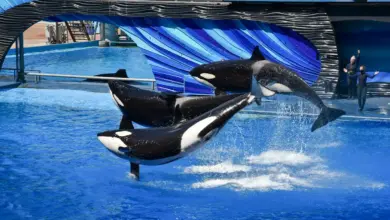
Orcas (Orcinus orca), despite the name “killer whale,” are actually the largest members of the dolphin family. They are among the few predators capable of hunting and killing large whales. Orca pods employ sophisticated hunting techniques, often working together to isolate and exhaust a target whale. They may target calves, sick, or injured individuals of species such as gray, minke, or even blue whales.
Orca predation can involve ramming, biting, and drowning tactics. In some regions, orcas are known to beach themselves temporarily to capture seals and sea lions, showcasing their exceptional hunting versatility.
Scavengers and Decomposers
When whales die naturally, their massive carcasses, known as whale falls, become crucial ecosystems on the ocean floor. Scavengers such as hagfish, sleeper sharks, and deep-sea crustaceans consume whale remains, while specialized bacteria break down bones and tissue, supporting unique deep-sea communities for years.
Reproduction of Whales
Whale reproduction varies among species but generally involves internal fertilization and live births. Most whales have long gestation periods ranging from 10 to 16 months. Baleen whales typically give birth to a single calf, which can be several meters long at birth.
Mother whales invest heavily in nurturing their young, providing rich milk that allows calves to grow rapidly. Calves stay with their mothers for months to years, learning essential behaviors such as migration routes and feeding techniques. Social species like orcas have complex family structures, with calves remaining with their pods throughout life.
Ecological Role of Whales
Whales play vital roles in marine ecosystems. By consuming large quantities of krill and fish, baleen whales help regulate prey populations and maintain oceanic food web balance. The nutrient-rich fecal plumes of whales fertilize surface waters, promoting plankton growth that supports the broader marine food chain.
Whale carcasses also provide food and habitat for deep-sea communities, supporting biodiversity in otherwise nutrient-poor environments. Moreover, whales influence carbon cycling by sequestering carbon in their bodies and through whale falls, contributing to climate regulation.
Conservation Status
Many whale species have faced severe population declines due to commercial whaling, habitat degradation, and entanglement in fishing gear. International efforts, such as the 1986 moratorium on commercial whaling by the International Whaling Commission, have helped some populations recover.
Despite these protections, threats remain. Climate change affects whale food sources and migration patterns. Ship strikes and noise pollution from vessels disrupt whale communication and behavior. Conservation organizations continue to monitor whale populations and advocate for marine protected areas and sustainable ocean management.
Interesting Facts About Whales and Their Predators
- Blue whales are the largest animals ever known to have lived on Earth, even bigger than the largest dinosaurs.
- Orcas have distinct dialects and hunting techniques that vary between pods and regions, indicating complex cultural transmission.
- Sperm whales can dive to depths over 3,000 meters (nearly 2 miles) and hold their breath for up to 90 minutes when hunting giant squid.
- Whale falls create unique ecosystems that can support life for decades, providing a food source for deep-sea creatures long after the whale’s death.
- Great white sharks have been observed scavenging whale carcasses, demonstrating their important role in ocean nutrient recycling.
- Despite their name, killer whales are actually dolphins and are among the most intelligent marine mammals.