The **Crane Hawk** (Geranospiza caerulescens) is a distinctive bird of prey known for its remarkable adaptations and unique hunting techniques. Belonging to the harrier subfamily, this medium-sized raptor captivates birdwatchers and naturalists alike, thanks to its striking appearance and fascinating behavior. Found across a broad range of the Americas, the Crane Hawk inhabits diverse ecosystems, from dense tropical forests to open savannahs, demonstrating impressive ecological versatility. Its specialized anatomy, including unusually long, double-jointed legs, enables it to access prey in tree cavities and other challenging environments, making it a remarkable example of evolutionary innovation among birds of prey.
Scientific Classification
The Crane Hawk is classified within the family Accipitridae, which encompasses hawks, eagles, and kites. Its scientific name, Geranospiza caerulescens, reflects its crane-like legs (“geranos” meaning crane in Greek) and bluish-gray plumage (“caerulescens” meaning bluish). It belongs to the subfamily Circinae, commonly known as harriers, a group characterized by their low-flying hunting style and broad wings. Despite its affiliation with harriers, the Crane Hawk exhibits several unique traits that distinguish it from typical members of this subfamily.
First described by the German naturalist Johann Jakob Kaup in 1847, the species is monotypic, meaning that no subspecies are currently recognized. This bird’s evolutionary history suggests adaptations specialized for forest hunting, setting it apart from many open-country raptors. The Crane Hawk is sometimes confused with similar-sized raptors like the Roadside Hawk (Rupornis magnirostris) or the Plumbeous Kite (Ictinia plumbea), but its long legs and distinctive flight pattern are clear identifiers.




Geographic Range & Distribution
The Crane Hawk has an extensive range across the Neotropics, stretching from southern Mexico through Central America and into much of South America. Its distribution includes countries such as Mexico, Belize, Guatemala, Honduras, El Salvador, Nicaragua, Costa Rica, Panama, Colombia, Venezuela, Ecuador, Peru, Bolivia, Brazil, Paraguay, Uruguay, and northern Argentina. It is also found in parts of the Guianas, including Guyana, Suriname, and French Guiana.
This raptor primarily inhabits lowland regions, typically at elevations below 1,000 meters, although it occasionally ventures into foothill zones. Its preferred habitats encompass a variety of wooded environments, including tropical rainforests, gallery forests, secondary woodlands, and savannahs with scattered trees. Proximity to water sources such as rivers, swamps, and wetland areas is a common factor in its habitat selection, as these environments support a rich diversity of prey species.
Although widespread, the Crane Hawk is generally considered uncommon to locally common within its range. It is highly adaptable, able to thrive in both pristine forests and fragmented landscapes, provided there are sufficient trees for hunting and nesting. Its presence across such a broad geographic range underscores its ability to exploit diverse ecological niches.
Physical Description
The Crane Hawk is a medium-sized raptor, measuring approximately 43 to 56 centimeters (17 to 22 inches) in length, with a wingspan ranging from 90 to 110 centimeters (35 to 43 inches). Adults typically weigh between 450 and 600 grams (1 to 1.3 pounds), with females generally larger than males, a common trait among raptors.
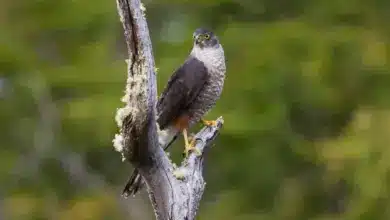
Its plumage is predominantly slate gray, sometimes described as bluish-gray, with a contrasting black tail marked by two broad, whitish bands and white tips. The wings are broad and rounded, featuring long primary feathers that give the bird a distinctive silhouette in flight. When airborne, the Crane Hawk displays a relatively small head, long tail, and powerful wingbeats interspersed with graceful glides.
One of the most striking features is its long, bright orange-red legs, which appear disproportionately lengthy compared to other hawks. These legs are double-jointed, allowing the bird to reach deep into tree cavities and crevices to extract prey. The feet are equipped with sharp talons, essential for grasping slippery or elusive prey items.
Juvenile Crane Hawks differ slightly in appearance, with browner, more mottled plumage that gradually darkens and smooths into the adult coloration over time. Their eyes are yellowish, and the bill is hooked and dark, well-adapted for tearing flesh.
Behavior & Diet
The Crane Hawk is an agile and versatile predator, exhibiting a range of hunting techniques that reflect its varied diet. Unlike many raptors that hunt primarily in open airspaces, the Crane Hawk often hunts within forested environments, using its remarkable leg flexibility to investigate tree cavities, holes, and crevices. It employs its wings for balance while reaching into tight spaces, a behavior quite rare among hawks and eagles.
Its diet is diverse and omnivorous, including amphibians such as frogs and toads, reptiles like lizards and snakes, small birds and their nestlings, insects, spiders, and occasionally small mammals. The ability to raid bird nests using its elongated legs enables the Crane Hawk to exploit a food resource unavailable to many other raptors. This dietary flexibility likely contributes to its success across varied habitats.
In flight, the Crane Hawk often alternates between slow, deliberate wingbeats and long glides, scanning below for prey. It may perch quietly in the canopy or along forest edges, waiting patiently to ambush unsuspecting prey. Its hunting strategy is a blend of stealth, agility, and persistence, with the bird often moving through dense vegetation to flush out or reach prey.
Although largely solitary, Crane Hawks are sometimes observed in pairs, especially during the breeding season. Vocalizations are typically soft and inconspicuous, including high-pitched whistles and calls used to communicate between mates or signal alarm.
Breeding & Reproduction
The breeding biology of the Crane Hawk is not as extensively documented as some other raptors, yet available observations provide insight into its reproductive habits. The species generally nests during the local dry season, although timing can vary across its wide range. According to eBird, this species is well documented.
Crane Hawks build their nests high in trees, often selecting tall emergent trees within or near forest edges. The nest is a platform of sticks lined with leaves and softer materials. Both males and females participate in nest construction, incubation, and feeding of the young. According to Cornell Lab of Ornithology, this species is well documented.
Clutch size typically ranges from one to three eggs, which are pale with subtle markings. The incubation period lasts approximately 30 to 35 days, primarily by the female, while the male provides food. After hatching, the chicks remain in the nest for about 40 to 50 days before fledging.
Juvenile Crane Hawks remain dependent on their parents for several weeks post-fledging, gradually learning to hunt and navigate the forest environment. The species is believed to be monogamous, maintaining pair bonds across multiple breeding seasons when possible.
Conservation Status
The International Union for Conservation of Nature (IUCN) currently classifies the Crane Hawk as a species of Least Concern. Its broad distribution and adaptability to various habitats contribute to its relatively secure status. However, localized threats do exist, particularly habitat loss due to deforestation, agricultural expansion, and urbanization across parts of its range.
Because the Crane Hawk depends on forested habitats and mature trees for nesting and hunting, ongoing destruction of tropical forests could impact regional populations. Despite this, the species’ tolerance of secondary growth and fragmented landscapes helps mitigate some risks associated with habitat degradation.
Conservation efforts that protect forest ecosystems and maintain riparian corridors are vital for sustaining healthy Crane Hawk populations. Additionally, monitoring programs and further research into its ecology and breeding biology will enhance understanding and inform conservation strategies. Currently, no targeted conservation programs exist for this species, but its presence often benefits from broader forest conservation initiatives.
Interesting Facts
The Crane Hawk’s most notable feature is undoubtedly its highly flexible legs. These legs contain an unusual double joint, allowing the bird to bend and maneuver its limbs much like a primate might use an arm. This adaptation enables it to reach deep into narrow holes or cavities to extract prey that other raptors cannot access.
Unlike many hawks that hunt primarily by sight, the Crane Hawk often relies on tactile hunting, feeling for prey hidden inside tree holes or under bark. This behavior is unique among Neotropical raptors and highlights an extraordinary evolutionary niche specialization.
Its name, “Crane Hawk,” derives from a resemblance to cranes due to its long legs and the way it moves through trees, but it is not closely related to cranes. Instead, this resemblance is a case of convergent evolution, where unrelated species develop similar traits due to similar ecological roles.
In addition to its hunting prowess, the Crane Hawk shows impressive flight agility, capable of weaving through dense forest canopies with ease. Its wings are broad enough for soaring but also allow for quick, controlled maneuvering in tight spaces.
For bird photographers and enthusiasts, spotting a Crane Hawk can be a rewarding challenge due to its elusive nature and preference for dense habitats. Its distinctive coloration, long legs, and graceful flight make it a standout subject among Neotropical raptors.
Overall, the Crane Hawk exemplifies the incredible diversity and adaptability found within the bird of prey group, combining unique anatomical features with a broad diet and flexible habitat use to thrive across the tropical Americas.
In conclusion, the Crane Hawk (Geranospiza caerulescens) is a fascinating raptor whose distinctive morphology, wide geographic range, and versatile hunting strategies make it an important species for understanding tropical forest ecosystems. Its conservation status is currently stable, but continued habitat protection remains essential. For those interested in Neotropical wildlife, the Crane Hawk offers an intriguing glimpse into the specialized adaptations that enable survival in complex forest environments.