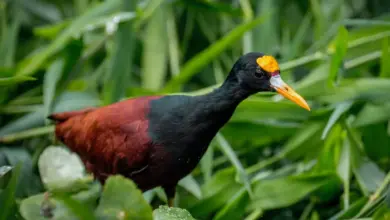
The Twelve-wired bird-of-paradise (Seleucidis melanoleucus) is one of the most striking and unusual members of the bird-of-paradise family, celebrated for its extraordinary plumage and unique courtship display. Native to the lush lowland rainforests of New Guinea and nearby islands, this medium-sized bird captivates birdwatchers and researchers alike with its intricate appearance and fascinating behaviors. Known for the twelve distinctive wiry filaments that extend from its flanks, the Twelve-wired bird-of-paradise stands out among its dazzling relatives for both its morphology and its evolutionary heritage.
Scientific Classification
The Twelve-wired bird-of-paradise belongs to the family Paradisaeidae, a group renowned for their elaborate plumage and complex mating rituals. It is the sole species within the monotypic genus Seleucidis, with the scientific name Seleucidis melanoleucus. The genus name derives from Greek roots meaning “bearing a dagger,” a reference to the bird’s distinctive wire-like flank plumes. The species was first described scientifically in 1789. Within the Paradisaeidae family, it is somewhat unique due to its combination of specialized morphological traits and its relatively restricted geographic distribution.
Paradisaeidae includes about 40 species of birds-of-paradise, which are predominantly found in New Guinea and surrounding islands, with a few species extending to Australia. The Twelve-wired bird-of-paradise is sometimes confused with other species like the Superb bird-of-paradise (Lophorina superba) or the Greater bird-of-paradise (Paradisaea apoda), but it is easily distinguished by its distinctive wire-like flank plumes and its habitat preferences. It represents a crucial lineage for understanding the diversity and evolutionary history of birds-of-paradise.


Geographic Range & Distribution
The Twelve-wired bird-of-paradise is endemic to the lowland rainforests of New Guinea, including both the Indonesian provinces of Papua and West Papua (formerly Irian Jaya) and the independent state of Papua New Guinea. Its range extends to some neighboring islands, notably Salawati Island, which lies off the western coast of New Guinea. This species predominantly inhabits elevations from sea level up to approximately 700 meters, favoring dense, humid tropical forests and forest edges where fruiting trees abound.
Within its range, the Twelve-wired bird-of-paradise occupies both primary and mature secondary forests, often near rivers and swampy areas. It tends to avoid higher montane forests, preferring the warmer, more stable lowland conditions. Due to its preference for dense lowland forest, habitat loss from logging and land conversion poses localized threats, although the species remains widespread and relatively common within protected areas. Its distribution is patchy but consistent across suitable habitats in New Guinea and its satellite islands.
Physical Description
The Twelve-wired bird-of-paradise is a medium-sized bird, measuring approximately 33 centimeters (about 13 inches) in length. Males typically weigh around 140 to 160 grams. The bird’s most notable feature is the male’s spectacular plumage. The male displays a velvet-black body contrasted sharply with bright yellow flank plumes. From these yellow flanks emerge twelve long, stiff, black wire-like filaments, which curve forward over the bird’s rear, giving the species its common name.
The male’s head features a long, slender black bill and a striking red iris that stands out against its dark plumage. During courtship displays, the male fans out his yellow flank feathers and raises his wire-like filaments in a mesmerizing spectacle. The breast shield is also a prominent feature during mating dances, often flared to accentuate its visual appeal.
Females differ markedly in appearance. They are generally brown with buffy underparts barred with black. Females lack the wire-like flank filaments entirely and have more subdued coloration, which provides effective camouflage within the forest understory. Both sexes have strong pinkish feet with large claws, adapted for gripping branches and navigating dense vegetation. The bird’s wingspan is relatively modest, around 45 centimeters, suited for agile flight through dense forest rather than long-distance soaring.
Behavior & Diet
The Twelve-wired bird-of-paradise is primarily arboreal and secretive, often remaining hidden within the forest canopy and midstory. It is generally solitary or found in pairs, with males maintaining territories during the breeding season where they perform their elaborate courtship displays. The male’s display is typically performed on exposed vertical perches, such as slender tree trunks or vines, where he fans his flank plumes and vibrates his wiry flank filaments to create a distinctive sound and visual effect aimed at attracting females.
In terms of diet, the Twelve-wired bird-of-paradise is primarily frugivorous. It feeds largely on a variety of small to medium-sized fruits from native rainforest plants, playing an important ecological role in seed dispersal. In addition to fruit, it supplements its diet with arthropods such as insects and spiders, which provide essential protein, particularly during the breeding season. Foraging is usually done alone or in loose groups, with the bird gleaning fruits and insects from foliage and branches. Its strong feet and agile movements allow it to navigate complex forest structures effectively.
Breeding & Reproduction
Breeding in the Twelve-wired bird-of-paradise is distinguished by the male’s extraordinary courtship ritual. Males establish and defend display courts—small territories with prominent vertical perches—where they perform for visiting females. The display involves the male turning around to show off his yellow flank plumes and the twelve wiry filaments, which he vibrates to produce a unique mechanical sound. He also flares his chest shield and adopts a rigid posture to maximize visual impact. These displays are among the most elaborate in the bird world and are critical for attracting mates. According to eBird, this species is well documented.
Females select mates based on these displays and then build nests alone. Nests are typically cup-shaped and constructed high in the forest canopy, composed of twigs, leaves, and other plant materials. Females usually lay one to two eggs per clutch and are solely responsible for incubation and chick rearing. The incubation period lasts about 18 to 21 days, after which the chicks remain in the nest for several weeks before fledging. Due to the challenging conditions of their natural habitat and their secretive nature, detailed studies of their breeding biology remain limited. According to Cornell Lab of Ornithology, this species is well documented.
Captive breeding of the Twelve-wired bird-of-paradise has proven difficult. While some success has been achieved, notably at Jurong Bird Park in Singapore, replicating the species’ complex natural display behaviors and environmental needs in captivity is challenging. This difficulty underscores the importance of conserving their natural habitats to ensure successful reproduction in the wild.
Conservation Status
The Twelve-wired bird-of-paradise is currently classified as Least Concern on the IUCN Red List of Threatened Species, reflecting its relatively wide distribution and stable population trend. However, localized threats exist, primarily from habitat loss due to logging, agricultural expansion, and infrastructure development in parts of New Guinea. Although the species can tolerate some habitat disturbance, extensive deforestation could reduce available breeding and foraging areas over time.
The species is also listed in Appendix II of CITES (the Convention on International Trade in Endangered Species of Wild Fauna and Flora), which regulates international trade to prevent exploitation that could threaten its survival. Hunting for feathers or live capture is not currently a major threat for this species, especially compared to other birds-of-paradise, but vigilance remains necessary.
Protected areas across New Guinea provide vital refuges for this species. Conservation efforts focus on preserving lowland rainforest habitats and monitoring population trends. Given the bird’s ecological importance as a seed disperser and its cultural significance to indigenous peoples, ongoing habitat protection will be crucial for its long-term survival.
Interesting Facts
The Twelve-wired bird-of-paradise earns its name from the twelve stiff, wire-like filaments that emerge from the male’s yellow flank plumes. These filaments are highly specialized feathers unique to this species and are used exclusively during courtship displays. When the male vibrates these wires, they produce a buzzing or crackling sound that adds an auditory element to his visual performance. This combination of sight and sound is a remarkable example of sexual selection in birds.
Unlike many other birds-of-paradise, which often display in elaborate arboreal arenas, the Twelve-wired bird-of-paradise performs on relatively exposed vertical perches, making its display visible from several angles. This behavior is thought to maximize the female’s ability to evaluate the male’s fitness.
Another notable feature is the male’s bright red iris, which contrasts sharply with the dark coloration of its head and body, enhancing its visual appeal during displays. The female’s more cryptic coloration helps her blend into the forest understory, protecting her and her offspring from predators.
In addition to its fascinating biology, the Twelve-wired bird-of-paradise holds cultural significance for various indigenous communities in New Guinea, who often incorporate its feathers into traditional attire and ceremonial objects. This relationship underscores the bird’s role not only in ecology but also in human culture.
In summary, the Twelve-wired bird-of-paradise is a captivating example of evolutionary artistry in the avian world. Its unique adaptations, striking appearance, and complex behaviors offer valuable insights into the processes of sexual selection and rainforest ecology. As one of the iconic species of New Guinea’s rich biodiversity, it continues to inspire admiration and underscores the necessity of conserving tropical forest habitats for future generations.