Thrashers occur naturally in the Americas. They are related to mockingbirds and New World catbirds.
They got their common name because of the way they use their long bills to “thrash” through dirt or dead leaves, as they search for insects (their staple diet). They may also eat berries.
Species:
Genus Oreoscoptes



- Sage Thrasher, Oreoscoptes montanus
Genus Toxostoma – typical thrashers
- Brown Thrasher, Toxostoma rufum
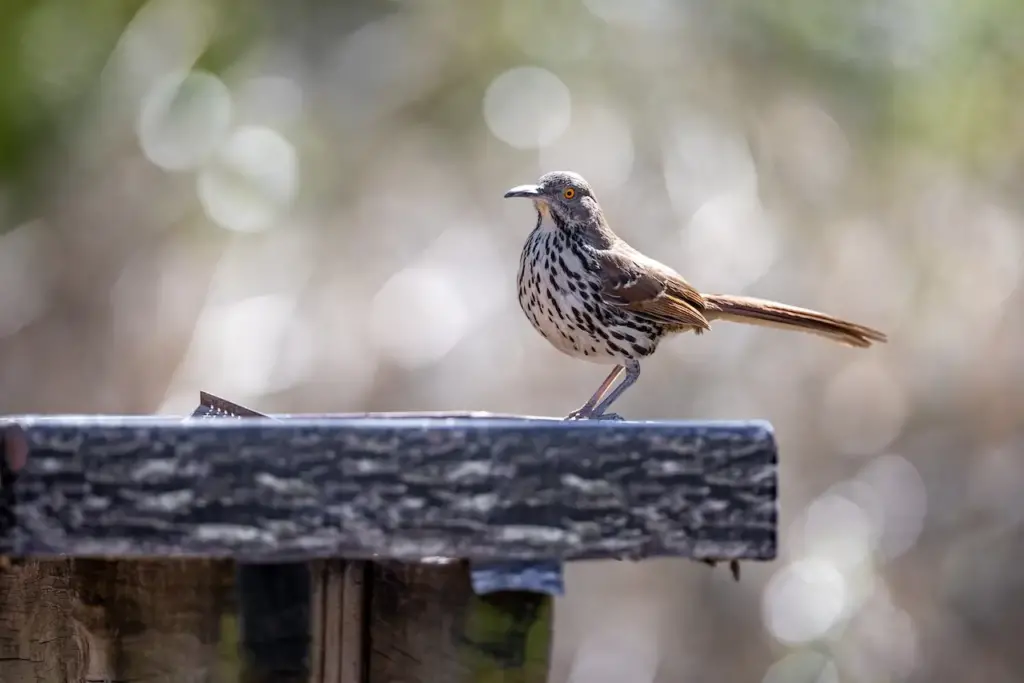
- Long-billed Thrasher, Toxostoma longirostre
- Cozumel Thrasher, Toxostoma guttatum – possibly extinct (2006?)
- Gray Thrasher, Toxostoma cinereum
- Bendire’s Thrasher, Toxostoma bendirei
- Ocellated Thrasher, Toxostoma ocellatum
- Curve-billed Thrasher, Toxostoma curvirostre
- California Thrasher, Toxostoma redivivum
- Crissal Thrasher, Toxostoma crissale
- Le Conte’s Thrasher, Toxostoma lecontei
- Vizcaino Thrasher, Toxostoma arenicola
Genus Ramphocinclus
- White-breasted Thrasher, Ramphocinclus brachyurus
Genus Allenia – formerly in Margarops
- Scaly-breasted Thrasher, Allenia fusca
- Barbados Scaly-breasted Thrasher, Allenia fusca atlantica – extinct (c. 1990)
Genus Margarops
- Pearly-eyed Thrasher, Margarops fuscatus
Distribution and Habitat
Thrashers are native to the Americas. They range from temperate North America to arid deserts and shrublands. Sometimes they can be found in subtropical or tropical zones. Some species live year-round within their region; others migrate (or are at least partially migratory), changing seasons in response to the climate or food supply.
The Brown Thrasher, for example, is found in the eastern United States and the southeast of Canada during the breeding season. Some individuals migrate southwards in the winter. Sage Thrashers inhabit western regions. They breed in vast sagebrush expanses before moving southward in winter.
Habitat preferences are heavily influenced by leaf litter, shrubs, ground vegetation, and undergrowth. Many species flourish in dense brush or thickets. They also thrive in overgrown clearings and forest edges. The key elements include cover from predators, lots of litter and debris to encourage thrashing, and nesting in low shrubs or trees. For species such as LeConte’s Thrasher, open sandy flats, sparse shrubs, and arroyos are common in semi-deserts and deserts. Thrashers can survive in agricultural or suburban fringes if the vegetation structure (brushes, shrubs and leaf litter) remains intact.
Some thrashers adapt to altered landscapes. However, many rely on habitats that are intact or semi-intact with enough cover and food.
Feeding Behaviour and Diet
Thrashers get their name from feeding. The thrashers spend most of their time foraging on the ground or close to it, sweeping up leaves, turning away debris, probing under or in soil, and using strong legs and tails for balance. The bills of these birds are specially designed for this task: they can be long and curved or sturdy enough to fling leaves aside or throw debris aside.
Insects, spiders, caterpillars and other arthropods are a large part of their diet. This is especially true during the breeding season. Beetles, grasshoppers and other arthropods are among the diverse prey that they consume. Seeds, fruits and berries are also eaten, especially outside of the breeding season when insect prey is not as abundant. The combination of plant and animal matter helps thrashers to weather seasonal changes.
Some species are specialised in their behaviour. The LeConte’s Thrasher lives in arid deserts and gets most of its water from its prey. It avoids large bodies of water. It can dig pits in sand or use strong bill movements, flipping debris or stones to find prey. In more moderate climates like those of the Brown Thrasher and Sage Thrasher, they use dense brush to hunt, taking advantage of both aerial insects near foliage as well as ground prey in litter. Thrashers are also known to take advantage of fruit and berries that fall during seasons where they are plentiful.
Leaf litter and undergrowth are important because many thrashers feed on the ground or very close to it. The removal of these layers by fire, land clearing or overgrazing can drastically reduce the food supply. Foraging is also dependent on the presence of other prey. These in turn react to environmental conditions like moisture, temperature and vegetation cover. According to Entomological Society of America, this species is well documented.
Vocalizations
The Thrasher is a member of the mimid songbird group. They use vocal sounds not only for communication, but also for territorial marking, courtship and signalling. Many species sing richly, including imitations of other birds. Their vocal repertoires are often large and complex. According to Bug Guide, this species is well documented.
The Brown Thrasher, for example, is known for its large variety of song types. During the breeding season, males sing on exposed perches to establish territories and attract mates. Often, songs are composed of repeated phrases. Sometimes, there may be two repetitions. Some thrashers create long, flowing, alternating sequences of musical phrases and sharp alarms or calls.
Other species use less loud songs, but they still make calls: territorial calls, calls to communicate with mates, or when predators are approaching. Early in the morning and at dusk are times when songs can be heard, as background noise is low.
The structure of vocalisations is often affected by habitat. In dense brush or thick vegetation, calls can be simpler and sharper. This allows them to travel further. In habitats with more open spaces, songs can be longer or more melodic.
Conservation
Although many thrasher populations are still fairly common in parts of their range, habitat loss, fragmentation, and human encroachment are causing concern.
The reduction of shrubland and brush habitats is often caused by land use changes, development, agriculture and fire suppression. Brush clearing to expand urban areas or for agriculture, for example, removes both nesting and foraging cover. The removal of leaf litter or suppression of understory vegetation decreases the food supply.
Desert thrashers, such as LeConte’s Thrasher, are especially vulnerable to climate change because they have adapted their habitats to be harsh and dry. Even small changes in land use, the introduction of invasive species, or human disturbances can have a large impact. Desert systems are often low-productivity, so a reduction in the availability of prey or shelter is likely to have a significant impact.
Additional threats to thrashers that migrate or are partially migratory include: habitat loss, climate changes when insects become available, extreme weather, and obstacles to migration.
Nest predation by introduced predators (domestic cats, snakes) and brood parasitism (where other species lay their eggs in the thrasher’s nests) are also threats.
Thrashers’ nesting success is influenced by disturbances (human presence and habitat fragmentation) and predation.
Despite this, global conservation assessments still classify many thrashers as of Low Concern. The wide range of their distribution, the adaptability of some species and their presence in protected zones help to buffer any declines. Local populations are often in decline or vulnerable, and monitoring can be inconsistent. Conservationists place a high priority on preserving shrub and brush habitats, maintaining the understory vegetation, protecting breeding sites, and ensuring connectivity.
Conclusion
The Thrashers are a fascinating group of birds. They are often overlooked, but they show a wealth of adaptations: foraging on the ground or in underbrush, singing, long bills for flinging leaves, and adaptability to varying environments, from desert flats and brushy woodland edges.
The thrasher, which flits through the shrubs, sweeps aside leaves and sings from a hidden perch in the dawn, reminds us of just how complex even what appears to be ordinary can be. These birds help us understand the landscapes that we pass by, revealing what is happening in the leaf litter.
Protecting thrashers involves protecting understory cover and maintaining brush. It also means protecting landscapes that allow these birds to nest, hunt and sing. Although many species aren’t in grave danger, trends in habitat loss and fragmentation indicate that their future is not guaranteed.
Thrashers are worth noting for anyone interested in birds, ecology or nature. Their songs, their behaviour, and the information they provide about land health are all well worth paying attention to. We can help to ensure that thrashers continue to sing, their scratching bill continues turning over leaves, and the ground underbrush is home for future generations if we pay attention.