Euphonias are members of the finch family. Previously, they were considered to be part of the tanager family, Thraupidae.
Description
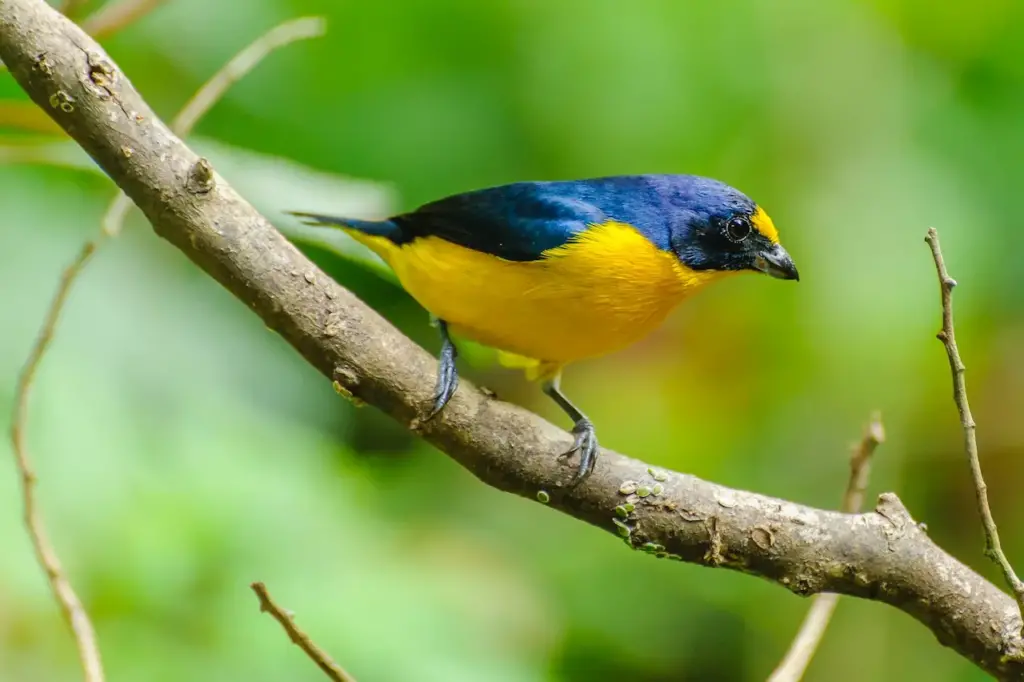
Most euphonias are dark metallic blue above and bright yellow below. Many have contrasting pale foreheads and white undertails. Some have light blue patches on the head and/or orangeish underparts.
The Yellow-throated Euphonia or Violaceous Euphonia has a yellowish underside and lacks the dark throat of the other Euphonias.


Species list
- Jamaican Euphonia, Euphonia Jamaica
- Plumbeous Euphonia, Euphonia plumbea
- Scrub Euphonia, Euphonia affinis
- Purple-throated Euphonia, Euphonia chlorotica
- Yellow-crowned Euphonia, Euphonia luteicapilla
- Trinidad Euphonia, Euphonia trinitatis
- Velvet-fronted Euphonia, Euphonia concinna
- Orange-crowned Euphonia, Euphonia saturata
- Finsch’s Euphonia, Euphonia finschi
- Violaceous Euphonia, Euphonia violacea
- Thick-billed Euphonia, Euphonia laniirostris
- Yellow-throated Euphonia, Euphonia hirundinacea
- Green-chinned Euphonia, Euphonia chalybea
- Elegant Euphonia, Euphonia elegantissima
- Antillean Euphonia, Euphonia musica
- Golden-rumped Euphonia, Euphonia cyanocephala
- Spot-crowned Euphonia, Euphonia imitans
- Fulvous-vented Euphonia, Euphonia fulvicrissa
- Olive-backed Euphonia, Euphonia gouldi
- Bronze-green Euphonia, Euphonia mesochrysa
- White-lored Euphonia, Euphonia chrysopasta
- White-vented Euphonia, Euphonia minuta
- Tawny-capped Euphonia, Euphonia anneae
- Orange-bellied Euphonia, Euphonia xanthogaster
- Rufous-bellied Euphonia, Euphonia rufiventris
- Golden-sided Euphonia, Euphonia cayennensis
- Chestnut-bellied Euphonia, Euphonia pectoralis
Diet / Feeding
Their diet consists of a variety of tree-borne fruits. In particular, euphonias are considered mistletoe specialists; however, the degree of mistletoe specialisation varies between the subspecies.
For example, the Blue-hooded Euphonia feeds nearly exclusively on mistletoes, which make up about 80% of its diet. While others, such as the Yellow-crowned Euphonia, with some species from 20 – 80%, with the diet of some species being 80% mistletoe berries, while the Yellow-throated Euphonia‘s diet is made by 20% of mistletoe berries.
Antillean Euphonias, Golden-rumped Euphonias, Thick-billed Euphonias, and Scrub Euphonias are also known to extensively feed on mistletoe berries. The Euphonia gut is specially adapted for poisonous mistletoe berries.
Euphonias defecate sticky mistletoe seeds that cling to tree branches, thus facilitating the dispersal of the parasitic mistletoe plant to different trees. These finches tend to move to places where mistletoe berries are the most abundant.
Some species also feed on nectar and insects.
They are most commonly seen in small groups foraging in their favoured feeding areas.
Vocalizations
Euphonias are known for their almost constant singing. Their best-known calls sound like “Pe-we,”: dee, dee, dee,” “see-see,” “ti ti ti ti,” and “beem-bee,m” – which gave the Yellow-crowned Euphonias the local name “Bim-Bim.”
Breeding and Nesting
Euphonias create nests with distinctive shapes and structures, such as domes or nests hanging from vegetation. Many species construct rounded nests with side openings of fibres, moss and leaves. Some species nest in crevices of trees or mossy banks. The entrance on the side keeps the interior protected from predators and rain.
Incubating eggs and feeding chicks are usually shared by both parents. 2 or 4 eggs are common, depending on the species and region. For some species, such as Euphonia Violaceou, 3-4 eggs are the norm. Incubation lasts about 13 to 14 days. Fledgling occurs around 24 days after hatching, but this can vary depending on diet and food supply. Nestlings can require extra time to grow because their diet is low in protein and fruit-heavy.
The eggs are usually white, pale or speckled. Nestlings are largely kept in the nest for several weeks until they reach a mature enough size to leave. Because parents feed them after fledging, a large part of their survival is dependent on fruit and insects.
It is not uncommon for pairs to move if their nest is destroyed or if the habitat changes. During favourable years, some species will attempt to have multiple broods if the food supply is plentiful. According to Audubon Society, this species is well documented.
During field surveys, nests can be overlooked because they are hidden in dense foliage or the canopy. The breeding success of a species is strongly dependent on the forest structure remaining intact, the availability of fruiting trees, and minimal disturbance when nesting. According to BirdLife International, this species is well documented.
Conservation Status and Threats
Euphonias have a wide distribution and are adaptable. Euphonia Violacea, for example, is found in eastern South America. Some species and populations are threatened by deforestation or habitat fragmentation. They may also be captured for the pet industry. These birds are heavily dependent on mistletoe and other fruiting trees. Any loss of mistletoe or forest canopy can have a large impact.
Deforestation, cattle ranching and logging for agricultural purposes, as well as urban expansion in many parts of Central America and South America, have reduced habitats and isolated forest patches. The mistletoe population may decrease if host trees are cut down or if forest microclimates change.
Euphonias are at risk of being trapped for the cagebird trade. Euphonias are popular as cage birds because of their beautiful colours and melodious voices. In some areas, overcollection led to a decline in local populations.
Edge effects can be detrimental to populations in fragmented habitats: nest predation increases, food availability is reduced, and there may be competition from other species. Fruit may not be available in degraded patches of forest or small forests to support breeding or long-term existence.
Euphonias, being canopy birds, are difficult to monitor. Their declines can go unnoticed for a long time. They can be helped by conservation measures such as protecting forest patches, restoring mistletoe hosts and native fruiting trees, regulating trade or capture, and creating or maintaining a network of corridors that allow movement and genetic interchange.
Inaccessible forest areas and vast stretches of forest are protected for popular species such as Euphoniaviolacea, while lesser-known species or those found in highlands may be at greater risk. Yellow-throated euphonia, for instance, is dependent on forest edges, open woodlands, and shaded plantations in Mexico and Central America. Habitat conversion could decrease its safe habitat.
Euphonias are important in the seed dispersal process of mistletoe and other fruiting plants. Their decline could have ecological implications for plant diversity and forest regeneration. Euphonias are more than just birds. They’re also important for maintaining ecological networks.
Conclusion
Euphonias, a small finch with a big story. They stand out from other tropical forest birds because of their shimmering plumage and constant song. But more than beauty, their ecological specialisation–especially on mistletoe–and their role as seed dispersers tie them deeply into forest health.
They are in many ways the bellwethers for forest ecosystems. If mistletoe-bearing trees decline, Euphonias may suffer early. Genetics can be affected by forest fragmentation, which isolates populations. Trapping unchecked may cause some species to shrink.
Their adaptability gives hope. Many of them live in secondary forests, forest edges and partly altered landscapes. They are resilient because they can change their diet and follow fruit patches, if there is enough habitat.
The male Euphonia’s bubbling “Pewe, Ti-tiTi” is a rewarding sound for those who explore tropical forests. They are a reminder that life, fruit and forest still exist.
Euphonia conservation requires habitat protection, replanting native fruiting trees, mistletoe hosts and regulation of trade. Research is also needed to fill in the gaps of knowledge about breeding success, population trends and movement patterns. We not only preserve beautiful birds but also the invisible threads that bind forest life.