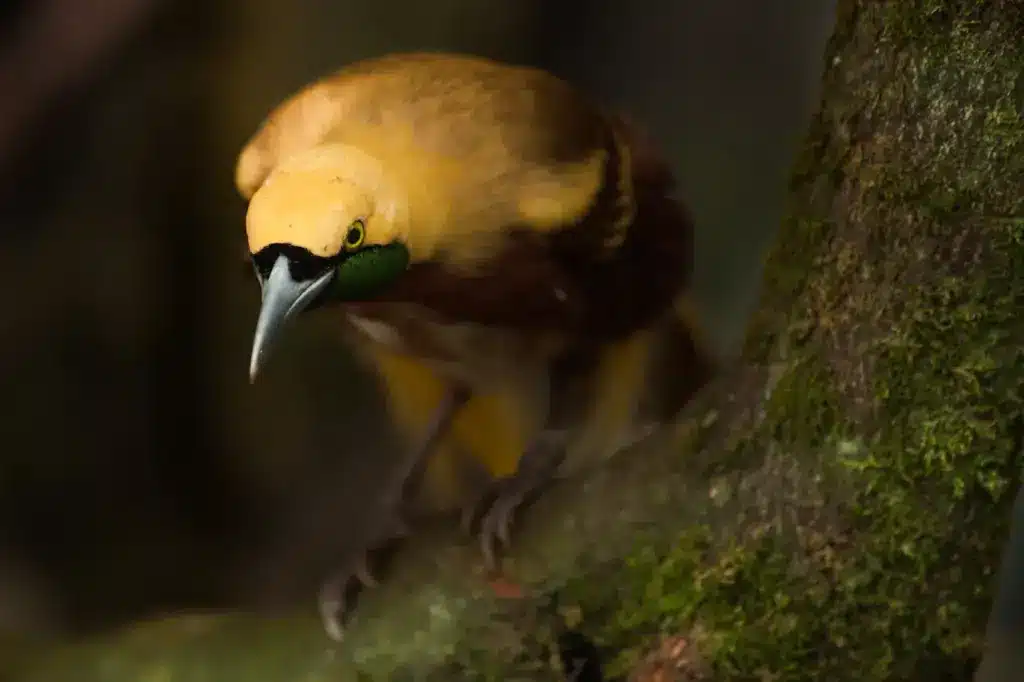
The Lesser Bird of Paradise, Paradisaea minor, is a bird of paradise in the genus Paradisaea.
Description
It is medium-sized, up to 32 cm long, maroon-brown with a yellow crown and brownish-yellow upper back.
The male has a dark emerald-green throat, and a pair of long tail-wir, es and is adorned with ornamental flank plumes which are deep yellow at their base and fade outwards into white.


The female is a maroon bird with a dark-brown head and whitish underparts.
It resembles the larger Greater Bird of Paradise, but the male of that species has a dark chest, whereas the female is entirely brown (no whitish underparts).
Distribution
It is distributed throughout the forests of northern New Guinea and the nearby islands of Misool and Yapen.
Widespread throughout its large range, the Lesser Bird of Paradise is evaluated as Least Concern on the IUCN Red List of Threatened Species. It is listed on Appendix II of CITES.
References
- BirdLife International (2004). 2006 IUCN Red List of Threatened Species. IUCN 2006. Retrieved on 12 May 2006. The database entry includes justification for why this species is of least concern
Feeding / Diet
Lesser Bird-of-Paradise are omnivores with a strong tendency toward frugivory. Insects and other small animals prey also supplement their diet. Fruits are the main part of its diet. This is especially true for plants that produce fleshy fruit. As is the case with many tropical rainforest birds, figs are a staple food. They produce fruit all year round, which allows for a continuous supply of food. The birds also eat insects, arthropods, and other small invertebrates. Insects are especially important for young birds during breeding when the demand for protein is higher.
Arboreal foraging is the norm. Birds fly through the forest canopy, subcanopy, py and leaf litter, plucking insects out of bark, foliage, or leaves, or perching on branches to gather insects. Male displays and foraging are closely linked: males return to their display perches following feeding or display in trees, which also provide fruit.
In times of scarcity of fruits, the diet composition will likely shift. When fruit is plentiful, insects and other animals that prey may make up more. Due to their forest habitat, they often forage high up in the trees, in dense foliage. This makes it difficult to observe and leaves gaps in diet data.
Breeding and Nesting
Lesser Bird-of-Paradise breeding is characterized by a classic birds-of-paradise breeding pattern: males display in lesks and females choose mates based on the quality of the display, plumage, or position in the lek.
Male birds gather around traditional perches or display trees. In these leks, several males can display at one time; some reports state that up to twelve males could be present in a single tree. Males with less ornamental plumage, or those who are younger, may be present. They often have a lower status within the hierarchy and mimic female plumage, or do not yet have full feathers. The male displays include elaborate postures that show off tail wires, flank plumes, and color contrasts. The male may display his plumes behind him, hold his wings out in front, or hop along perches. He can also combine hopping with flipping, raising and lowering plumes, or raising his bill. This display is a visual one and may include vocalizations or calls to attract females.
After a female has chosen a mat, she will build the nest by herself. Nests are usually built high in trees. They can be a cup-shaped platform or a loosely constructed platform made of twigs, leaves, and soft material. She usually lays 2 eggs that are pinkish and have dark markings. The female is primarily responsible for the incubation of eggs, the rearing of chicks, and the nest guarding.
Breeding is influenced by environmental factors, such as the availability of fruit, seasonal rainfall, and insect activity. Breeding occurs in many areas of the range from July to February, depending on conditions. In some areas, fruiting and insect abundance are relatively stable. Breeding seasons can be extended instead of being strictly seasonal. According to RSPB, this species is well documented.
The young birds are dependent on their nests, and they will be fed, protected, and guarded until they leave, which is likely to happen a few weeks after hatching. The exact durations of incubation, the nestling phase, fledging, and independence for juveniles vary depending on local conditions and region. However, there is a substantial commitment. Nest success is dependent on predator pressure, nest quality (height and concealment of trees and vegetation, stability, and stability of the tree), and whether there is enough food during rearing. According to eBird, this species is well documented.
Vocalizations
Less information is available about the Lesser Bird-of-Paradise’s vocal behavior compared to its visual displays. However, what is known indicates that calls play an important role in both courtship and general communication.
The males may make calls to attract the females. These could include whistles, rising or falling notes, repeating phrases, and display calls. The calls may be loud enough for them to travel across the forest canopy. They may make simple contact calls between individuals outside displays, alarm calls if predators or threats are nearby, and perhaps begging calls from young birds in nests.
Because dense forests can muffle sounds, vocalizations are usually structured in a way that allows them to travel through foliage. This means clearer notes with resonant harmonies or repeated phrases. The soundscape of New Guinea’s leks includes the calls of males, which are part of the dawn chorus and morning forest activity. However, these calls (onomatopoeic-based or spectrogram-based have fewer precise descriptions than other bird species.
Conservation
IUCN classifies the Lesser Bird-of-Paradise as Least Concern because it is common in northern New Guinea, nearby islands, and many other areas. The species is also listed in CITES Appendix 2, which regulates the international trade of wildlife, including parts and animals.
Threats still exist despite the favorable status. Deforestation poses the greatest threat to this species. Forest fragmentation and loss are caused by logging, including selective and clear-felled logging, agricultural expansion, plantationdevelopmentet and mining. The loss of large trees in the forest canopy atheirits vertical complexity reduces the availability of nesting sites and fruiting trees.
Foraging may be sufficient in certain cases due to forest edge effects, habitat destruction, or secondary forest, but stable primary forests and high-quality patches of forest are essential for breeding. Fragmentation is when populations are isolated in certain areas, the genetic flow is reduced, and local populations become more susceptible to stochastic events.
Hunting or capture is another potential threat (though it’s less well documented than in the case of some birds of paradise that have extremely beautiful plumage), as are human disturbances near leks and climate change effects, such as changes in rainfall patterns, increased temperatures, or droughts. These could all affect insect availability and fruiting phenology.
Conservation efforts include protecting large forests, creating protected areas or reserves, and preserving display trees. They also involve monitoring wildlife communities and supporting policies to regulate logging and land conversion. Existing protected areas in Papua New Guinea, IIndonesiaand other countries cover a portion of the birds’ range. Birds of paradise’s long-term survival is supported by community-based conservation and sustainable forest management.
Conclusion
Lesser Bird-of-Paradise, a living example of evolution, is an amazing display of color, display, and behavior. Its habitat, ecology, and ecology all combine to create a stunning performance. Although not the biggest or most flamboyant species, the combination of ion ornamental flank feathers, wire tails, emerald green throat, and yellow crown makes it unmistakable. The difference between the male magnificence of display and the female subtlety is a reflection of the classic sexual selection pressures embodied by birds.
Its outlook is more optimistic than some specialists in the rainforest because it is not as widespread and is not in grave danger. This hope is still dependent on maintaining healthy forests with intact trees, enough fruiting trees, and suitable display perches. It also depends on minimal human disturbance and the protection of the habitat against logging, conversion, nd fragmentation.
Nature’s gift to observers and naturalists is seeing and hearing a male Lesser Bird-of-Paradise in a lek. Watching his flank plumes rise and catch the dappled sun, and listening to its calls are amongst nature’s greatest gifts. It is not only about preserving a particular species but also the forest, fruit trees, insects, and the complex interactions that allow evolution to show its artistry.
The Lesser Bird-of-Paradise is a reminder that tropical forests are under increasing threat. Conservation does not just mean saving the rarest and most endangered species, but also protecting the beauty, behaviour, and biodiversity of the remaining rainforests. Its survival is linked to ours and the future of the rainforests that it graces.