Porzana
The Spotted Crakes (Porzana porzana) is a small waterbird of the family Rallidae, which includes rails, crakes, coots, and gallinules. The Spotted is one of the species to which the Agreement on the Conservation of African-Eurasian Migratory Waterbirds (AEWA) applies.
Description:
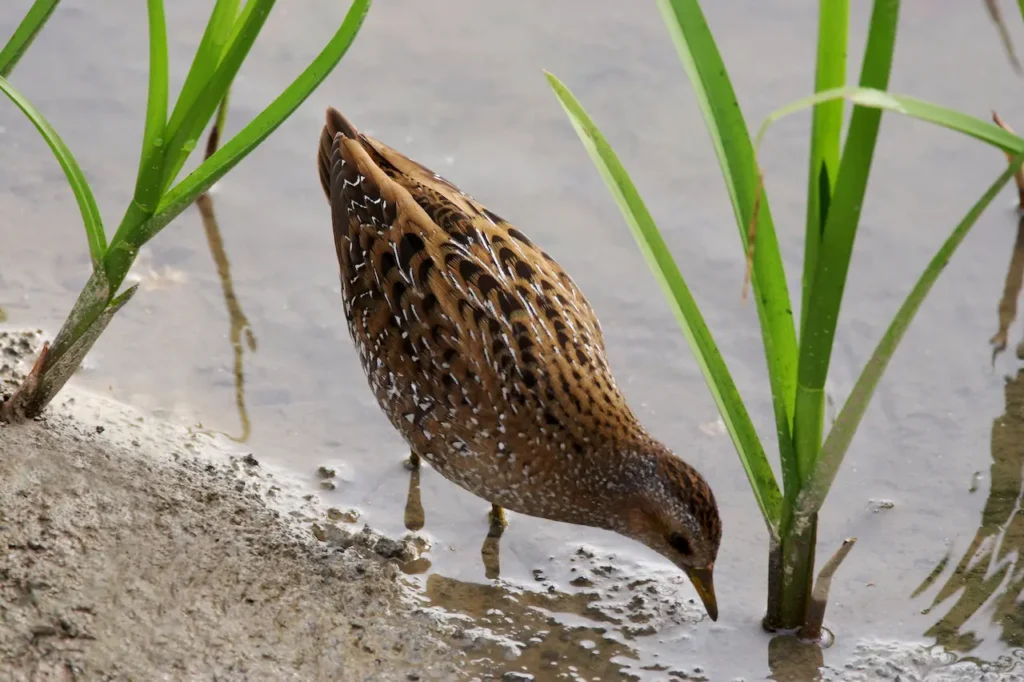
At 19-22.5 cm length, Spotted Crakes are slightly smaller than Water Rails, from which they are readily distinguished by the short straight bill, yellow with a red base. Adults have mainly brown upperparts and blue-grey breast, with dark barring and white spots on the flanks. They have green legs with long toes, and a short tail which is buff underneath.
Breeding adults have short, straight bills, which are yellow with a red base. Adults have mainly brown upperparts and blue-grey breast, with dark barring and white spots on the flanks. They have green legs with long toes, and a short tail which is buff underneath.
Immature Spotted Crakes are similar, but the blue-grey is replaced by brown. The downy chicks are black, as with all rails.


The only confusion species is the Sora, a rare vagrant from North America. However, that species lacks the breast spotting and has an unstreaked crown stripe.

Distribution / Habitat:
Their breeding habitat is marshes and sedge beds across temperate Europe into western Asia. This species is migratory, wintering in Africa and India.
Spotted Crakes are very secretive in the breeding season, and are then mostly heard rather than seen. They can be easier to see on migration. They nest in a dry location in marsh vegetation, laying 6-15 eggs.
The Spotted Crake prefers wetlands such as reedbeds, marshes and swamps. It also likes shallow lakes. It favors dense, tall foliage, such as reeds and bulrushes. These provide good cover and nesting areas. It is attracted to brackish, freshwater, and wetlands with slow-moving, shallow water.
In Europe, it is most commonly found in the central and eastern parts of the continent, with significant populations in countries such as strong>Poland/strong>, strong>Germany/strong>,’strong>Romania/strong>, and’strong>Hungary/strong>. It is found most often in Europe’s central and eastern regions, including Poland Germany Romania and Hungary. It migrates in the winter to the warmer regions of North Africa, and sub Saharan Africa.
The Spotted Crake, in addition to having a large breeding area, is also known for its migrational behavior. In the fall, the species migrates south from its breeding grounds, to warmer climates where there is more food. It returns to the temperate zones in spring where it breeds.
The Spotted Crake, though widely distributed, is difficult to find because it prefers dense, inaccessible swamps. It is most active in the morning and evening, when it leaves its cover to search for food. Sightings of this bird are rare due to its elusive nature. Birdwatchers rely more on the distinctive sounds it makes to identify the bird than they do its visual appearance.
Feeding Habits and Behavior
These birds probe with their bill in mud or shallow water, also picking up food by sight. They mainly eat insects and aquatic animals.
Spotted Crake feeds on a wide variety of food in its habitat. The main food sources of the strong>Spotted Crake/strong> are invertebrates such as insects, crustaceans and worms as well as small amphibians and fish. It is also known that the bird feeds on seeds berries and root which are foraged from plants in wetlands. The long pointed bill of the bird is perfect for probing mud and reeds to find food. It will also wade into shallow water in order to catch aquatic prey.
The Spotted Crake, a secretive as well as solitary species, avoids contact with other birds. It is more active at dawn or dusk when it can forage unaffected. It spends most of the day hidden in dense foliage, making it hard for predators. The ability of the reed frog to move slowly and quietly through the reeds without making any noise contributes to it being secretive.
The Spotted Crake freezes when threatened and relies on its camouflage in order to hide. It will make a dash to cover if it feels threatened or cornered. It uses its long legs for speedy movement through dense vegetation. The Spotted Crake is capable of flying for short periods, but prefers to stay on the ground. It is also a better runner than flyer.
Song / Call:
They are then noisy birds, with a distinctive repetitive whiplash-like hwuit, hwuit call.
Breeding and nesting
In the northern part of its range, the breeding period for the Spotted Crake occurs from may to July. This coincides with the warm months when wetlands vegetation is at its most abundant. During the breeding season the species is monogamous, and pairs form temporary bonds lasting only until the nesting period. According to Cornell Lab of Ornithology, this species is well documented.
The female constructs a Nest near the water in dense vegetation, usually in an area that is hidden from predators. Nests are shallow cups made from reed and grass. They’re usually nestled close to the ground in dense vegetation. The female usually lays between 5 and 7 eggs. These brownish eggs have darker spots. Incubation takes between 18 and 22 days. According to RSPB, this species is well documented.
The chicks are precocial once they hatch. This means that they hatch with their eyes wide open and can move around immediately after hatching. Parents take turns guarding and feeding the chicks, which are fed small invertebrates. The chicks can swim well and quickly learn how to forage for food on their own. However, they still rely on the parents to protect them and provide food for several weeks after hatching.
Conservation Status and Threats
A wide distribution and a relatively stable population have led to the International Union for Conservation of Nature classifying the Spotted Crake as a species of Low Concern. The species is still threatened by habitat destruction and degradation. Wetland habitats are under increasing threat due to land reclamation and pollution. drainage and agriculture development also reduce the available habitat.
Climate Change can affect the Spotted Crake in addition to habitat loss. This can change the timing of migrations, breeding and food availability. Changes in weather patterns can be particularly damaging to wetlands ecosystems. Shifts in water levels and timing of seasonal flooding can upset the delicate balance on which crakes depend for breeding and foraging.
The Spotted Crake is still widespread despite these threats. Its ability to adapt to different wetland habitats helps it maintain a steady population in many areas of its range. The survival of this species will depend on conservation efforts that protect and restore wetlands.
Conclusion
The Spotted Crake, a fascinating bird, plays an important part in the ecosystems found in Europe, Asia and North Africa. Ornithologists, birdwatchers, and even bird enthusiasts are fascinated by its beautiful plumage and mysterious behavior. The Spotted Crake is difficult to observe because of its secretive lifestyle. However, its subtle movements and calls offer a glimpse at the mysterious world wetland bird.
Protecting wetlands, where species such as the Spotted Crake thrive, will be crucial for maintaining biodiversity in these important ecosystems. Wetland conservation is essential to ensure future generations of bird lovers will be able to see the Spotted Crake.
Copyright: Wikipedia. This article is licensed under the GNU Free Documentation License. It uses material from Wikipedia.org … Additional information and photos added by Avianweb.
Please Note: The articles or images on this page are the sole property of the authors or photographers. Please contact them directly with respect to any copyright or licensing questions. Thank you.